

Under her care, p.1
Under Her Care, page 1
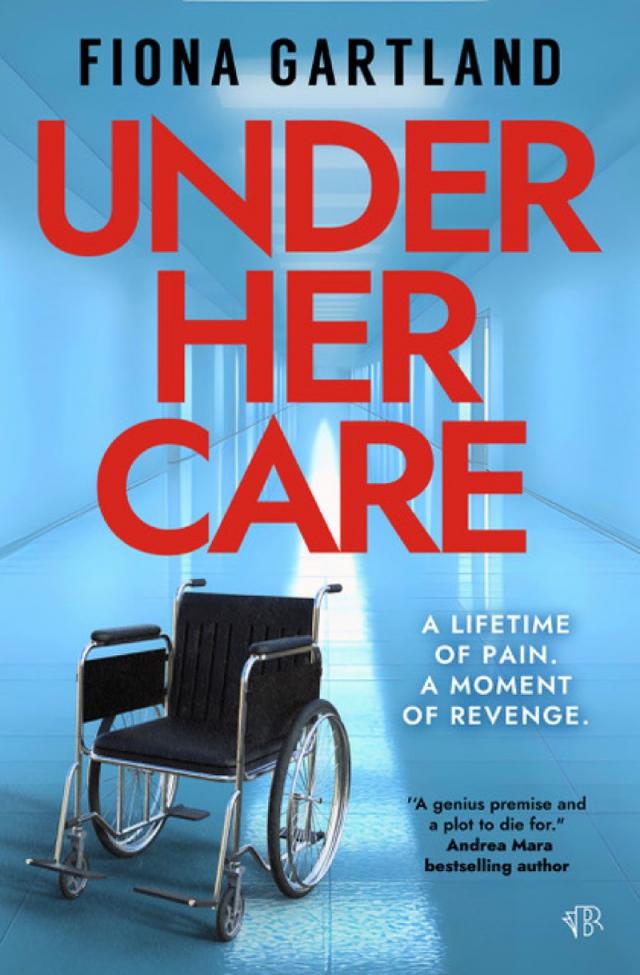


UNDER HER CARE
FIONA GARTLAND
Copyright © 2026 Fiona Gartland
The right of Fiona Gartland to be identified as the Author of the Work has been asserted by them in accordance with the Copyright, Designs and Patents Act 1988.
First published in 2026 by Bloodhound Books.
Apart from any use permitted under UK copyright law, this publication may only be reproduced, stored, or transmitted, in any form, or by any means, with prior permission in writing of the publisher or, in the case of reprographic production, in accordance with the terms of licences issued by the Copyright Licensing Agency.
All characters in this publication are fictitious and any resemblance to real persons, living or dead, is purely coincidental.
www.bloodhoundbooks.com
Print ISBN: 978-1917705783
CONTENTS
Newsletter sign-up
Prologue
Part I
Chapter 1
Chapter 2
Chapter 3
Chapter 4
Chapter 5
Chapter 6
Chapter 7
Chapter 8
Chapter 9
Chapter 10
Chapter 11
Chapter 12
Chapter 13
Chapter 14
Chapter 15
Chapter 16
Part II
Chapter 17
Chapter 18
Chapter 19
Chapter 20
Chapter 21
Chapter 22
Chapter 23
Chapter 24
Chapter 25
Chapter 26
Chapter 27
Chapter 28
Chapter 29
Chapter 30
Part III
Chapter 31
Chapter 32
Chapter 33
Chapter 34
Chapter 35
Chapter 36
Chapter 37
Chapter 38
Chapter 39
Chapter 40
Chapter 41
Chapter 42
Chapter 43
Epilogue
You will also enjoy:
Newsletter sign-up
Acknowledgements
A note from the publisher
For Patty Quigley whose love of crime writing is infectious
We could all potentially kill somebody, right?
— Stanley Tucci, Inside Man
PROLOGUE
She closes the papery curtain round his hospital bed, white plastic loops jerking along the U-shaped pole. A nightlight illuminates his veins, knotty blue ropes beneath translucent skin, and makes visible the lumen tail dangling from the central line inserted in his jugular. He doesn’t stir, his grey-haired, bony chest rising and falling gently under partially-buttoned, paisley-patterned pyjamas.
She takes the syringe in her gloved hands and draws back the stopper to create a vacuum. Air rushes irresistibly into its barrel, sufficient to ensure results, she hopes. She must stay calm. Speed of delivery matters. Not too fast, not too slow. When sufficient air enters his vein, it will travel to the right atrium of his heart and then to the right ventricle, obstructing blood flow and triggering cardiac arrest. At post-mortem it will be difficult to identify the cause. A heart attack in an ill patient. It happens.
Her hand trembles as she connects the syringe to the end of his central line and unclamps the lumen. Her right thumb rests on the plunger. His chest continues to rise and fall.
But for how much longer?
PART 1
CHAPTER ONE
SEPTEMBER 2025
Nurses act with kindness and compassion.
— St Francis Xavier’s Nursing Code of Professional Ethics
Brigid Glenmore can’t find her slippers. Perched on the edge of her bed, wizened legs dangling, she scans the floor. She’s bent at the neck; spine and shoulders curved in a hook, as though she’s gradually relinquishing her body to the pull of gravity head first.
‘They were here a few minutes ago,’ she says.
A cleaner has been to St Angela’s ward, and odours of disinfectant and polish temporarily overlay the scent of bedpans and weeping ulcers and respiratory sputum. The linoleum floor has a dust-free gleam.
‘Lily’s been in with the polisher. She probably pushed them under your bed,’ Beth says. The nurse gets down on her hands and knees, reaches beneath the metal frame and fishes around until the tweedy, rubber-soled slippers are under her fingers.
‘Here we are now, Brigid,’ she says pulling them out, standing, arching her back in a stretch. ‘On they go.’ She slides them onto the woman’s feet, over crusty skin and toenails thickened and yellow.
‘Thanks, love,’ Brigid says and puts a hand to her mouth, presses it against thin lips painted with a slick of pink lipstick. ‘The teeth are in. I’m ready.’
Her daughters and sons-in-law, grandchildren and great grandchildren are waiting in the visitors’ room. Beth offers her arm and Brigid leans on it and eases herself off the bed.
‘Are you sure you don’t want your walker? Or the wheelchair? It’s a fair step.’
The woman shakes her head, fine white curls on her scalp immobile. ‘I want them to see me on my own two feet,’ she says.
Compared to Brigid’s shrunken form, Beth, though only five foot three, looks tall, strong-shouldered beneath a sky-blue tunic, wide-hipped under navy trousers, as they move in unison out of the bay. There are five other beds here, and some of the occupants wave as the pair go by.
‘I won’t be too long,’ Beth says over her shoulder to Evelyn O’Gara at the nurses’ station on the corridor.
‘Happy birthday, Mrs Glenmore,’ the clinical nurse manager calls after them.
Brigid lifts a hand in acknowledgement, but doesn’t turn her head. ‘Bit of a wagon, that one,’ she says.
Beth purses her lips to subdue a laugh and they progress slowly down the narrow corridor with its vaulted ceiling and shiny-painted walls and black and white photos of nursing nuns. St Angela’s general medical ward is on the fifth floor of St Francis Xavier’s, a hospital built in the eighteenth century, extended and renovated in a hotch-potch over the hundreds of years that followed, due to be closed in a year or twenty. It occurs to Beth that she could have insisted on pushing Brigid in a wheelchair as far as the last single room and let her walk from there. Her family wouldn’t know any better. But she wouldn’t do that; the woman is entitled to her dignity.
‘I hope I have your determination when I get to your age,’ Beth says as they finally reach the visitors’ room.
Cheers echo down the corridor when Beth opens the door. Happy birthday banners hang from the ceiling, balloons float in mid-air, ‘90’ written on them and ‘birthday girl’ in gold letters. Brigid shuffles over the threshold into the room unaided and her extended family swarms toward her.
Beth turns to leave, but Brigid grabs her by the sleeve and waves her free hand, silencing her audience. ‘Do you know what I want to say? Florence Nightingale will never be dead. This here,’ she pats Beth on the forearm, ‘this here is the kindest nurse in all the world.’
Purple blotches appear on Beth’s neck and spread upwards, colouring the normally pale face, reaching almost to the tips of her pinned up, balayaged hair. She extricates herself with a muttered thanks and hurries away. Halfway down the corridor someone calls her name. It’s Rosemary bustling after her, Brigid Glenmore’s daughter, in her sixties, put-upon. Beth stops and the woman, when she reaches her, takes a moment to catch her breath.
‘Mammy asked me to give you this.’ She removes a small white envelope from the pocket of her faux fur gilet.
‘She shouldn’t have,’ Beth says and takes it.
‘You deserve it. You’re terrible good to her.’
Beth feels another blush coming on. ‘Tell her thanks very much.’
‘I will. We found a place for her, by the way. Did she tell you?’
‘No. Where?’ She’d known Brigid couldn’t go back to living alone and the family had asked about the state Fair Deal scheme, which would help pay for the cost of a nursing home.
‘The Elms in Laytown. Very close to the beach. Do you know it?’
‘I’ve heard of it. It has a great reputation. She’ll be well looked after there.’
Rosemary smiles with satisfaction. ‘And it’s only a fifteen-minute walk from me so I’ll be able to visit her every day.’
At least there is that, Beth supposes. But Brigid Glenmore’s home is on the North Strand near Dublin city centre and Laytown is in Meath, over forty kilometres away, far from friends and neighbours, far from everything she’s known her whole life. Despite the size of her extended family, no one is in a position to move in with her and help her stay in her own home a little longer. Beth has seen it before; people no longer able to take care of themselves relocated to nursing homes miles from where they live. Occasionally they thrive in a new environment, sometimes they wilt away like clumsily replanted oak trees.
‘We’re only waiting on the paperwork from the HSE,’ Rosemary says. ‘Anyway, I better get back.’
‘Thank your mother for the prezzie.’ Beth shoves the envelope in her pocket and scurries away to catch up on other duties.
Her next priority is to collect a patient who’s in need of a nurse escort to St Angela’s from the accident and emergency department on the ground floor.
‘I’ll be back in fifteen minutes,’ she tells a colleague near the nurses’ station. â €˜Can you keep an eye out for my call bells?’
She hurries before the nurse has a chance to respond, conscious of the patient waiting to have a wound dressed, and the one who needs laxatives asap, and the others she’ll have to attend to afterwards. In her mind, they’re all standing in a row like people at a bus stop, checking their watches, tutting. It’s possible some of them are dying because she’s fallen behind with her work. She shakes her head, dismisses this catastrophising just as her favourite podcast on mental health has advised her, and hurries on along the corridor to the exit door with its porthole window, and out to the landing and the lifts.
There are two lifts on this side of the building and they’re in almost constant use. She presses the button repeatedly and one appears in its own time, its doors grinding open, revealing three passengers, plus a bed with a patient in it. Beth steps inside and selects the ground floor.
She nods at Liz Rafferty, a nurse from ICU, and at the porter, Jim Mooney, whose job it is to transport patients from one ward to another or to various locations within the hospital for tests and scans. They both nod back.
Her attention moves to the man in the bed. He’s elderly and a bag of IV fluids hangs from the bed pole above his head, a clear tube snaking down to a central line in the side of his neck, where a cluster of other short tubes, lumens, dangle ready for whatever other drugs he will require. Another tube is visible halfway down the bed, peeping out from beneath the blankets, attached to a bag half filled with urine.
Her gaze moves briefly over his face, closed eyes, rough, pock-marked skin, a lipoma like a small white jellybean just below his right nostril, but not as old as she first thought, only diminished by illness and pyjamas. Behind him, against the back wall of the lift, a tall, broad man in uniform is standing, a prison officer. The patient is an inmate. Could it be him? She wants to scrutinise his face to see if his crime is visible on it. A diamond thief, she imagines, might have unnaturally deep brow furrows from concentrating on safe-breaking. And a murderer’s eyes might appear hard or vacant. But his are closed. And she ought not to speculate. Not here. Someone might remember her eagerness.
‘Every individual is entitled to our care and respect, regardless of background or disposition, and without fear or favour,’ Evelyn O’Gara told her group at their first day of training, and Beth has worked hard to internalise that, tried to care equally for each person. She’d chosen nursing as a career at the age of nine when a bout of chicken pox had spread through her class like flame on a string of firecrackers. When she caught it, her dad couldn’t take time off work so a neighbour, a retired nurse, had looked after her. The woman’s kindness, her gentle touch, her mothering, had set a candle burning in Beth. She wishes now she could have a conversation with the woman, Mrs Keaveney she was called, and ask her more practical questions.
The lift jolts to a stop on the third floor, St Kevin’s cardiac ward. Its doors open slowly as though exhausted from overuse. Beth steps to the side to let the party out.
The prison officer, in his late twenties she imagines, glances at her as he goes by, blue eyes grazing her, lips twitching briefly into a small upward curve. ‘Thanks,’ he says.
Beth lets her gaze linger on him. He’s good looking in a sensible sort of way, his uniform of navy trousers and pale blue shirt is clean and crisp, the short sleeves stretched over his muscles. He’ll be popular while he’s here, she thinks. The lift doors close again and she continues to the ground floor.
In the compact, windowless break room, Beth pours boiling water into a mug containing a green teabag. Its steam twists and rises and dissipates against the low ceiling above her head. She sits down at a yellow Formica table, the colour chosen to lift spirits in what was a storage space, repurposed for staff on the ward to save them a time-consuming trip to the canteen on the ground floor. Apart from three tables and half a dozen chairs, it has a kettle, a sink, a cupboard with teabags and instant coffee, and a greasy old sandwich toaster no one uses.
Beth stretches out her legs, rotates her ankles. They’ve puffed up again and are spilling over the sides of her navy lace-ups. What was it Alice called them? Cankles. Yes. She’s twenty-eight and she has cankles. Closing her eyes, she imagines herself in her apartment with someone at the end of her couch, her feet in his lap and his hands massaging them, working between each metatarsal, loosening the tension, easing her stress. The fantasy makes her toes tingle.
A sudden snore jerks her and she opens her eyes. Her half-finished drink is cooler. She checks the fob watch pinned to her tunic. Damn it. The unplanned nap has eroded her break. Only eight minutes left now. Is it enough time to dash down to St Brendan’s ward and visit her dad? Probably. She told him she’d try and there’s no doubt she ought to, but she doesn’t move.
She drinks the lukewarm tea and berates herself for not leaving home fifteen or twenty minutes earlier. If she had, she could have visited him before her shift began and told him Shane Lowry was five under at Augusta. Not that he needs her to deliver golf results; he has his phone with him and he’s no luddite. But it would have made a good talking point. Laundry had delayed her. She’d had to wait at the apartment for the washing machine to stop so she could put the clothes on the drying rack before she left. Otherwise, she’d face a stinking machine load at the end of her shift. On top of that, she’d promised her flatmate she’d tidy the countertops in their tiny kitchen.
But those are just excuses. Her lack of time and energy is not the only problem. She’s avoiding her dad because when she seems him, she’s almost overcome with guilt for what she’s done. She aches at the thought of it and at the sight of him. Those grey eyes lowered, his thin frame beneath a blue blanket, right leg with a knuckle knee and calf as thin as a meat-stripped chicken wing, left leg hidden, immobilised under a plaster cast stretching from his ankle bone to above his knee.
She dreads what he’ll say. He has extricated a promise from her, an agreement to his plan and she must see it through somehow, though it fills her with dismay. She pushes the thought away. There’s no need to concern herself with it yet.
She sighs and pulls herself to her feet and returns to her responsibilities; the occupants of her six-bedded bay, one of four on St Angela’s ward. She must also look after two of the ward’s seven single rooms, making a total of eight patients in her care, only one of whom is male and is tucked away in a room on his own. There’s a wide age range, which she likes, and the current batch are suffering from various respiratory illnesses, skin and rheumatological conditions, and diabetes.
Brigid Glenmore has poorly controlled type two diabetes and difficulties working out how much insulin she should take, which leads to dramatic and frightening collapses. When scolded by the doctors about her diet, she tells them she’s ‘too long in the world to deny herself treats’ and won’t ‘take guff from men and women only a wet week off their mothers’ teats’. She is one of Beth’s favourites on account of that and also because Beth has no grandparents of her own.
Back on the bay now, she switches on the TV at the request of Brigid, who wants to see her dog programme. The stations flick past one after another, quiz shows and troubled teens and anodyne murder mysteries, ads for incontinence pants, online roulette, and stairlifts, until she finds a terrier with its paw in a bandage. She pockets the remote control intending to return it to the nurses’ station. Otherwise it’ll disappear beneath someone’s bedclothes, or into a locker or some visitor’s handbag.






