Philip roth, p.1
Philip Roth, page 1


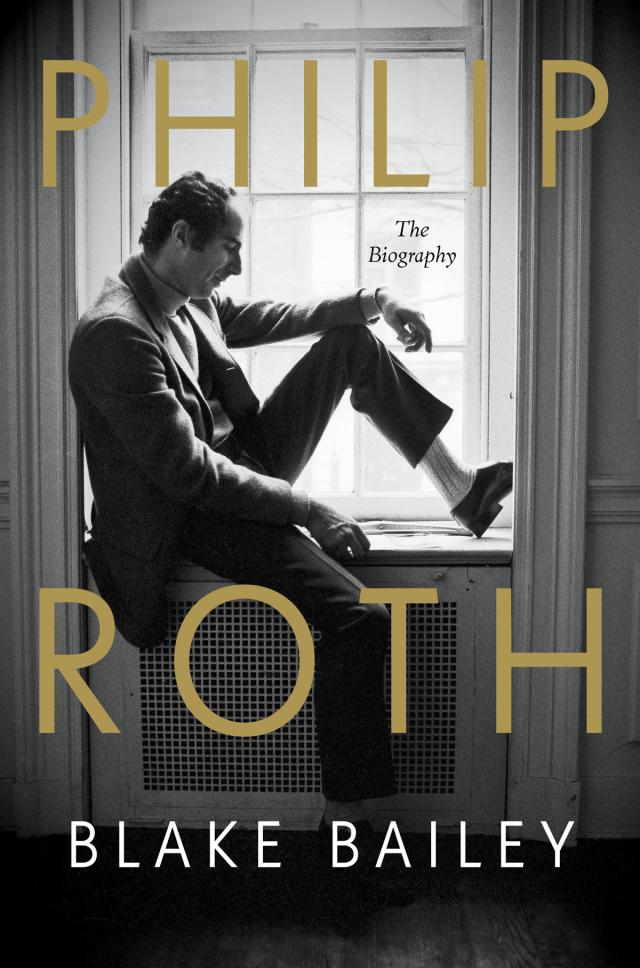
PHILIP
ROTH
The Biography
Blake Bailey
For Mary and Amelia
I don’t want you to rehabilitate me.
Just make me interesting.
—Philip Roth to his biographer
CONTENTS
PROLOGUE
PART ONE
LAND HO!
1933–1956
PART TWO
DON’T STEP ON THE UNDERDOG
1956–1968
PART THREE
THE MORONIC INFERNO
1968–1975
PART FOUR
ENTERING A DOLL’S HOUSE
1975–1995
PART FIVE
AMERICAN MASTER
1995–2006
PART SIX
NEMESES
2006–2018
EPILOGUE
ACKNOWLEGDMENTS
NOTES
INDEX
PHILIP ROTH
PROLOGUE
ON OCTOBER 23, 2005, PHILIP ROTH DAY WAS CELEBRATED in Newark. Two busloads of fans went on the Philip Roth Tour, stopping at evocative locations—Washington Park, the public library, Weequahic High—where passengers took turns reading pertinent passages from Roth’s work. Finally the crowd disembarked outside Roth’s childhood home at 81 Summit Avenue, cheering wildly when Roth himself arrived in a limousine. “Now you just step up here and give me a kiss!” said Mrs. Roberta Harrington, the present owner of the house, and Roth kept her at his side the rest of the day. Mayor Sharpe James, whom Roth adored (“a big-city mayor with all the bluster and chicanery”), said a few words before Roth pulled away the black cloth covering the historical plaque on his house: “This was the first childhood home of Philip Roth, one of America’s greatest writers of the 20th and 21st centuries. . . .” Next, Roth and the crowd moved across the street to the corner of Summit and Keer, which a white-on-green street sign now proclaimed to be Philip Roth Plaza.
Afterward a reception was held at Roth’s childhood library branch, Osborne Terrace, where the mayor rose to the lectern: “Now, you Weequahic boys don’t think that us South Side boys know how to read,” he said to Roth, referring to the mostly black high school he’d attended around the time Roth had been at Weequahic. Then the mayor read (“wonderfully”) a passage from The Counterlife:
“If you’re from New Jersey,” Nathan had said, “and you write thirty books, and you win the Nobel Prize, and you live to be white-haired and ninety-five, it’s highly unlikely but not impossible that after your death they’ll decide to name a rest stop for you on the Jersey Turnpike. And so, long after you’re gone, you may indeed be remembered, but mostly by small children, in the backs of cars, when they lean forward and tell their parents, ‘Stop, please, stop at Zuckerman—I have to pee.’ For a New Jersey novelist that’s as much immortality as it’s realistic to hope for.”
Finally it was Roth’s turn to speak: “Today, Newark is my Stockholm, and that plaque is my prize. I couldn’t be any more thrilled by any recognition accorded to me anywhere on earth. That’s all there is to say.” A few days earlier, his friend Harold Pinter had won the Nobel.
“Mr. Roth is a writer whose skill and power are greater than his admittedly great reputation,” wrote the eminent critic Frank Kermode, eight years before, after reading American Pastoral—Roth’s novel about the fall of Newark, and the larger loss of American innocence in the sixties, which would go on to win the Pulitzer. Kermode may have been thinking of an earlier novel, also set in Newark, on which much of Roth’s reputation continued to rest: Portnoy’s Complaint, his 1969 best seller about a mother-haunted, shiksa-chasing Jewish boy who masturbates with a piece of liver (“I fucked my own family’s dinner”). Much of what Roth later wrote was in reaction to the mortifying fame of this book—the widespread perception that Roth had written a confession instead of a novel, and never mind the perception among elements of the Jewish establishment that Roth was a propagandist on a par with Goebbels and Streicher. The great Israeli philosopher Gershom Scholem went so far as to suggest that Portnoy would trigger something akin to a second Holocaust.
Given his whole magisterial oeuvre—thirty-one books—Roth would earnestly come to wish he’d never published Portnoy. “I could have had a serious enough career without it and I would have sidestepped a barrage of insulting shit”—charges of Jewish self-hatred, misogyny, and general unseriousness. “I’d written this book about sex and jerking off and whatever, so I was a kind of clown or fuck artist. But then I finally beat them down. Fuckers.”
ROTH WAS AMONG the last of a generation of heroically ambitious novelists that included such friends and occasional rivals as John Updike, Don DeLillo, and William Styron (a neighbor in Litchfield County, Connecticut), and arguably Roth’s work stands the best chance of enduring. In 2006, The New York Times Book Review canvassed some two hundred “writers, critics, editors, and other literary sages,” asking them to identify the “single best work of American fiction published in the last twenty-five years.” Six of the twenty-two books selected for the final list were written by Roth: The Counterlife, Operation Shylock, Sabbath’s Theater, American Pastoral, The Human Stain, and The Plot Against America. “If we had asked for the single best writer of fiction of the past twenty-five years,” A. O. Scott wrote in the accompanying essay, “[Roth] would have won.”
But of course Roth’s career extended well beyond the prescribed twenty-five years, beginning with Goodbye, Columbus, in 1959, for which he won the National Book Award at age twenty-six. His third novel, Portnoy’s Complaint, was on the 1998 Modern Library list of the 100 best English-language novels of the twentieth century, while American Pastoral was, with Portnoy, subsequently included on Time magazine’s 100-best list of 2005. During the fifty-five years of his career, Roth’s evolution as a writer was astounding in its versatility: after the deft satire of his early stories in Goodbye, Columbus, he went on to write two somber realistic novels (Letting Go, When She Was Good) whose main influences were Henry James and Flaubert respectively—an odd apprenticeship, given the outlandish farce of the Portnoy era that followed (Our Gang, The Great American Novel), the Kafkaesque surrealism of The Breast, the comic virtuosity of the Zuckerman sequence (The Ghost Writer, Zuckerman Unbound, The Anatomy Lesson, The Prague Orgy), the elaborate metafictional artifice of The Counterlife and Operation Shylock, and finally a synthesis of all his gifts in the masterly, essentially tragic American Trilogy: American Pastoral, I Married a Communist, and The Human Stain. In the final decade of his career, Roth continued to produce novels—almost one a year—exploring profound aspects of mortality and fate. Altogether his work forms “the truest picture we have of the way we live now,” as the poet Mark Strand put it in his remarks for Roth’s Gold Medal at the 2001 American Academy of Arts and Letters ceremonial.
Roth deplored the misconception that he was essentially an autobiographical writer, while making aesthetic hay of the matter with lookalike alter egos that include a recurring character named Philip Roth. Some novels were more autobiographical than others, to be sure, but Roth himself was too protean a figure to be pinned to any particular character, and relatively little is known about the actual life on which so vast an oeuvre was supposedly based. Some of the confusion on this point was deeply embarrassing to the author. “I am not ‘Alexander Portnoy’ any more than I am the ‘Philip Roth’ of Claire [Bloom]’s book,” he brooded over the actress’s scurrilous 1996 memoir, Leaving a Doll’s House. Were it not for Portnoy, Roth believed, his former wife “would never have dared to perpetrate” a version of himself so blatantly at odds with the “disciplined, steady, and responsible” person he always considered himself to be.
Certainly this is how Roth was portrayed in Janet Hobhouse’s posthumous roman à clef, The Furies, whose characters include a famous writer named Jack modeled on Roth. He and Hobhouse had had an affair in the mid-1970s—they’d lived in the same building near the Metropolitan Museum—and her portrait remains perhaps the most rounded of a man who, though a household name, stayed largely out of the public eye. While her narrator accounts for the more conventional aspects of Jack/Roth’s charm (“not just the speed of his mind, but the playfulness, the willingness to leap, dive, flick the wrist, keep the game going”), she is seduced foremost by his “monkish habits,” the way “he organized his existence around the two pages a day he set himself to write”: “I thought yearningly of the contained, near-ascetic life going on two floors below me: the sober twilight perusals of literary journals, the rustle of foreign correspondence in a Jamesian high silence.”
For what it’s worth, Roth perceived himself as the opposite of anti-Semitic or misogynistic, and indeed had little patience for reductive categories one way or the other. His “monkish” lifestyle, for instance: “My reputation as a ‘recluse,’ ” he wrote a friend, “was always idiotic.” What it meant, essentially, was that he liked to be “blissfully” occupied with his work in rural surroundings, as opposed to “gossip[ing] about [him]self to people in New York or appear[ing] on late-night TV.” In fact he was often intensely engaged with the world, repeatedly traveling to Prague in the seventies and befriending dissident writers such as Milan Kundera and Ludvík Vaculík, whose books he promoted in the West with the Writers from the Other Europe series he edited at Penguin for many years. Also, during his relationship with Bloom, he divided his time among London, New York, and Connecticut, while spending weeks in Israel to research aspects of The Counterlife and Operation Shylock—or, in the years after, traveling wherever else he wanted to go to learn about glove making or taxidermy or grave digging; he even undertook, once, a reading tour for Patrimony, so at least he’d know what that was like, too. But the better part of his career was quite as Hobhouse described it: the daylight hours doggedly spent at his desk, and nights in the company of a woman—both of them reading, if Roth had his way. “What should I have been doing instead so as not to be labeled a recluse,” he remarked, “passing my nights at Elaine’s?”
It’s true Roth managed to have a florid love life, which he was apt to discuss “in a sort of kindly reverie,” the way Dr. Johnson bethought himself of Hodge, his favorite cat. An essential side of Roth remained the cherished son of Herman and Bess—“a pleasing, analytic, lovingly manipulative good boy,” as his alter ego Zuckerman chidingly describes him in The Facts—whose probity was such that he married two disastrously ill-suited women, not least because they desperately wanted him to. (This while refusing any number of more compatible partners.) And meanwhile he steadily rebelled against his own rectitude, quite as the clinical definition of “Portnoy’s Complaint” would have it: “A disorder in which strongly-felt ethical and altruistic impulses are perpetually warring with extreme sexual longings, often of a perverse nature.” Portnoy, again, is among the least autobiographical of a gallery including Zuckerman, Kepesh, and Tarnopol, but in each character is a kindred duality. As for Roth himself, his greatest urge was always to serve his own genius—amid the keen distractions, albeit, of an ardently carnal nature. “Philip once said something about Colette’s husband Willy,” said his friend Judith Thurman. “He was talking about the fin de siècle, this world of eroticism, and he said, ‘It was so wonderful! They walked around with a buzz twenty-four hours a day.’ Meaning a sexual buzz. Think if you have a musical ear, so that you’re out in the street and the taxi is C minor and the bus is G major and you’re hearing all these things, and translate that as a sexual vibe.”
ALONG WITH THE LIKES OF Willa Cather, William Faulkner, and Saul Bellow, Roth was awarded the Academy of Arts and Letters’ highest honor, the Gold Medal in fiction, a year after the completion of his American Trilogy. The following year, 2002, at the National Book Awards ceremony, Roth received the Medal for Distinguished Contribution to American Letters and used the occasion to correct “a pertinent little misunderstanding”: “I have never thought of myself, for the length of a single sentence, as an American Jewish or a Jewish American writer,” he wrote in his highly prepared remarks, “anymore than I imagine Theodore Dreiser or Ernest Hemingway or John Cheever thought of themselves as American Christian or Christian American writers.” Susan Rogers, his main companion at the time, remembered that Roth worked on the speech for two or three months prior to the ceremony, and read it aloud to her “at least six times.”
After his American Trilogy—what some called his “Letter to Stockholm” series—a consensus formed that Roth stood alone among contemporary novelists. Stockholm, however, remained unmoved. “The child in me is delighted,” Bellow had said about awards in general and the Nobel in particular; “the adult in me is skeptical.” Roth appropriated the remark for his own boilerplate, and meanwhile he couldn’t help thinking about the most conspicuous difference in his and Bellow’s respective careers—especially after Bellow’s widow gave Roth the top hat her husband had worn in Stockholm, which Roth displayed ever after on a stereo speaker in his apartment. (Roth was asked whether it fit his own head: “No, I can’t fill Saul’s hat,” he said. “He’s a much better writer.”) Toward the end of his life, Roth would walk (very slowly) from his Upper West Side apartment to the Museum of Natural History and back, stopping on almost every bench along the way—including the bench on the museum grounds near a pink pillar listing American winners of the Nobel Prize. “It’s actually quite ugly, isn’t it?” a friend observed one day. “Yes,” Roth replied, “and it’s getting uglier by the year.” “Why did they put it there anyway?” Roth laughed: “To aggravate me.”
PART ONE
LAND HO!
1933 – 1956
Bess with her adored second-born at Belmar Beach.
“He who is loved by his parents is a conquistador,”
Roth liked to say, amid later glory.
(COURTESY OF PHILIP ROTH ESTATE)
CHAPTER
One
DURING A TRIP TO ISRAEL, IN 1984, ROTH TOOK HIS friend David Plante—a gay, gentile writer—to the Orthodox Quarter of Jerusalem, Mea She’arim, where the two stood on a corner watching Hasidim milling about in their black coats and hats, the boys with their heads shorn except for long side curls. Almost everyone, young and old, wore thick eyeglasses. “You could be in a shtetl in Poland in the eighteenth century,” said Roth, whose grandparents had grown up in such a place. One Hasid passed by with a towel over his shoulder, and the writers followed to where the man met other Hasidim for their afternoon bath. “Wait till I get this around,” Roth chuckled to his companion, “—Plante standing outside a bathhouse trying to pick up a Hasid.”
For Roth, levity was better than nostalgia in the face of this living reminder of his family origins. He could hardly remember his grandparents ever speaking of the old country, of the people they’d left behind, and was left to surmise that the shtetls of Galicia weren’t really like the Broadway version of Sholem Aleichem, what with winsome Jews “singing show tunes that brought tears to your eyes,” as Roth put it. His father’s parents came from an especially bleak corner of that bygone world—Kozlów, near the city of Tarnopol, which is perhaps best remembered (among Jews anyway) as the site of the Khmelnytsky Uprising in the seventeenth century. Throughout the Middle Ages, Polish landowners had employed Jewish agents to collect rents and taxes from the peasantry, who meanwhile were reminded every Sunday, in church, that the Jews had killed Christ. “Pole, Yid, and hound—each to the same faith bound,” read the legend commonly nailed to trees where a Pole, Jew, and dog had been hanged. Almost every Jew in Tarnopol was killed or expelled in the massacre, and the city itself was burned to the ground.
By the nineteenth century, Galicia was the northernmost province of the Austro-Hungarian Empire, whose 1867 constitution allowed freedom of religion and equal rights for all subjects. Such liberality did little to improve the lot of Galician Jews, however, whose population exploded with refugees fleeing pogroms in neighboring Russia. Some fifty thousand a year died of starvation, and by the 1880s Galicia had both the highest birth and death rates among the old Polish territories, with only half its children living to the age of five. “Often the relations between the social strata of the shtetl came to little more than a difference between the poor and the hopelessly poor,” wrote Irving Howe. Galician Jews usually lived amid a welter of grim huts and cobbled streets winding every which way to a crowded marketplace—a dreary insular world menaced by disorderly gentiles. Solace was found in ritual and piety. A good Jew’s life was finely regulated by 613 mitzvoh, commandments, everything from reciting blessings for one’s homely pleasures to lighting candles and slaughtering chickens just so. Children were cowed with tales of dybbuks and golems, their marriages were arranged, their baser impulses rigorously suppressed. No wonder the more intelligent among them learned to laugh at the wretched way God’s chosen people saw fit to live.
The law was embodied by rabbis, and one of these in Kozlów was Roth’s great-grandfather, Akiva, who also had a reputation as a storyteller. His son Alexander, called Sender, was studying to be a rabbi when he married, in 1886, Bertha Zahnstecher, whose Flaschner connections on her mother’s side would stand the family in good stead once they came to America. Over the course of twenty-five years, Bertha bore nine children with Sender—two of whom, Freide and Pesie, died in infancy; of the surviving seven, Philip Roth’s father, Herman, was the first to be born in the New World.
Roth knew even less about his mother’s side of the family, and virtually nothing about their origins in the old country. What may be gleaned from basic genealogical data is that Roth’s maternal grandfather and namesake, Philip (Farvish) Finkel, was also born near Tarnopol in the town of Bialy Kamien (White Stone), the second of five brothers. As for Roth’s maternal grandmother, Dora Eisenberg, she grew up roughly 250 miles away near czarist Kiev, and was almost certainly moved to emigrate, with three sisters and two brothers, to escape the vicious anti-Semitism that prevailed throughout the empire after the assassination of Alexander II, in 1881, by a revolutionary group that czarists claimed (falsely) to be dominated by Jews.