Helliconia, p.1
Helliconia, page 1


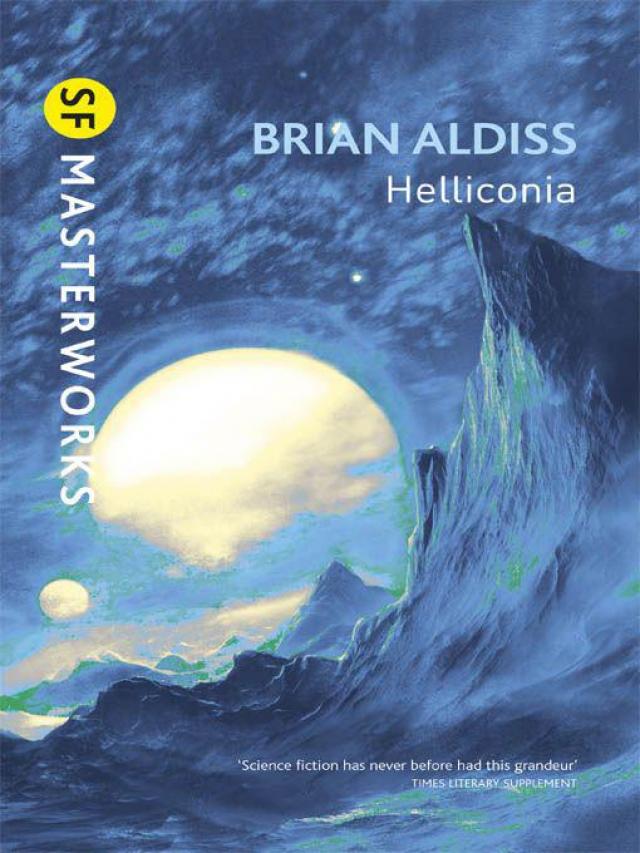
Helliconia
Helliconia Spring / Helliconia Summer / Helliconia Winter
BRIAN ALDISS
Science Fiction Masterworks Volume 80
eGod
CONTENTS
Title
Praise
Map
Introduction by Graham Sleight
Preface by Brian Aldiss
Helliconia Spring
Prelude: Yuli
Embruddock
Chapter I: Death of a Grandfather
Chapter II: The Past That Was Like a Dream
Chapter III: A Leap from the Tower
Chapter IV: Favourable Temperature Gradients
Chapter V: Double Sunset
Chapter VI: ‘When I Were All Befuddock …’
Chapter VII: A Cold Welcome for Phagors
Chapter VIII: In Obsidian
Chapter IX: In and Out of a Hoxney Skin
Chapter X: Laintal Ay’s Achievement
Chapter XI: When Shay Tal Went
Chapter XII: Lord of the Island
Chapter XIII: View from a Half Roon
Chapter XIV: Through the Eye of a Needle
Chapter XV: The Stench of Burning
Helliconia Summer
Chapter I: The Seacoast of Borlien
Chapter II: Some Arrivals at the Palace
Chapter III: A Premature Divorce
Chapter IV: An Innovation in the Cosgatt
Chapter V: The Way of the Madis
Chapter VI: Diplomats Bearing Gifts
Chapter VII: The Queen Visits the Living and the Dead
Chapter VIII: In the Presence of Mythology
Chapter IX: Some Botheration for the Chancellor
Chapter X: Billy Changes Custody
Chapter XI: Journey to the Northern Continent
Chapter XII: The Downstream Passenger Trade
Chapter XIII: A Way to Better Weaponry
Chapter XIV: Where Flambreg Live
Chapter XV: The Captives of the Quarry
Chapter XVI: The Man who Mined a Glacier
Chapter XVII: Death-Flight
Chapter XVIII: Visitors from the Deep
Chapter XIX: Oldorando
Chapter XX: How Justice Was Done
Chapter XXI: The Slaying of Akhanaba
Helliconia Winter
Prelude
Chapter I: The Last Battle
Chapter II: A Silent Presence
Chapter III: The Restrictions of Persons in Abodes Act
Chapter IV: An Army Career
Chapter V: A Few More Regulations
Chapter VI: G4PBX / 4582–4–3
Chapter VII: The Yellow-Striped Fly
Chapter VIII: The Rape of the Mother
Chapter IX: A Quiet Day Ashore
Chapter X: ‘The Dead Never Talk Politics’
Chapter XI: Stern Discipline for Travellers
Chapter XII: Kakool on the Trail
Chapter XIII: ‘An Old Antagonism’
Chapter XIV: The Greatest Crime
Chapter XV: Inside the Wheel
Chapter XVI: A Fatal Innocence
Chapter XVII: Sunset
Appendices
Appendix 1
Appendix 2
Appendix 3
Appendix 4
Appendix 5
Appendix 6
Acknowledgements
About the Author
Also by Brian Aldiss
‘Our ablest SF writer’
Guardian
‘Propels the reader headlong into marvel. A trilogy which has acquired monumental nobility’
The Times
‘Science fiction has never before had this grandeur’
Times Literary Supplement
‘Brian Aldiss’ towering imagination places his Helliconia trilogy far above standard science fiction’
Daily Mail
‘Rarely has someone else’s brave new world been brought so stunningly to life’
Daily Telegraph
‘One of the best SF writers Britain has ever produced’
Iain M. Banks
‘A marvellous journey to another world – a remarkable feat of the imagination’
John Fowles
INTRODUCTION
The premise of Helliconia can be set out in a sentence, but it takes hundreds of pages to understand fully what it means. The planet Helliconia is locked into an orbit around two stars that gives it a ‘great year’ equivalent to 2,592 of ours. The three volumes making up the trilogy – originally published as Helliconia Spring (1982), Helliconia Summer (1983), and Helliconia Winter (1985) – chart this cycle. As the planet warms, the human-like inhabitants gain ascendancy over the savage phagors, but this pattern is reversed as the great year turns back to winter.
Helliconia is not the last science fiction work by Brian Aldiss – he has had 25 years of productive writing since it was published – but it’s easy to see it as a capstone for his work. It certainly embodies ideas he was working out in earlier books like Non-Stop (1958) and Hothouse (1962). They were concerned with how humanity discovers, or fails to discover, its place in a universe shaped by forces out of its control. In those books, knowledge of the true situation isn’t especially consoling, but there’s still great value attached to applying rationality to the world.
Helliconia marks something new in Aldiss’ work in the detail of its invention and the rigour with which the setting is presented. In a book like Hothouse, the flora and fauna of the garish future are described with a kind of joyous abandon. In Helliconia, there’s still the same fascination with how the world works, but a more rigorous sense of how the ecosystem fits together. Aldiss acknowledges many scientists who helped him put together the picture of Helliconia: not least is James Lovelock, whose Gaia Hypothesis proposes that the elements of the Earth’s ecosystem interact far more intricately than we might think. Helliconia’s ecosystem is certainly elaborate, and the relationships within that system – between humans and phagors, say – are gradually revealed through the story.
In his history of SF, Billion Year Spree (1973), Aldiss talks at length about his admiration for writers of the scientific romance such as H. G. Wells and Olaf Stapledon. They too valued empirical investigation even as they warned about its limits and dangers. The scientific romance tends to use the viewpoint of a detached observer rather than a participant in the events described – think of the traveller in The Time Machine or the disembodied narrator of Star Maker. Yet Aldiss has always been interested too in individual humans and their struggles. In Helliconia, the detached viewpoint is provided by the Earth space station Avernus, orbiting Helliconia and relaying its events back to our solar system. But what occupies the bulk of these books is the story of people like Yuli or Luterin and their efforts to fight for or preserve what seems most precious to them.
A couple of things can be picked out from this vast tapestry. The first, as I suggested above, is the idea of struggle. Helliconia is the very opposite of an abstract book because it’s so rooted in personal stories. There’s always the sense that what’s most valuable about human society is potentially at risk and needs to be fought for. The second is self-knowledge. It’s always significant in Aldiss’ work when someone knows, or becomes aware of, their place in the universe. So the dialogue between science and religion, as for instance between the king and CaraBansity in Chapter II of Helliconia Summer, is especially important. The third is how images of cyclical change recur throughout the work, from the quotations by Lucretius that start the first and third books to the waves climbing and retreating from the shore at the start of the second.
Helliconia is so rich with invention that I could easily spend ten times as long as this introduction discussing it. One final image, though, is how often the human story we’re shown argues against the environment it’s in. At the very end of the sequence, Luterin feels ‘exhilaration’ even though the vast winter is closing in; so even though the wind smothers his shouts, we know that spring will come again.
Graham Sleight
PREFACE
A publisher friend was trying to persuade me to produce a book I did not greatly wish to write. Trying to get out of it, I wrote him a letter suggesting something slightly different. What I had in mind was a planet much like Earth, but with a longer year. I wanted no truck with our puny 365 days.
‘Let’s say this planet is called Helliconia,’ I wrote, on the spur of the moment.
The word was out. Helliconia! And from that word grew this book.
Science of recent years has become full of amazing concepts. Rivalling SF! We are now conversant with furious processes very distant from our solar system in both time and space. Cosmologists, talking of some new development, will often say, ‘It sounds like science fiction.’ A perfectly just remark, reflecting as it does the relationship that exists between science fiction and science.
This relationship is not capable of precise definition, since science permeates our lives, and both scientists and writers are wayward people. It is a shifting relationship. What is clear is that science fiction functions in predictive or descriptive mode. It can attempt either to stay ahead of science, to foresee future developments or discontinuities; or it can dramatise newly achieved developments, making the bare (and, to some, arid) facts of science accessible to a wide readership.
An example of the former method (the ‘Wait and See’ method) is Gregory Benford’s novel, Timescape, in which he talks of the intricacies of time in a way which has only recently entered discussion by the scientific comm unity.
An example of the latter method (the ‘Digestive Tract’ method) is H. G. Wells’ The Time Machine, in which he demonstrates, as it were, the possibility of solar death – a startlingly new idea when Wells wrote.
In Helliconia, the Digestive Tract method is employed. In 1979, while this book was a mere building site, its foundations open to the alien sky, James Lovelock published a small book entitled Gaia: A New Look at Life on Earth. The name Gaia was suggested by Lovelock’s friend (I might even claim him as a friend of mine) William Golding, the novelist. The classical Gaia was the goddess of the Earth in Greek mythology; Lovelock was outlining an impersonal updated version of that gubernatory personage. Lovelock pointed out that the continued survival of a living Earth is miraculous. Life survives despite an amazingly narrow range of chemical and physical parameters – parameters subject to fluctuation.
How is it that the Earth’s temperature has not long ago increased, as has happened on ‘our sister planet’ Venus; that the salinity of the oceans has not become more toxic than the Dead Sea; that atmospheric oxygen has not become tied down in oxides, or that hydrogen has not escaped from the upper atmosphere? Lovelock’s answer, known as the Gaia Hypothesis, is that everything on the earth, the biomass, constitutes a single self-regulatory entity – living, of course, but of course without conscious intention. Gaia has no particular centre, no prime minister or parliament, no Führer; not even a Greek goddess; it functions through its unfocused complexity, built up over millions of years. The implication is that the work of bacterial and other forces has built, and maintains, the living world we know, best to suit themselves – a process in which humanity has played small part.
I gave myself up to James Lovelock’s arguments in his first book and succeeding ones in the way that, in an earlier phase of existence, I had surrendered myself to Thomas Hardy’s novels.
Interestingly, Lovelock is an independent biologist of a rather old-fashioned kind, unsupported by universities or other institutions. And his hypothesis relies on the mode of close observation and enquiry which is such a marked feature of Charles Darwin’s work. Darwin perceived where we merely see. Lovelock points out that what he calls ‘city wisdom’ has become almost entirely centred on problems of human relationships; whereas, in a natural tribal group, wisdom means giving due weight to relationships with the rest of the animate and inanimate world.
He says, ‘I speak from personal experience when I say that those of us who go forth in ships to travel to remote places … are few in number compared with those who chose to work in city-based institutions and universities.’
From travel, investigation, and perception, Lovelock built up his integrative hypothesis. I was wildly excited by it. Whether it was true or not, I felt that it was just and should be proved by research, and that here was a thesis which delivered new understanding. Lovelock wrote during the period of the Cold War, when we lived in the shadow of nuclear war, and the threat of nuclear destruction, followed by nuclear winter. Had nuclear winter come about, it would have been the ultimate profaning of nature, the rape and slaughter of Gaia.
These intellectual and emotional ideas were in my mind when I sat down to the seven-year task of writing Helliconia. I hoped in it to dramatise on a wide scale the workings out of Lovelock’s hypothesis.
The story between these covers is just a scientific romance. It talks about pretty ordinary fallible people living within fallible systems, just like us – together with the alien who also has a share in us. Although it may not look like it, I did not intend to place a great scientific emphasis on this introduction. SF, that spectral entity, is not science but fiction, bound to obey many of fiction’s ordinary rules, possibly with an extra imaginative dimension – there is no proof whatsoever that life exists elsewhere in the galaxy.
Deeply interested in the workings of the world of affairs, of economics and ideology and religion, I had written a novel (Life in the West) concerning such matters, of which I was merely a bystander. The novel met with enough success for me to hope to do something similar on a larger scale.
So at first I thought of an allegory, with the three major power blocs represented by three Helliconian continents. Happily, this scheme soon faded away – although three continents were left behind by the tide, Campannlat, Hespagorat, and Sibornal.
For by then creative instincts flooded in, washing away more didactic ones. All the conflicting impulses with which our minds are filled seemed to rise up and organise themselves in a remarkable way. Whole populations seemed to assemble, with a great rustle of garments, from the dark. This astonishing creative process, with its seeming autonomy, is one of the major pleasures of writing.
Naturally, I had to find a story. Three stories, in fact.
There I already had general ideas, once I realised that I desired to assemble a large cast of characters.
What I could not grasp to begin with was what the Helliconian vegetation would look like.
I was stuck. My three most able advisers, Tom Shippey, Iain Nicholson, and Peter Cattermole, had done their best to drum philological and cosmological facts into my head. Still I could not think what a tree on Helliconia would look like. If I could not imagine a tree, I told myself, I was incapable of painting the whole new binary system I – we – had devised.
One evening in 1980, I was travelling from Oxford to London by train, to attend some function or other at the British Council. The time was towards sunset as the train passed Didcot power station. My wife and I had often talked about the station’s cooling towers; were they not, from a distance at least, beautiful? Wasn’t the industrial landscape beautiful? Would John Keats have found such sights ‘a joy for ever’?
The towers on this occasion stood with the sun low behind them. They breathed forth immense clouds of steam into the still-bright sky. Towers and steam were a unity, black against the light background.
Yes! They were Helliconian trees!
The cooling towers, those cylinders with their corseted Victorian waists, were the trunks. The billowing ragged forms of steam were the foliage. The foliage would emerge from the trunk only at certain times of year.
That moment of revelation was what I needed. I started to write my scientific romance. Among the many characters with whom I became involved, I felt most affection for Shay Tal, who stands her ground at Fish Lake; the lovely summer queen, MyrdemInggala; young Luterin; and especially Ice Captain Muntras, who plies a trade once fashionable on Earth in the days before refrigerators, selling what is sometimes prized, sometimes cursed.
As the whole matter had seemed to unfold from that one word, Helliconia, so we believe the whole universe has unfolded from the primal atom. The principle is similar. It is also contained emblematically in the second book of this novel. A defeated general walks through a Randonan forest, a great rain forest swarming with life, a seemingly permanent thing. Yet, only a few generations earlier, it all burst out of a handful of nuts.
When the third and final volume was published, my enthusiastic publisher, Tom Maschler, asked me over a drink, ‘What would you say Helliconia’s really all about?’
I shrugged. ‘A change in the weather …,’ I said.
Most so-called contemporary novels are freighted with nostalgia. Perhaps one reason for either loving or shunning science fiction is that it is relatively free of the poisons of forever looking back. It looks to the future, even when it looks with foreboding.
Science fiction has a remarkable and expanding history this century. It has diversified from cheap paperbacks and magazines to all forms of culture, whether acknowledged or otherwise, from pop to grand opera. It is a curious fact that a large proportion of SF takes place off-Earth, sometimes very far off. One day, a cunning critic will explicate these mysteries.
Meanwhile, here is another story, taking place a thousand light years from Earth. But less far from its concerns.
For this first one-volume edition, I have added appendices. They contain some of the stage directions, as it were, of the drama. The drama can be read and, we hope, enjoyed without them; the appendices form something of a separate entertainment.
Brian W. Aldiss