

Cast a cold eye, p.1
Cast A Cold Eye, page 1


Previous Manny Rivera Mysteries by Rich Curtin:
Artifacts of Death
February’s Files
Trails of Deception
MoonShadow Murder
Deadly Games
Death Saint
Shaman’s Secret
Coyote’s Regret
Final Arrangements
Author’s Website:
www.richcurtinnovels.com
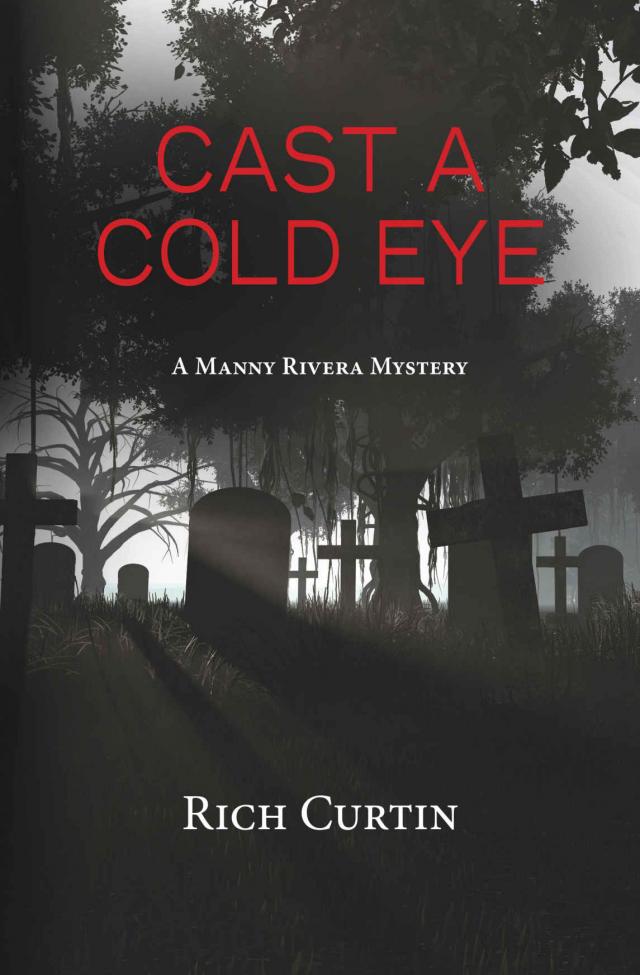
CAST A
COLD EYE
A Manny Rivera Mystery
Rich Curtin
This is a work of fiction. Names, characters, places, and events are products of the author’s imagination or are used fictitiously and are not to be construed as real. Any resemblance to actual incidents, locales, organizations, or persons, living or dead, is entirely coincidental.
All rights reserved. No part of this book may be used, reproduced, or transmitted in any manner whatsoever without written permission of the author, except in the case of brief quotations embodied in critical articles and reviews.
Cover Design by Berge Design
Copyright © 2021 Rich Curtin
All rights reserved
ISBN-13: 9798758422281
CAST A
COLD EYE
ACKNOWLEDGEMENTS
I am indebted to Kay Laird, Sheryleen Grothus, Karen Fillis, Jeri Tribo, and Diane Evans for reviewing the manuscript of this book and making valuable suggestions for improving the writing and the story. My heartfelt thanks to each of them.
1
MOAB’S JEEP JAMBOREE WEEK was in full swing as Deputy Sheriff Manny Rivera eased his Grand County Sheriff’s Department pickup ahead in the stop-and-go traffic on Main Street. Visitors had come from all over to participate in the popular event, and the downtown area was congested with vehicles and people. It was a glorious October morning with clear skies and a crisp freshness in the air, a welcome change from the hot summer months. He lowered his window and inhaled, filling his lungs with the cool air, then exhaled. No doubt about it—today was a perfect day to kick off the Jamboree.
Caravans of Jeeps were parked curbside, their intrepid drivers and passengers awaiting the official departure time to start their engines and head into the backcountry. There they would attempt to conquer one of the eleven off-road Jamboree trails rated from Easy to Extremely Demanding. Rivera was familiar with the routes and the damage some of them could inflict on vehicles and passengers. The most difficult trails had names like Steel Bender, Cliff Hanger, Hell’s Revenge, and Metal Masher, and each year they attracted adventure seekers wishing to test their mettle against the tortured topography of the canyon country. He scanned the participants and silently wished them luck, hoping all would return to Moab unscathed.
He was late for work, and the heavy traffic was at a near standstill. He fiddled with the shiny gold band on the ring finger of his left hand. Wearing a ring was a new sensation for him—he still hadn’t gotten used to it. It had been on his finger ten days now, and he was more sure than ever that asking Gloria Valdez to become his wife had been the best decision of his life.
Parked along the curb on his right was a column of heavy-duty Jeeps with raised suspensions, 32-inch tires, winches, air compressors, open tops, and steel roll bars. They were equipped with heavy duty jacks, spare axles, and multiple spare tires. Stan Lansing, a Jeep Jamboree volunteer and bartender of a popular hangout called the Moab Tavern, was inspecting the vehicles to ensure they met safety requirements and checking off items on a clipboard. The vehicles were occupied mostly by young men with facial hair and serious expressions. Rivera knew from experience that this file of Jeeps was headed for the trail known as Behind the Rocks, a trail rated Very Demanding involving challenging rock climbing where the probability of vehicle damage was significant.
On the other side of the street was a line of stock Jeeps owned mostly by senior citizens headed for the Porcupine Rim Trail, a relatively tame two track with viewpoints overlooking the spectacular array of buttes and pinnacles in Castle Valley and beyond. The seniors were standing by their vehicles looking relaxed and listening to Bobby Ray Archer, the self-proclaimed Poet Laureate of Moab, recite lines from his poems extolling the beauty of the canyon country.
In the next block, Rivera came upon a local bluegrass band playing a lively tune he recognized as Foggy Mountain Breakdown to entertain the Jeep crews and spectators. The banjo player was Pete Pearson, a local rockhound he’d met while working on a previous case. Pearson was an accomplished musician who could play any stringed instrument and play it well. Rivera smiled, thinking a song with the word breakdown in the title might not be the best choice for the Jeep Jamboree.
Rivera liked living in a small town. Everywhere he looked, he saw people he knew either as friends or acquaintances. He remembered thinking when he moved to Moab from Las Cruces ten years ago what a rich and diverse array of activities the town had to offer its residents and visitors. There were art festivals, music festivals, a rodeo, hiking and running events, mountain bike races, rock and mineral shows, and, of course, the Jeep Jamboree and its springtime cousin, the Jeep Safari. Today’s drive down Main Street served to reinforce his belief that Moab was where he wanted to spend the rest of his life.
When he reached Center Street, he was able to turn right, escaping most of the congestion. He parked in front of the sheriff’s building, entered, and headed down the hallway toward his office, detouring by the break room to grab a mug of coffee. He felt content and relaxed.
He’d been sitting in his office no more than three minutes when his cell phone buzzed. The caller was Millie Ives, the sheriff’s dispatcher, who had been serving in that capacity for longer than anyone could remember.
“Manny, we just received a call from an Andrea Greene up in the LaSal Mountains. She sounded frightened and was a bit incoherent, but she said she saw what appeared to be a dead body in the back seat of a Jeep Wrangler parked by that small lake just off the Beaver Basin Road. You know where that is?”
Rivera stood up. “Sure do. I’m on my way.”
“EMS has been dispatched to the scene.”
Rivera took one last swallow of coffee, hustled out of the building, and hoisted himself into his vehicle. He switched on the light bar and headed out of Moab using secondary roads to avoid the heavy downtown traffic. He turned right on Highway 128 and sped northeast between the red rock cliffs channeling the flow of the Colorado River. The rising sun created alternating patterns of copper colors and dark shadows on the scalloped cliff faces, a beautiful sight Rivera would normally observe and appreciate. This morning, focused on navigating the curves in the road at high speed, he barely noticed.
Turning right at Castle Valley, he drove into the LaSal Mountains on the gravel of the Castleton-Gateway Road. As his altitude increased, the color of the foliage transitioned from the dark green of the junipers and pinyon pine to the green, yellow, and reddish-brown fall colors of the scrub oaks, and from there to the white barked aspen trees, their leaves now a dazzling golden color. As he continued higher, the aspens gave way to stately, dark green pines which created mottled shadows across the roadway.
Rivera slowed down, turned right onto the Beaver Basin Trail, and bounced up the rutted road for a little over a mile until he reached a small lake on his left. He parked in the gravel parking area next to the lake, pulled on a pair of latex gloves, and hopped out of his vehicle. The EMS crew had already arrived, and two medics carrying black bags were walking away from an older model Jeep Wrangler. They looked at Rivera with grim expressions and shook their heads.
On the other side of the parking area was a late model Subaru crossover. A woman with a shocked expression was standing next to it, her eyes focused on the medics. Inside the Subaru was a younger woman with her hands to her face who looked to be weeping.
The senior medic approached Rivera and spoke in a muted voice. “There’s a young man in the back of the Jeep, Manny. He’s dead. Looks like a bullet to the temple.”
“Okay, Andy, thanks. I’ll take it from here.”
The medics climbed into their vehicle and drove off.
Rivera approached the Jeep. It was covered with dust and had dozens of scratches on its sides, the kind a vehicle picks up from scraping against brush growing at the edges of narrow backcountry roads. He opened the rear door and confirmed what the medics had told him. The victim looked to be in his early twenties. He was lying on his side in the back seat. There was a small, dark hole in his right temple and a single rivulet of dried blood running back to his hairline. Rivera shook his head in disgust, closed the door, and approached the ladies.
The woman standing by the Subaru was middle-aged with short graying hair. She was wearing jeans and a black, long-sleeve, Audubon Society sweatshirt with the image of a multi-colored Painted Bunting on front, its wings extended in flight. A pair of expensive binoculars hung from a lanyard around her neck.
“Hello, Deputy,” she said in a tremulous voice. “My name is Andrea Greene. I’m the one who called the sheriff’s office.”
Rivera introduced himself and pointed to her car. “Is your friend okay?”
“That’s my daughter Iris. She’s kind of shook up, but I think she’ll be all right. Is that man dead?”
“Yes, he is. May I ask what you ladies were doing up here?” Rivera posed the question even though he had already deduced from the lady’s binoculars and sweats hirt that they were birders.
“We came up here to do some birding. That Jeep was parked there when we arrived. We hiked to the far end of the lake, found a place to sit, and did what birders do. We watched for birds and recorded our observations. We saw some beautiful specimens but nothing out of the ordinary. When we came back to the car a couple of hours later, the Jeep was still there. We hadn’t seen anyone else in the area since we arrived, so we began wondering who the Jeep belonged to. Iris walked over to it and peeked through the window. When she shrieked, I came running over. The man inside looked dead. There was blood on his head. We didn’t want to touch anything. I reported it right away.”
“You did the right thing,” said Rivera. “Did you see anything unusual around here when you arrived? Another vehicle, maybe? Or people on foot?”
“No, nothing but the Jeep,” said Andrea.
“Where are you staying?”
“At the Red Cliffs Lodge. We’ll be there for four more days. We’re part of a Denver birding club. A bunch of us came here hoping to score some rare species.”
“Okay, thank you for reporting this. I’ll be in touch if I have further questions.” He jotted her contact information into his notepad. “You ladies can go now.”
After the women drove off, Rivera returned to the Jeep, opened the door, and scanned the interior. The young man’s eyes were still open. He had the appearance of someone who spent a lot of time outdoors. Despite the graying of his skin brought on by death, Rivera could see he had a ruddy complexion and a sprinkling of freckles on his nose. His hair was light brown, and his eyes were hazel. He was a wholesome looking fellow with a clean-cut, all-American look. His face reminded Rivera of one he’d seen in a book of Norman Rockwell drawings.
Rivera backed away from the vehicle, scanned the area, and took in the setting. All was quiet except for the sound of tree branches rustling in the breeze and the chirping of unseen birds. The fragrance of pine filled the air. The surface of the lake was placid, except for the occasional circular pattern of ripples created by fish feeding on water bugs. A pair of Mallard ducks flew into view and landed gracefully in the middle of the lake, creating a pair of V-shaped wakes. It was a beautiful and peaceful ponderosa forest scene now marred by the presence of a murdered human corpse. Rivera could never understand this kind of violence. Why in the world would someone snuff out a young man’s life and leave him out here in the middle of nowhere? And what kind of mind could justify such a horrid act?
2
RIVERA CALLED THE DISPATCHER, briefed her on the situation, and asked her to send the Medical Examiner. Then he got to work. He scanned the ground and decided the gravel surface of the parking area would yield no useful footprints or tire impressions. Then, careful to avoid disturbing any potential evidence, he took a series of photographs inside and outside the Jeep. That done, he took a closer look at the body. It appeared someone had fired a single, small-caliber bullet into the victim’s right temple. The powder burns in the man’s hair and on the side of his head indicated the killer had shot him at close range. Rivera saw no other visible trauma on the body.
He extracted the man’s wallet from the back pocket of his jeans and pulled out a Colorado driver’s license. The picture on the license was a match for the victim’s face. Russell Randall was from Glenwood Springs and was twenty-three years of age. The wallet contained three hundred and fifty-seven dollars, so robbery wasn’t the killer’s motive. And suicide could be ruled out since Rivera had found no gun in the vehicle.
The automobile registration Rivera extracted from the glove box revealed that the Jeep was owned by Randall. Other papers found there were the usual—tire warrantees, oil change receipts from Valvoline in Grand Junction, and an owner’s manual. The keys were still in the ignition. He noted that the interior was well worn and coated with a fine layer of red rock dust. It was evident the vehicle spent a lot of time in the backcountry. In the man’s shirt pocket, he found a ballpoint pen; in his pants pockets were a cell phone, a handkerchief, and thirty-six cents. He placed the items in separate evidence bags.
Rivera searched through the rest of the vehicle. In the rear, he found a one-person tent rolled up and secured with a bungee cord, a dusty sleeping bag, a long handle spade, a trench shovel, a pick, a metal detector, and a 5-gallon can filled with gasoline. He also found a wooden box containing cooking gear, utensils, lanterns, and other camping equipment. On the front passenger seat was a journal containing handwritten notes and drawings. He bagged the journal, deciding to review its contents back at the office.
As he strung crime scene tape around the area, Rivera wondered if the man was part of the Jeep Jamboree group. He rejected that idea as soon as it occurred to him. None of the Jamboree trails came up into the LaSals. And the vehicle looked old and didn’t have the necessary equipment required to participate. In addition, he didn’t find a Jamboree permit.
Rivera wondered about a motive. At this point in the investigation, it could be anything. He expected that, as he learned more about Randall, possible motives would present themselves. There was one thing that stood out now, though—the shooting appeared to be a professional job. The killer had fired a single shot to the victim’s head. It was fired up close from a small caliber weapon so the bullet would enter the head but not exit, thereby avoiding a messy scene. Most likely the shooter wore gloves, so finding useful fingerprints would be unlikely. Nevertheless, Rivera would call in a forensics team and have them dust for prints on the off chance the killer might have slipped up.
Rivera wondered why the victim had been left here. And why was he in the back seat of his vehicle? Rivera thought about that for a long time, finally deciding that Randall had been shot elsewhere, loaded into the back of his vehicle, and driven to this place. The lack of blood spattered anywhere in the vehicle supported that theory. Then, after abandoning the Jeep and its contents, the killer either left on foot or was driven away. If the latter, that meant a second vehicle and a second person—the driver—were part of the picture.
Rivera guessed the killer wouldn’t choose to escape on foot. Why take a chance of being spotted walking away from a crime scene on remote mountain roads? The rare passerby would surely remember him and his description. Might even offer him a lift. That would have been too much of a risk. In his mind, the two-vehicle theory moved up a couple of notches on the probability scale.
Rivera was carrying the evidence bags to his vehicle just as the County Medical Examiner arrived. Dr. Marvin Phelps was new, enthusiastic, and full of energy. Rivera had met him a few months earlier at a retirement party held for Dr. Pudge Devlin, the former medical examiner. At the party, Phelps had provided Rivera with an extensive discourse on the modern forensic pathology training he had received. Rivera had taken a liking to the young man.
As soon as he saw Phelps exit his late model Toyota Tundra pickup truck holding his black bag, Rivera was hit in the gut with a dose of melancholy. He found himself missing his old friend Pudge, his sense of humor, and his dusty, dented pickup truck. Pudge had opted out of the medical business to devote his full attention to his vineyards and winery.
“Good afternoon, Deputy Rivera,” said Phelps. He was of medium height and had a lean build. His dark brown hair was long and wavy and framed a boyish face. He was wearing tan slacks and a light-blue dress shirt, both freshly pressed.
“Thanks for coming, Marvin.”
The young doctor pointed. “May I assume the body is in the Jeep parked over there?”
“Right. It looks like he took a small-caliber bullet to the temple.” Rivera smiled at the doctor. “And if we’re going to be working together, you should start calling me Manny.”
“Okay, Manny, I’ll check it out.”
Rivera waited in the shade of a pine tree while Phelps did his work with the corpse. Five minutes later, Phelps emerged from the Jeep.
“Manny, I’ll send you a copy of my report after I’ve performed a full autopsy, but it looks like the cause of death was just as you said—a small caliber bullet to the brain. I estimate he’s been dead less than twelve hours.”






