

The haar, p.1
The Haar, page 1
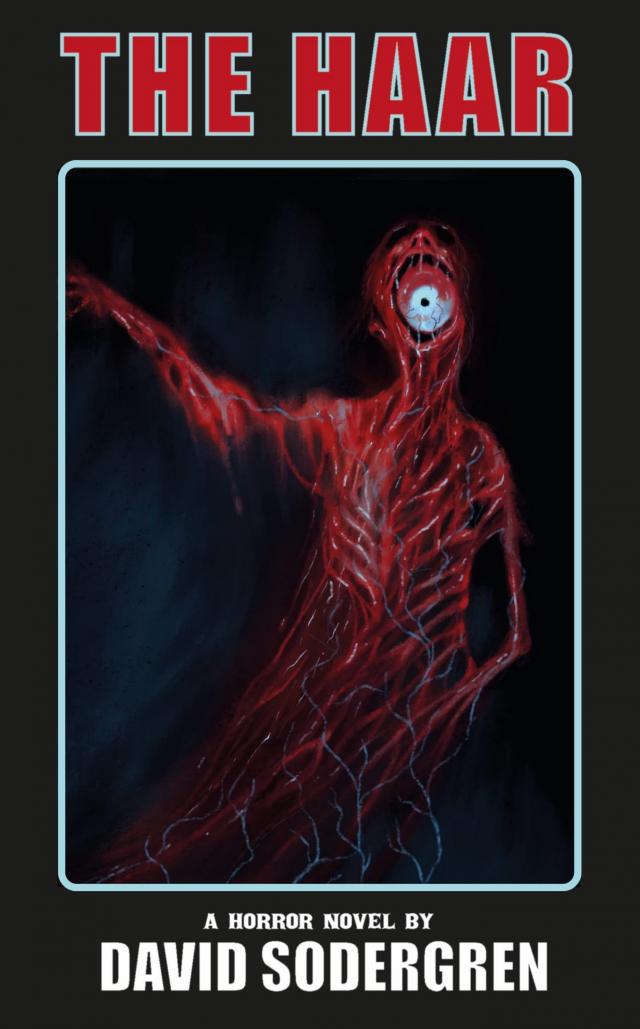


The Haar
David Sodergren
This book is a work of fiction.
Any resemblance to names and people, living or dead, is purely coincidental.
No part of this publication may be reproduced or transmitted in any form without written permission from the author.
* * *
Cover art by Trevor Henderson
* * *
Copyright © 2022 David Sodergren
All rights reserved.
ISBN: 9798800159837
For my gran
You would not have liked this book at all.
Contents
Chapter 1
Chapter 2
Chapter 3
Chapter 4
Chapter 5
Chapter 6
Chapter 7
Chapter 8
Chapter 9
Chapter 10
Chapter 11
Chapter 12
Chapter 13
Chapter 14
Chapter 15
Chapter 16
Chapter 17
Chapter 18
Chapter 19
Chapter 20
Chapter 21
Chapter 22
Chapter 23
Chapter 24
Chapter 25
Chapter 26
Chapter 27
Chapter 28
Chapter 29
Chapter 30
Afterword
The Memoirs of Connie Jamieson
Acknowledgments
About the Author
Also by David Sodergren
1
Muriel Margaret McAuley was eighty-four years old the first time she saw a man turned inside-out by a sea monster. You might think it would bother a woman of her age, but, as Muriel was fond of saying, she had seen a lot in her eighty-four short years.
Most notably, she had been first on the scene back in sixty-six, when the lighthouse lamp failed and The Charlotte Dane fishing vessel had crashed into the rocks, disgorging its human cargo into the bay. Muriel had witnessed it from her rain-streaked kitchen window as she scrubbed the dishes. She ran from the small cottage she shared with her husband Billy, and waded into the sea, rolling up her pinafore and dragging mangled bodies from the pounding water. The rest of the fishing village of Witchaven had soon joined her in the rescue attempt. Some of the men they pulled from the icy sea were still alive. Some were dead, and others were in pieces.
The next morning, Muriel had carted her trusty wheelbarrow down to the beach and collected as many parts as she could find. Legs, arms, feet… even a head had washed ashore. She left the wheelbarrow in the garden while she phoned the authorities, then made soup for lunch while waiting for the limbs to be taken away for identification.
So aye, it’s fair to say it took more than a little blood to turn Muriel McAuley’s cast-iron stomach. In fact, the only thing Muriel couldn’t abide — that really, truly nauseated her — were stuck-up wee arseholes in suits telling her what to do.
“I think you should leave,” she said curtly to the tall woman in the powder blue suit.
The woman smiled politely, displaying rows of immaculately straight, white teeth, but remained steadfast in Muriel’s doorway. The coastal wind blew a strand of blonde hair across her face, and she casually brushed it aside. Normally, Muriel would invite a guest into her home, especially on a crisp morning like today… but not this woman.
The wind howled in from across the North Sea, and the woman on the doorstep shivered, trying her best to disguise it. Those Americans never could get used to the Scottish climate, thought Muriel.
“Miss McAuley,” the woman said brusquely, her pleasant facade coming perilously close to slipping. “Just listen to what I have to say.”
Muriel couldn’t stop staring at her teeth. They were perfect. She had never seen anything like them. They looked like they had been carved from ivory, not a gap between them, not a single imperfection. She wanted nothing more than to swing a right hook and knock them out of the woman’s thick skull.
It wasn’t like Muriel to lose her temper. As anyone in Witchaven would attest, Muriel never raised her voice. At least, not in anger. When she was calling for her chickens, or for her son Paul to come in for tea, then sure, she could shout as loud as a trapped coo. But Paul had left home forty years ago and had a son of his own now, and Billy had built a chicken coop and fence to stop the hens from wandering off, so Muriel’s larynx had been well rested for a good few decades.
But this woman was putting all that to the test. She clutched an expensive leather bag to her chest, her knuckles red raw from the cold.
“Miss McAuley, this is a once in a lifetime deal. You’d be, if you don’t mind me saying, a fool to pass it up.”
Muriel narrowed her eyes and tried to compose herself.
“I’ve been called a lot worse than a fool over the years, young lady. In fact, I think I’ve been called every name under the sun, and by people I respect a lot more than you. And, might I add, it’s Mrs McAuley, not Miss.”
The woman’s eyes brightened. She was a beautiful girl, no older than thirty. Muriel thought she would be best working her charms on men. What old buffoon could say no to a smile like that?
“Oh, you have a husband? Perhaps I should talk to him. I’m sure there must be a way to come to an agreement and end this unpleasant business once and for all.”
“My husband has been dead for twelve years.”
The woman’s smile lapsed, her lips eclipsing the brilliant white teeth. “I see.”
“He died in this house. The house he built. Our house. And when he passed, God rest his soul, this land, and everything on it, became mine. I’ve lived here most of my life. My son was born here, and I will surely die here, but not before I’m ready.”
Muriel rose to her full height, all five-foot-two, putting her eyes level with the woman’s flawless, blemish-free chin.
“And I most certainly will not sell to some toe-rag from the telly so he can build a golf course and ruin a beautiful piece of land, no matter how many millions of pounds he has.”
The grin returned to the woman’s face, her teeth seeming to force her mouth open in their desire to dazzle all onlookers. “Billions,” she said.
“Excuse me?”
“Mr Grant is a billionaire. Not a millionaire.”
“I don’t care if he shits gold bullions,” said Muriel, her cheeks colouring at her choice of language. “I, and those left in this village with a modicum of decency, will never sell to the likes of him, not for all the tea in China. And the fact he sends you door-to-door like a… like a bloody vacuum cleaner salesman, instead of coming himself, speaks volumes about his character.”
“Mr Grant is a very busy man, as I’m sure you can appreciate. He would love to come and meet the residents face-to-face, but he has a great many duties overseas.”
“Aye, more folk to kick out of their homes?” snapped Muriel. She was getting cold, and wanted to close the door and head back inside for a seat and a cup of hot tea, but the woman’s feet were firmly planted in her doorway.
“We’re not kicking anyone out,” the woman said, putting the word in air quotes. “We’re offering them a unique chance at happiness.”
“You’re destroying the natural beauty of the land!”
Muriel gazed past the woman at the waves lapping against the unspoilt white sand beach. The rolling dunes led up to the cliff face where local youths used to defy death by leaping into the frigid water, back when there were local youths in Witchaven.
The woman snorted. “You call this beauty? Wait until you see what Mr Grant has in mind.”
Muriel shook her head. “I’ve seen him on the news. He’s planning on landscaping the whole area. This land is protected, you know. What he’s doing is illegal.”
“Well,” said the woman. “Your local council doesn’t agree.”
“Aye, and what a bunch of plums they are. They might be willing to be bought, but I’m not. They can’t buy me, not for all the tea in China.”
“You already said that.”
Muriel stared at the woman. Was she repeating herself? She was too angry to think straight. She had watched Mr Grant outline his plans for the area on the news.
A slum, he had called the village. A slum!
Witchaven was many things, but a slum it was not. A fishing village since the eighteen-hundreds, it consisted of two dozen cottages and a few farm houses, all blindingly white in the sun. The views were spectacular, the sun rising over the ocean every morning. Life was peaceful here. The only concession to modern progress was the addition of electricity and telephone lines back in the sixties, around the time the Post Office had opened. Now, of course, the Post Office was gone. Mark and Lizzie had shuttered the windows for the last time four months ago, having accepted a deal from The Grant Organisation. Three days later, the building had been demolished, the same building where Muriel used to post her Christmas cards and pick up her groceries.
Muriel bristled. “I know fine well what that daft mug off the telly has planned, but the people of Witchaven still value integrity and tradition. We won’t stand for you coming in here and taking our land, turning it into—”
“It’s Patrick Grant’s land.”
Muriel’s blood boiled. Oh, they had shown her their title deeds before, a map with parts of the coastline coloured red to mark the land Grant supposedly owned. With each new deed they presented to her, the red area crept further and further along the coast, encroaching on properties that had stood since Wit chaven’s inception.
Muriel’s fingers tightened into loose, trembling fists.
“Get out of my house. Get off my property, and off my land.” She advanced on the woman, who took a step back, stumbling over the crooked step. “And make no mistake, this is my land, and will remain that way until I am dead and in my grave, millionaire or no millionaire.”
“Like I said, a billionaire,” the woman answered coolly. Her smile was gone, replaced by a glimmer of contempt. She turned to leave, heading towards the car that idled by the gate, dark and menacing, the windows tinted black. A burly man in sunglasses stood with his arms crossed, a radio hooked up to his ear.
Security? thought Muriel. Against who? Me?
She laughed, and the woman looked back, regarding her quizzically.
“Consider your options, Mrs McAuley,” she said. “An opportunity like this doesn’t come along often, and who knows how long it’ll stay on the table. Everyone has a price.”
Muriel hid her shaking hands behind her back and smiled. “Tell you what, young lady. You scurry back to your boss and tell him to double his offer.”
The woman paused. “Miss McAuley… I’m sorry, Mrs McAuley… I knew you were a smart woman, I really did.” She started towards Muriel, reaching into her bag. “I have the paperwork—”
“Aye,” interrupted Muriel. “Tell him to double it, then shove it up his arse.”
The woman froze. She took a deep breath and removed her hands from the bag. “You’re making a mistake,” she said. “The biggest mistake of your life.”
Muriel locked eyes with her. “Get off my land, or I’ll shoot you,” she said quietly, almost a whisper.
The woman backed up, her legs moving almost as fast as her mouth.
“Are you threatening me? Because I’ll go to the cops. I swear, I’ll—“
“Right, that’s it.” Muriel turned away, moving through her hallway with surprising speed. “You’d better be gone by the time I get back, missy, or I’ll sink a cartridge into that plump bottom of yours!”
She heard the woman shout something to the driver, and saw a flurry of activity out of the corner of her eye as she threw open the door to a cupboard and reached inside.
“I’m coming for you!” she roared, glancing out the window to the woman hurrying through the garden in her skirt and high heels. Panicking, the woman tripped, landing in the mud and screaming in terror as the security guard rushed to her aid.
When Muriel reappeared in the doorway, the woman glared at her, the whites of her eyes visible through wet mud that dripped down her face like melting clay, eyes that stared with unconcealed hatred at the weapon in Muriel’s hands.
An old wooden broom.
“That’s not a gun,” the woman said, spitting a mouthful of foul gunk onto the grass.
“Did I say a gun?” Muriel asked innocently. “I’m sorry, I meant broom. I’m gonna skelp your arse with a broom.”
The woman tossed a handful of mud towards Muriel. The missile fell short of its intended target.
“You old bitch!” she snarled. “You ain’t gonna live forever!” Her accent had changed, sounding looser, less refined. The security guard helped her up, brushing the mud from her jacket, and she slapped his clumsy hands away from her chest.
Muriel smiled and waved, watching as the woman bundled herself into the car, still shrieking expletives. If she thought it would shock Muriel, she was dead wrong. She had grown up and lived among fisherman all her life, and though she tried never to swear herself, she had heard it all before. The car careened around the bend, the wheels kicking up thick clouds of dirt as quiet fell once more upon Muriel’s modest cottage.
“A slum,” she muttered. “The man’s a bloody menace.”
She shivered. It was cold out today. The sky loomed above her, grey and heavy and ready to collapse. Muriel reached for the door. Her hands trembled. They always did, these days. She couldn’t stop them.
No matter. It only bothered her when she was drinking her tea, and she had learnt the painful way not to fill the mug too near to the brim. She closed the front door and ambled back into the living room, her heart pounding from the excitement. There, she sat by the window in her favourite chair and gazed out over the beach. Beyond it, the blue sea stretched to the horizon, a fishing boat bobbing lazily beneath the clouds.
Muriel closed her eyes. She wanted to relax, but couldn’t. She had work to do. And anyway, she knew they’d be back soon, with more offers and veiled threats.
They always came back.
2
The rest of the day passed much as it had every day of the twelve years since Billy’s passing.
Muriel sauntered out to the chicken coop, collecting the eggs for this evening’s dinner. Three today, a respectable haul. She checked her post box, found it was empty — it usually was — then went back inside and put on the wireless.
The radio, grandma. It’s called the radio.
She smiled at the thought of her grandson correcting her, and tried to recall the last time she saw him. This had been the first year he had forgotten to call and wish her a happy birthday. She couldn’t blame him. Jack was twenty now, and lived in London. He had his own life to live.
“Young people have to leave the past behind if they ever wish to grow up,” she said. Since Billy’s death, Muriel had made a habit of talking to herself. It kept the cottage from getting too quiet, especially on the long winter nights. She gazed at a photo of her and Billy, taken on their wedding day.
“Whereas old farts like ourselves have nothing but the past.”
She reached for the photo, wanting to lift it, but her trembling hands betrayed her. Her son had forced her to visit a doctor a few years prior, a strange, thin man who ran some tests to check if she had Parkinson’s. It turned out she didn’t, but no explanation for the shakes had been offered.
“Have to learn to live with it,” she said, determined to pick up the photo frame. It took her a moment, but she managed, clasping her fingers and thumb around the edge. The photograph shook in her hand. “Like standing in a bloody earthquake,” she muttered, and laid the frame back down before she dropped it. Billy gazed at her from the photograph, from across time itself, this simple image a bridge between then and now, the good times and the bad.
“Ach, it’s not so bad.”
Not so bad? Pretty soon you’re going to be out of house and home.
“Then so be it. I won’t sell our house. If they want rid of me, they’ll have to come round here and personally remove me.”
She tried to smile, but the thought terrified her. What if they could? What if they did? She couldn’t stay with her son. He had a family. Also, she had a nagging suspicion he wanted to put her away in a retirement home.
“You’re getting on, mum,” he would say whenever she called. “What if you had a fall? There’s no one around to check up on you.”
“If it’s my time, it’s my time,” she would always reply. The pair of them were like a broken record, and it did nothing but strengthen her resolve, just like whenever those slick Americans would call round with their fat cheques and hungry eyes.
Muriel didn’t care about money. Could they not understand that? She had a pension, and a small amount of savings, enough to see her through. But most importantly, she had her home and her dignity. She didn’t want to move into sheltered accommodation, or — God forbid — a care home.
During World War II, she had been shipped off to a home for boys and girls, and there she learned the value of independence, losing herself in her drawings. In the late fifties, she was offered a job as an illustrator, but upon learning of her upcoming nuptials to Billy McAuley, the offer had been rescinded.






