The Kid Clips a Coupon [Patent Leather Kid]
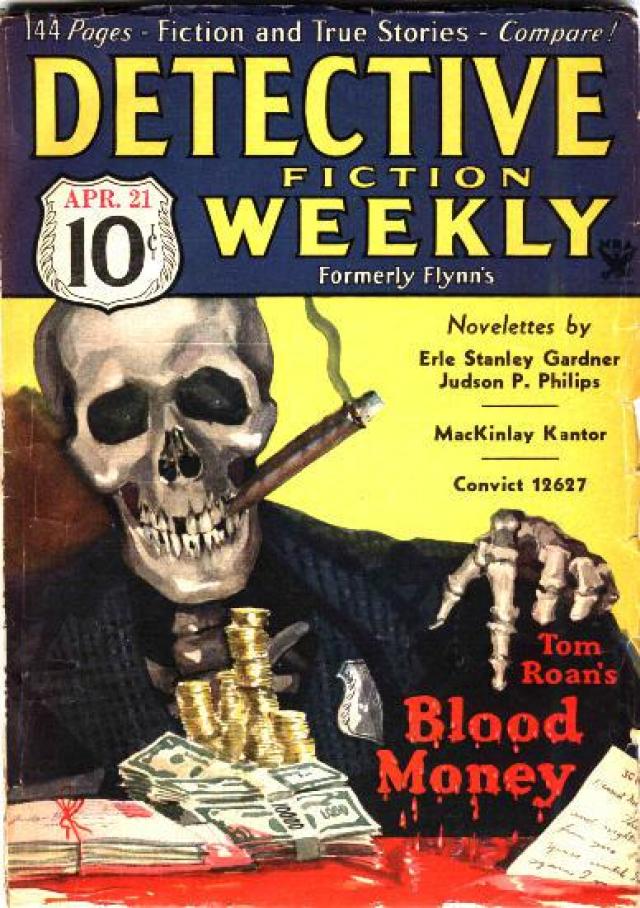
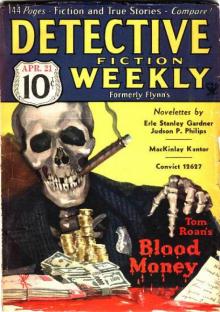
· Erle Stanley GardnerDetective Fiction Weekly [v 84 #2, April
21, 1934] (Red Star News Company, 10¢, 144pp, pulp) In many of Erle Stanley Gardner's pulp tales, such as the Ed Jenkins and Patent
Leather Kid stories, the protagonist is a sympathetic crook who preys on really
bad crooks. He learns about some scheme of theirs, then puts in plan his own
counter operation, one that will delicately interfere with their work, prevent
harm to the innocent, expose them to the police, and grab their loot. Both
scheme and counter-scheme are complex and detailed, with several ingenious
features. Oftentimes, in actual execution, things go somewhat wrong, and require
still further adjustments. The Lester Leith tales Gardner wrote in the 1930's and 40's seem completely
different. Gardner's Lester Leith stories contain puzzle plots. At least 4 of
the 5 that have been reprinted out of the circa 75 Gardner wrote for
Detective Fiction Weekly, in The Amazing Adventures of Lester
Leith, a 1980 collection edited by Ellery Queen.
The puzzle plots are usually fairly well done; in and of themselves, they could
support a 15 page story of the kind Agatha Christie was
so good at. On top of this, Gardner consistently adds another feature: the
development of an elaborate con by Lester Leith, designed to both solve the
crime, and steal the ill gotten gains of the criminal. This con job is full of
surreal and baroque elements; it tends to be wild, comic and bizarre. This con
job is very different from the-interfere-in-the-criminals'-scheme approach that
Gardner used in his Ed Jenkins tales, or in the Patent Leather Kid story, "The
Kid Clips a Coupon" (1934). Rather, it is a full fledge con. The reader is privy
to elements Leith will use in the scheme, but not the scheme itself, and now has
a second puzzle to unravel: what is Leith up to? These two puzzles interact in
interesting ways, as they are both gradually unraveled by the story. Leith often
explains the deductive logic he used to deduce the criminal and understand his
crime. This deduction seems almost as relentlessly logical as Sherlock Holmes or
Ellery Queen, and shows a surprising commitment by Gardner to the full paradigm
of the puzzle plot, not just a mystery, but also its fair play solution through
deduction from clues. While there is a detective (Leith) solving the first
crime; there is no detective figure solving the mystery of Leith's activities.
These activities simply unroll in front of the reader's eyes.
Read online