Women of wonder, p.1
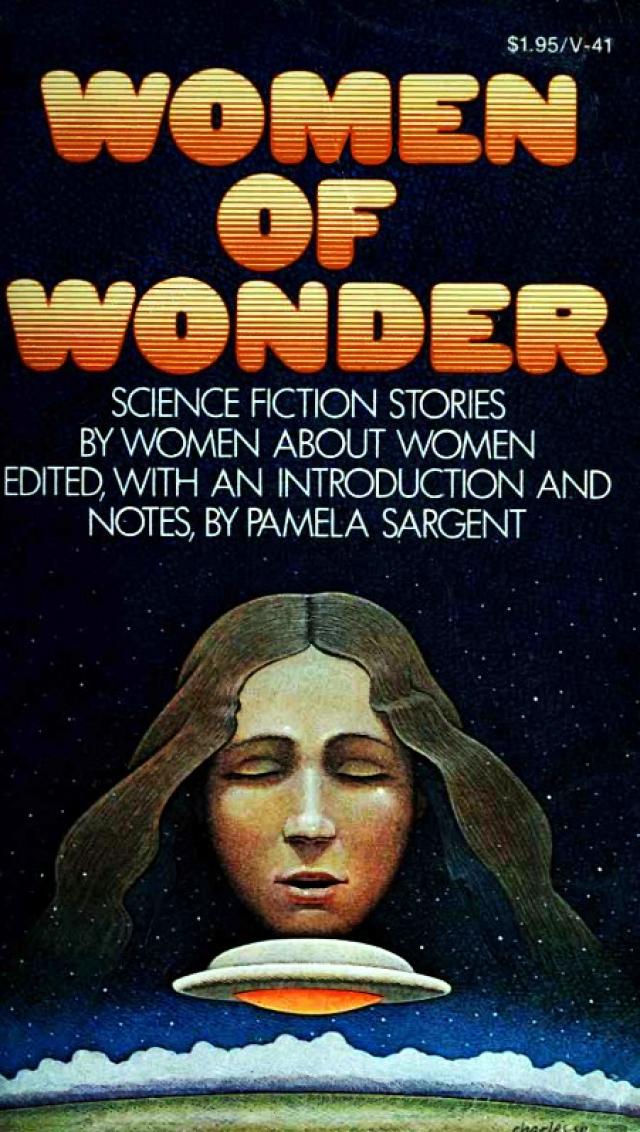
Women of Wonder, page 1


VINTAGE BOOKS EDITION
January 1975
Copyright © 1974 by Pamela Sargent
All rights reserved under International and Pan-American Copyright Conventions. Published in the United States by Random House, Inc., New York and simultaneously in Canada by Random House of Canada Limited, Toronto.
Library of Congress Cataloging in Publication Data
Sargent, Pamela, comp.
Women of wonder.
Includes bibliographical references.
CONTENTS: Dorman, S. The child dreams.—Merril, J. That only a mother.—MacLean, K. Contagion, [etc.]
1. Women’s writings, American. 2. Science fiction, American. 3. Women—Fiction. I. Title.
ISBN 0-394-71041-X
“That Only a Mother” by Judith Merril; copyright © 1948 by Street & Smith Publications, Inc. in the U.S.A. and Great Britain, and copyright © 1954 by Judith Merril. Reprinted from Astounding Science Fiction by permission of the author and her agent, Virginia Kidd.
“Contagion” by Katherine MacLean; copyright © 1950 by World Editions, Inc. Reprinted by permission of the author and her agent, Virginia Kidd.
“The Wind People” by Marion Zimmer Bradley; copy- right © 1958 by Quinn Publishing Company, Inc. Reprinted by permission of the author and her agents, Scott Meredith Literary Agency, Inc.
“The Ship Who Sang” by Anne McCaffrey; copyright © 1961 by Mercury Press, Inc. Reprinted by permission of the author and her agent, Virginia Kidd.
“When I Was Miss Dow” by Sonya Dorman; copyright © 1966 by Galaxy Publishing Corp. Reprinted by permission of the author and her agent, John Schaffner.
“The Child Dreams,” also by Sonya Dorman, is reprinted by permission of the author.
“The Food Farm” by Kit Reed; copyright © 1966 by Kit Reed. Originally published in Orbit Two by G. P. Putnam’s Sons; reprinted by permission of the author and her agents, Brandt & Brandt.
“Baby, You Were Great” by Kate Wilhelm; copyright © 1967 by Damon Knight. Reprinted from Orbit Two by permission of the author.
“Sex and/or Mr. Morrison” by Carol Emshwiller; copyright © 1967 by Harlan Ellison. Reprinted from Dangerous Visions by permission of the author and the author’s agent, Virginia Kidd. “Vaster Than Empires and More Slow” by Ursula K. Le Guin; copyright © 1971 by Robert Silverberg. Reprinted from New Dimensions One by permission of the author and the author’s agent, Virginia Kidd.
“False Dawn” by Chelsea Quinn Yarbro; copyright © 1972 by Random House, Inc. Reprinted from Strange Bedfellows by permission of the author.
“Nobody’s Home” by Joanna Russ; copyright © 1972 by Robert Silverberg. Reprinted from New Dimensions Two by permission of the author.
“Of Mist, and Grass, and Sand” by Vonda N. McIntire; copyright © 1973 by the Conde Nast Publications Inc. Reprinted from Analog by permission of the author.
I would like to thank the following people, without whose help, advice and moral support my task in putting together this anthology would have been much more difficult:
Janet Kafka
Vonda N. Mclntyre
George Zebrowski
Jack Dann
For Connie and Ginny
I
The story of women in science fiction clearly suggests the continuing emergence of a body of work characterized by the new-found outlook of its practitioners. This new outlook belongs naturally to good science fiction, where it has always been present to some degree, and to the new social-futurological concerns in the culture at large.
In the past, women, both as writers and as characters in sf novels and stories, were part of science fiction only sporadically. During the past twenty years, more women have entered the field. Some of them won acceptance initially by imitating the male writers, showing that they could do as well or better. Others explored the same material as male authors, but from a different perspective. There are signs that both female and male writers are beginning to work with new material and are questioning the assumptions which have dominated the field. Science fiction as a whole, however, still reflects the society around it.
Most science fiction has been written by men, and they still form a majority of the writers today. About 10 to 15 percent of the writers are women. The vast majority of the readers are male and a fair number of them are young men or boys who stop reading sf regularly when they grow older. It is difficult to get exact figures on this, but publications for science fiction readers have at various times reported that most of their subscribers are men; a readership of 90 percent male and 10 percent female is not unusual.
This is not at all surprising when one considers the relationship of science fiction to scientific and technical extrapolation, and the fact that science and technology are generally assumed to be masculine domains. Women have often been discouraged from entering scientific studies on various grounds: they do not have the aptitude, they are essentially intuitive rather than rational, they are concerned with trivialities or the “here and now” and are inherently hostile to any kind of intellectual exploration, being basically conservative. Practically speaking, it no doubt seemed unwise for a woman to invest the time and effort required for scientific study only to be relegated to the role of wife and mother. Women studying science and technology have often been, and sometimes still are, required to justify taking places that could have gone to men. This problem occurs often enough in other intellectual disciplines as well, but the study of art, literature, or the social sciences can be excused if the woman does not pursue it for too long. It might make her a better mother, a more interesting intellectual companion for her husband, or provide her with a hobby. The effort and long-term commitment that our society demands of those studying the sciences are seen as inimical to the roles women are supposed to play.
There are many scientists around who date their earliest interest in science to the time they read science fiction as boys. The writers, usually males themselves, knowing that their readership was primarily male, often wrote directly for this readership. As a consequence, young girls often found nothing of interest to them personally in science fiction. Already discouraged from having an interest in technology, many girls found little for themselves in books where men had most of the adventures and fun.
We can perhaps understand why the writers of science fiction took for granted certain presuppositions, as did almost everyone else in the society around them. Women, and racial minorities as well, suffered under these assumptions. If science was the province of males, it was also the province of white males. It is more common now to find black people and other minorities represented as characters in sf stories, although the number of black sf writers can be counted on the fingers of one hand. Women characters have been around longer but usually in unimportant roles. One can wonder why a literature that prides itself on exploring alternatives or assumptions counter to what we normally believe has not been more concerned with the roles of women in the future. There are two possible answers, although neither excludes the other. Either science fiction is not as daring or original as some of its practitioners would like to believe, this being more a worthy ideal than a reality; or this literature, designed to question our assumptions, cannot help reflecting how very deeply certain prejudices are ingrained—despite its sometimes successful efforts at imaginative liberation from time and place.
Ironically, a case can be made that the first writer of science fiction was a woman, Mary Shelley, the daughter of the eighteenth-century feminist Mary Wollstonecraft. Although influenced by the Gothic literature of the time in setting and mood, Mary Shelley’s novel Frankenstein (1818) also reflects an awareness of new scientific discoveries at this time, the dawn of the Industrial Age. The British author and critic Brian Aldiss writes:
In … combining social criticism with new scientific ideas, while conveying a picture of her own day, Mary Shelley anticipates the methods of H. G. Wells when writing his own scientific romances and of some of the authors who followed him.1
What Aldiss calls “the first real novel of science fiction” has had an obvious and enormous influence. The story of Frankenstein is a powerful one, mirroring as it does the conflict between growing scientific knowledge and the fear that this knowledge may destroy us, as Frankenstein’s monstrous creation destroyed him.
One feature of Frankenstein is of interest here. Ellen Moers points out that the Gothic novel in the hands of its most popular eighteenth-century practitioner, Ann Radcliffe, became “a feminine substitute for the picaresque, where heroines could enjoy all the adventures and alarms that masculine heroes had long experienced, far from home, in fiction.”2 But Moers goes on to say:
… what are we to make of the next major turning of the Gothic tradition that a woman brought about a generation later? Mary Shelley’s Frankenstein, in 1818, made over the Gothic novel into what today we call science fiction. Frankenstein brought a new sophistication to literary terror, and it did so without a heroine, without even an important female victim.3
It is interesting to note the absence of important female characters in this novel, which introduced a new literary form and set the mold for later sciencefiction works.
Brian Aldiss, in summing up Mary Shelley’s achievement, writes:
Overshadowed by her husband’s reputation, her writing has been too greatly neglected.
It is all too appropriate that Mary Shelley’s work has been neglected. Science fiction has been similarly neglected until recently. As the standing of Mary’s reputation is still in the balan ce, so is science fiction’s.4
Women writers of science fiction have been in the minority since Mary Shelley’s time. One nineteenthcentury exception was Rhoda Broughton, the niece of fantasy writer Sheridan Le Fanu. Broughton’s “Behold It Was a Dream,” a story about precognition, was published in 1873. In the story, a young woman, Dinah Bellairs, visits friends and has a dream which accurately forecasts their tragic death. It was not until the early twentieth century that another woman made a mark in science fiction.
Francis Stevens, whose actual name was Gertrude Barrows, was born in 1884. Her first published work, “The Nightmare,” appeared in 1917, Widowed and responsible for the support of her mother and child, she made part of her living through the writing of fiction, much of it fantasy. A science fiction novel, The Heads of Cerberus, was published in 1919 as a serial in Street is Smith’s The Thrill Book; it was later reissued by Polaris Press in 1953 in a limited edition.
The Heads of Cerberus may be the first work of science fiction to use the concept of parallel time, in which it is assumed that there are parallel worlds which have developed differently from our own as a result of different choices, circumstances and historical developments. This theme has been used fairly often in sf ever since.5 In Stevens’s novel, Robert Drayton, his friend Terence Trenmore, and Trenmore’s sister Viola journey to a future Philadelphia in a parallel world. Viola Trenmore, who fulfills the traditional role of love interest in the story, is also depicted as a courageous and determined woman.
The end of Francis Stevens’s life is as mysterious as some of her fiction. After moving to California, she simply disappeared. A letter sent to her by her daughter in 1939 was returned and all attempts to trace her were unsuccessful. To this day, no one knows what became of her.
Another gifted writer of science fiction and fantasy is C. L. Moore. Catherine Moore began writing during the 1930s, and the best of her work has a brooding, hypnotic atmosphere. Moore was adept at writing from the male point of view, a necessity for anyone who wished to publish in the pulp magazines which had dominated American sf since the 1920s. A number of her stories dealt with the adventures of Northwest Smith, a rugged soldier of fortune who traveled throughout the solar system. But Moore also wrote fantasy stories with a female heroine, Jirel of Joiry, a strong Amazonian figure.
One of Moore’s finest efforts is the short novel No Woman Born (1944). The heroine, a dancer named Deirdre, has her brain transplanted into a robotic body after nearly dying in a fire. In spite of her metal body, she is determined to dance again. The men in the story, anxious to protect her, want to prevent her from returning to the stage. Maltzer, the scientist who has given Deirdre her new body, fears that audiences will hate and resent the dancer. But Deirdre persists, gives a successful performance and points out to Maltzer how important it is for her to continue her contact with humanity through dance.
Moore’s story is an important one for several reasons. It is an interesting example of an sf story which relies for its tension not on the mechanics of an adventure plot, but on the interaction between characters. More important, it is one of the earliest thoughtful treatments of the cyborg, a person who is partly or mostly machine. Deirdre, in her metal body, has gained new senses to replace the ones she lost (smell, taste and touch), and she recognizes that she could easily become alienated from the human beings around her. She thinks she can prevent this from happening by using the contact with her audiences provided by dancing. The men in the story feel sorry for her, seeing her somehow as trapped and cut off in her mechanical body. Deirdre, however, finds a new perceptual world opening up to her, and succeeds in creating a new style of dance as well.
C. L. Moore married another science fiction writer, Henry Kuttner, in 1940, and the two began to collaborate on much of their work. Sf writer and critic Damon Knight commented on the marriage of these two different talents:
Kuttner’s previous stories had been superficial and clever, well constructed but without much content or conviction; Moore had written moody fantasies, meaningful but a little thin. In the forties, working together, they began to turn out stories in which the practical solidity of Kuttner’s plots seemed to provide a vessel for Moore’s poetic imagination.6
One of these collaborations, “Vintage Season,” an atmospheric story about visitors from the future in search of some enjoyment at the expense of the twentieth-century protagonist, is widely regarded as a classic in the field. This team of writers continued to write stories together and separately until Kuttner’s sudden death in 1958.
Leigh Brackett, who began writing sf during the 1940s, became a prolific writer of entertaining stories and novels and is still writing today. Her most recent credits include screenplays (Rio Bravo, The Long Goodbye’) as well as sf. Her work is characterized by plenty of action, he-man protagonists and toughness. In a way, Brackett exemplifies the supposed compliment, “she writes as well as a man”; in fact she writes exactly like a man steeped in machismo. Her vivid stories are fairly popular and are generally better written than many similar works.
One of Brackett’s stories, “The Halfling” (1943), provides an interesting example of her work. Its hero, “Jade” Greene, is the cynical owner of a carnival featuring performers from various planets. He becomes involved with a young woman named Laura Darrow who, unknown to Jade, is an alien sent by her tribe to kill renegades on other worlds. When Jade realizes that Laura is an assassin responsible for the murder of two of his performers, he kills her in selfdefense during a final confrontation. Although the characters are stereotypes, Brackett hints at an underlying sensitivity in Jade and makes Laura a good deal tougher than one might expect a female character to be. But the story, which might have been an interesting study of the relationship between man and alien and the conflict between their very different cultures, is marred by the emphasis on action and the hardness, approaching brutality, of the hero.
The character of Laura no doubt personifies some of the attitudes toward women held by many sf readers. She is a beautiful creature, but extremely dangerous and full of guile and deception. Another female character, a human named Sindi who suspects that Laura is an alien, is treated as a jealous woman by Jade. When Sindi objects to Jade’s hiring Laura as a dancer, he tells her, “Just like a dame. Why can’t you be a good loser?”7
A very different writer, Wilmar Shiras, began her sf career with a story, “In Hiding,” published in Astounding in 1948. In this story, a psychiatrist, Peter Welles, meets a seemingly average boy who has been sent to Welles by a schoolteacher. The boy, Timothy, is not doing anything overtly wrong, but the teacher suspects him of hiding something and believes he might be disturbed, Welles befriends the boy and discovers that Timothy is in fact a genius, capable of pursuing many different studies. Timothy has already published books under pseudonyms and has been doing work in genetics and linguistics. The boy is a mutant whose parents worked in an atomic-energy plant at the time of an accident. Born after the accident, Timothy was genetically changed. Two years after the accident his parents suddenly died, as did others who had worked in the atomic plant. Welles and Timothy resolve to find the other orphaned children of such workers and help them.
In a second story, “Opening Doors” (1949), Welles and Timothy find another genetically altered child genius, Elsie Lambeth. Elsie has lived in a mental hospital for years, unable to play the role of a “normal” child. She has adjusted to the hospital and is relatively free to do what she wants there. She finds it easier to live in the institution than in a world suspicious of an inquisitive and brilliant child. Welles and Timothy must try to convince Elsie that she has made the wrong kind of adjustment.
Shiras went on to write a novel about these children and others, Children of the Atom (Gnome Press, 1953). This thoughtful work does not present the children as frightening threats but as interesting and concerned individuals, and it raises some ethical questions. How can the children best use their gifts for the benefit of humanity? Should they remain in the special school they and their adult friends and relatives plan, or should they go out into the world and associate with other children not so gifted? How will they deal with the suspicion and hatred others might feel toward them? In the problems of these mutant children, we can see reflections of the problems of all children; minority children, those who do not fit in, those whose dreams are discouraged or ridiculed, rejected children, idealistic children. In the situation of Elsie Lambeth and others, women might recognize some of the compromises and adjustments they have had to make in a world which often places a low value on their intellectual accomplishments.