A devil comes to town, p.1
A Devil Comes to Town, page 1


-
A PLAYFUL LITERARY NOVEL WITH THE PRODIGIOUS RHYTHM OF A THRILLER
Wild rabies runs rampant through the woods. The foxes are gaining ground, boldly making their way into the village. In Dichtersruhe, an insular yet charming haven stifled by the Swiss mountains, these omens go unnoticed by all but the new parish priest. The residents have other things on their mind: Literature. Everyone’s a writer—the nights are alive with reworked manuscripts. So when the devil turns up in a black car claiming to be a hot-shot publisher, unsatisfied authorial desires are unleashed and the village’s former harmony is shattered. Taut with foreboding and Gothic suspense, Paolo Maurensig gives us a refined and engaging literary parable on narcissism, vainglory, and our inextinguishable thirst for stories.
-
Praise for A Devil Comes to Town
‘Paolo Maurensig gives us a refined and engaging literary fable on narcissism and vainglory, and also on our inextinguishable thirst for stories’
Q Libri
‘In addition to the beauty of the plot of A Devil Comes to Town, one appreciates the refinement with which Maurensig tackles strong and intimate themes such as narcissism, self-awareness, and the Sartrean archetype of “hell is other people”’
EsteticaMente
‘Paolo Maurensig skillfully mixes bizarre narrative with great truths about the human soul’
GraphoMania
‘A diabolical game that convinces from start to finish. With this short novel, Maurensig offers us an apologue on the literary world that speaks of a country in which everyone writes, and where to breathe the air becomes hellish. The author of The Lüneburg Variation pulls the reader into a plot so intriguing and absorbing that it almost feels like reading a thriller’
Liberidiscrivere
‘Maurensig has created a gripping short novel that is critical about the realities of publishing, a hybrid of at least two genres, highly imaginative, and involving even beyond the final page’
Critica Letteraria
‘Biblical, oblique, and lying somewhere between thriller, fantasy, and legend, the new novel by Paolo Maurensig, A Devil Comes to Town, is a disturbing reflection in narrative form concerning the darker side of writing’
Il Giornale
‘A cultured and refined divertissement—with enjoyable retro references to late-romantic gothic literature, to the fantasy of Von Chamisso, to Hoffmann, and to Schnitzler’s later works—this book is also a pungent and very topical apologue’
Cronache Letterarie
‘Intelligently constructed and written in an elegant and refined style, this is a gem for even the most formidable readers; a fantastic little book that will keep you entertained for several wonderful hours over the weekend. Don’t miss it!’
Passione per Libri
‘Paolo Maurensig has written a playful literary novel that has the prodigious rhythm of a thriller’
Goodreads
An arresting talent among recent Italian writers
THE NEW YORK TIMES
-
PAOLO MAURENSIG was born in Gorizo, and lives in Udine, Italy. Now a bestselling author, he debuted in 1993 with The Lüneburg Variation, which has sold over a million copies worldwide and been translated into 38 languages. His novels include Canone Inverso, The Guardian of Dreams, and The Archangel of Chess. For his novel Theory of Shadows, published by FSG in the US in 2018, he won the Bagutta Prize. A Devil Comes to Town is his latest novel.
ANNE MILANO APPEL has translated works by Claudio Magris, Paolo Giordano, Paolo Maurensig, Giuseppe Catozzella, Primo Levi, Roberto Saviano, and many others. Her awards include the Italian Prose in Translation Award (2015), the John Florio Prize for Italian Translation (2013), and the Northern California Book Award for Translation (2014 and 2013).
-
AUTHOR
‘One day many years ago a publisher and his partner showed up at my door. I was asked to write a short biography for them on a famous 16th-century Venetian painter. The sum they offered me was reasonable and, as I had no other commitments at the time, I accepted the proposal. This strange couple began to frequent my house, and to win over more and more of my circle of friends. Until, soon enough, I realized that they were sowing discord.’
TRANSLATOR
‘Translating this engaging tale about rabid foxes, a manuscript in a drawer, collective frenzy, and the devil posing as a publisher—all narrated by a would-be writer and a cleric with a shadowy past—was a thorough delight. Is there anyone who will not make a pact with the devil just to see his novel published? Maurensig delivers a polished apologue on narcissism and vanity, and it was great fun to bring his dry wit and amusing turn of phrase to life in English.’
PUBLISHER
‘As a publisher I greatly enjoyed the humor with which the greed of publishers and the narcissism of aspiring writers are depicted in this refined and brooding literary fable. The claustrophobic intensity of the storytelling makes it read like a thriller. Paolo Maurensig is a fantastic Italian writer, and I am extremely happy and proud to be able to publish this dark gem of a novel.’
-
Paolo Maurensig
A Devil Comes to Town
Translated from the Italian by Anne Milano Appel
WORLD EDITIONS
New York, London, Amsterdam
-
Published in the USA in 2019 by World Editions LLC, New York
Published in the UK in 2019 by World Editions Ltd., London
World Editions
New York/London/Amsterdam
Copyright © Paolo Maurensig, 2018
English translation copyright © Anne Milano Appel, 2019
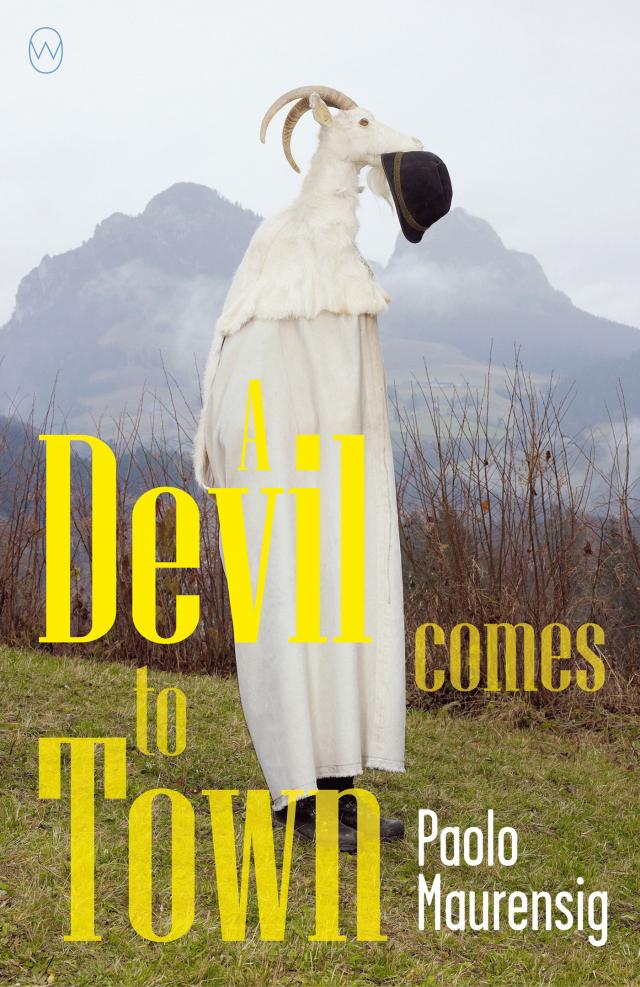
Cover image © Charles Fréger
Author’s portrait © Graziano Arici / agefotostock.com
This book is a work of fiction. Any resemblance to actual persons, living or dead, or actual events is purely coincidental.
Library of Congress Cataloging in Publication Data is available
ISBN Trade paperback 978-1-64286-013-9
ISBN E-book 978-1-64286-032-0
First published as Il diavolo nel cassetto in Italy in 2018 by Einaudi
All rights reserved. No part of this publication may be reproduced, stored in or introduced into a retrieval system, or transmitted, in any form, or by any means (electronic, mechanical, photocopying, recording or otherwise) without the prior written permission of the publisher.
Twitter: @WorldEdBooks
Facebook: WorldEditionsInternationalPublishing
www.worldeditions.org
-
What can prompt us to approach the difficult task of re-examining the many useless items that we’ve accumulated over the years and never found the courage to discard? An upcoming move maybe, or—as in my case—the need to clear out a room, till now a repository for worthless junk, so it could be put to different use. I can’t think of any other reason. Before parting with an object, we think twice about it, and most of the time we choose to keep it, convincing ourselves that it might be useful again in the future. Meanwhile things pile up until we are forced to make a clean sweep. Then we begin a journey back in memory: we browse through our past, we pause to gaze at old photos, to reread letters that we don’t remember having received, books with dedications, manuscripts … and I had stacks and stacks of those: since the publication of a fortuitous novel had afforded me a certain renown, I had become a pole of attraction for aspiring writers. Their manuscripts started coming with impressive regularity, the authors all requesting that I not only read them but give them my authoritative opinion, and possibly introduce them to some publisher, perhaps with the addition of a preface written in my hand. At the beginning I would take the trouble to read the texts through to the end, but I quickly realized that I would never be able to keep up, and that I would be spending most of my time on works of little or no interest. Getting rid of them, however, isn’t so easy: if it already pains me to have to part with an object, no matter how useless it may be, there is a certain regard for the author that each time stops me from disposing of the manuscripts. Consequently, I wanted to make sure I hadn’t made any error of assessment before sending them to be pulped. As I sat there flipping through one manuscript after another, I came across a large manila envelope, still sealed, amply covered by a mosaic of stamps from the Helvetic Confederation. I tore open the flap and found myself holding a text of roughly a hundred typed pages. There was no letter attached, nor was there a sender’s name, or a return address to be traced. Evidently the author wanted to remain anonymous. Or perhaps he meant to reveal himself in the course of the reading.
The title was: The Devil in the Drawer, and it began like this:
I tremble at the mere thought of having set this story on paper. For a long time I held it inside me, but in the end I had to unburden myself from a weight that threatened to compromise my mental equilibrium. Because it is certainly a story leading to the brink of madness. Yet I listened to it through to the end, without ever doubting the words of that man. All the more so because he was a priest.
I can understand that to the reader’s eyes all this has the appearance of a narrative device; literature is full of manuscripts, diaries, letters, and memos found in the most unexpected places and in the most unforeseen ways. But when you think about it, all stories begin by being drafted or printe d on paper; everything we read begins with a ream of sheets, or rather, a manuscript, one of the many that pile up on a publisher’s desk or that of whoever is responsible for reading them for him. There was nothing extraordinary, therefore, in the discovery of this one: that bundle of pages was in the right place, only it had escaped my attention. The only thing strange about it was the anonymity.
The incipit seemed promising. And so, sitting right smack in the middle of all kinds of tattered texts, leaving my clean-up work half finished, I went on reading.
Though the author avoids revealing his name, he nevertheless sets the scene for the beginning of his story by specifying the date and location. It all goes back to September 1991, during a brief stay in Switzerland, specifically in Küsnacht, a small town that overlooks Lake Zurich, where our author traveled to attend a conference on psychoanalysis.
I was there as a consultant for a small publishing house that wanted to include in its catalog a series dedicated to this fascinating as well as controversial subject. Put that way, one might think that I played an important role. In reality, the publishing house belonged to my uncle who, already the owner of a typography shop, after having printed thousands of volumes on behalf of third parties, had been seized by the sudden ambition to become a publisher himself, hiring me more out of familial obligation than for any recognized merits.
A few words to tell us something about himself. He immediately reveals his condition as an orphan: his mother died giving birth to him, his father passed away a few years later, the victim of an accident on the job, and he himself was raised by his paternal uncle. We also discover that he is devoured by a passion for writing, and thanks to these disclosures, we are able to attribute an age to him: rather young, one would say, around twenty-five or thirty. Speaking in the first person, the author has no need to reveal his name, but to avoid unnecessary circumlocutions, I will assign him one. I will call him Friedrich: a name that I feel suggests a pale, blondish, aspiring writer rambling through the valleys of Switzerland.
Speaking of his uncle, Friedrich says and I quote:
Books were the only thing we had in common: he aspired to publish them, I to write them. In fact, I found myself in that blessed larval state that we all pass through as soon as we discover (or delude ourselves) that we are called to one of the arts. For a certain time, I had been the errand boy at a local newspaper in exchange for a wage that was barely enough for cigarettes. I edited the obituary page and occasionally minor news briefs. I had published a short story or two in that paper, just to fill up the page. If there was a scarcity of news and some free space still remaining, the editor-in-chief would then have me dash off a little narrative no longer than 700 words. So, I had never written anything that went beyond the short story, never published except on the pages of that provincial newspaper, but deep within me I nurtured a dream; I endured that fallow period waiting for a seed sown in the ground to sprout, until before long it might reach the size of a lush, fruit-bearing plant.
When I was later hired by my uncle in the publishing house, with the job of reading manuscripts and correcting page proofs, I felt like I had taken a step forward. I lived surrounded by books, breathing in the scent of printers’ ink that to me was as intoxicating as a drug. I assumed the airs of a writer, with a notebook and pencil always in my pocket, ready when needed. I observed people, trying to read in each of them his individual story … and yet I doubted that anyone would ever think of telling it to me someday. In any case, I had a permanent job in a publishing house and, though it was poorly compensated, I held on tightly to it. And this was my first important out-of-town mission. My uncle had assigned me this task thanks to my command of the German language—though it has little similarity to the local parlance.
Carl Gustav Jung had lived and died in Küsnacht, and that year, on the occasion of the thirtieth anniversary of his death, there was a three-day conference that involved experts from all over the world. Listening to the speakers, famous in their circles but to me completely unknown, I might perhaps come upon some text to publish, one not too pretentious, thereby inaugurating the new editorial series. Possibly I would not find anything of interest, and if that were the case—so be it!—I would enjoy a brief vacation at the company’s expense.
I had not thought about booking a hotel, so I had to settle for staying at the Gasthof Adler, a clean, quiet inn, somewhat out of the way. An ideal place to write, I immediately thought—at that time I assessed everything with the eye of an ambitious writer. The inn was a few kilometers from the town center, where the conference was being held in a municipal auditorium. There was a postbus that came by every hour, but even on foot it wasn’t a very long walk, and if you wanted to shorten it, you could take a path that cut through a dense fir wood. The weather was beautiful, the lakeside air invigorated the lungs, and in the sunlight the palettes of the rosebushes that adorned every house—from the villas to the more modest dwellings—were an enchantment for the eyes. So, that morning I had decided to go on foot. I could not yet know that something would soon cloud the idyllic image that I had formed of the place. It was an encounter that took place under peculiar circumstances. I was walking toward town along the path that went through the woods, when all of a sudden I heard a scuffling coming from the underbrush. I stopped, curious. My first thought was that some frightened animal—perhaps a deer—would suddenly dash out in front of me. Instead, I soon saw that it was a man whose body was so enormous that he appeared misshapen. Wearing a split leather smock, he was stumbling through the trees holding a plastic bucket filled with a reddish pulp and flinging handfuls of it on the ground. When he became aware of my presence, he looked up at me: the receding chin and drooping lower lip made me think of a mentally retarded person who had been assigned a task that no one else would want to do. As soon as he saw me, the man waved his arm as if warning me of some danger. What was he trying to tell me with that gesture? I continued along the path gripped by a growing sense of unease, as if I had trespassed on private property. I wanted nothing more than to get away from that place as soon as possible and reach the village. I must have walked a few hundred meters, when I heard the hurried step of someone behind me who was going in my direction. For a moment I thought it was the man I had just seen going through the woods, but the pace was too agile and swift for a person of his girth. I kept going straight and only turned around at the last moment, when the stranger was about to catch up to me. I immediately felt a sense of relief when I saw that it was a priest. A Catholic priest: complete with cassock and wide-brimmed saturn. Small and somewhat bent—just as I had always pictured Father Brown—, he came alongside me with a quick step and, after greeting me briefly, promptly warned me. “Watch out for the foxes,” he said excitedly, “don’t let them come near you: there’s an epidemic of wild rabies going around.” Having said that, he went on his way, quickly leaving me behind before disappearing around the first curve of the winding path. He seemed in such a hurry—as if the devil were literally on his heels—that it made me fearful of imminent danger. I was at the point where the woods grew more dense and the tops of the taller firs obscured the pale disk of the sun. It may have been suggestion caused by that strange warning, but I suddenly felt as if I was about to have a panic attack. I picked up a sturdy dead branch, ready to defend myself if needed, and started running in a vain attempt to reach the priest who, with his sprinter’s pace, had by then vanished. Gradually, however, as the first houses and the dazzling glimmer of the lake appeared through the firs, I regained my control.
Friedrich, therefore, reaches the village, where everyday life unfolds in an orderly and peaceful manner. In the midst of all that normalcy, he smiles at the thought of having been the victim of irrational fear. What has just happened to him seems almost unreal. Soon enough he convinces himself that it was just a trick of the imagination. He enters the conference hall and takes a seat in one of the few chairs still free. For a few minutes he absently follows the talk already underway: a bombastic excursus on Jung’s life. Then, among the numerous bearded professors with their flowing white manes—some with an unlit pipe between their teeth—, he spots the small Catholic priest he’d just met in the woods, sitting a dozen or so rows further up. He soon finds out that the cleric is one of the speakers. When the talk in progress ends, in fact, the priest takes his turn at the lectern. Friedrich consults the program he has in his pocket. It is the last talk of the morning, and will end at noon. At that precise moment the town hall clock strikes ten, and with Swiss punctuality the floor passes to Father Cornelius—that was the priest’s name—whose talk is entitled: “The Devil As Transformist.” So that explained all that hurrying, thinks Friedrich, evidently he was worried about being late for the conference: a failing that the audience members would have considered unforgivable.