

Invaders from space, p.1
Invaders From Space, page 1


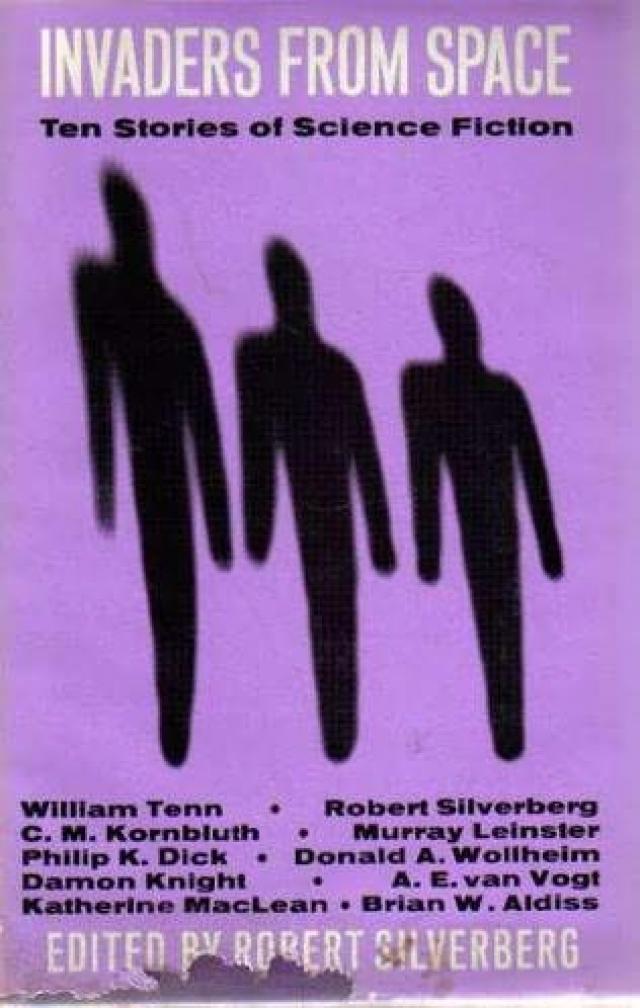
INVADERS FROM SPACE
TEN STORIES OF SCIENCE FICTION
Edited by Robert Silverberg
* * *
HAWTHORN BOOKS, INC. Publishers
New York
Copyright © 1972 by Robert Silverberg.
Copyright under International and Pan-American Copyright Conventions. All rights reserved, including the right to reproduce this book, or portions thereof, in any form, except for the inclusion of brief quotations in a review. All inquiries should be addressed to Hawthorn Books. Inc., 70 Fifth Avenue, New York, New York 10011. This book was manufactured in the United States of America and published simultaneously in Canada by Prentice-Hall of Canada. Limited. 1870 Birchmount Road. Scarborough, Ontario Library of Congress Catalog Card Number 75-179117.
Designed by Ellen E. Cal 23456789 10
ACKNOWLEDGMENTS
“The Liberation of Earth,” by William Tenn, copyright © 1953 by Columbia Publications, Inc. Reprinted by permission of the author and Henry Morrison, Inc., his agents.
“The Silly Season,” by C. M. Kornbluth, copyright © 1950 by Fantasy House, Inc. Reprinted by permission of Robert P. Mills, Ltd., agent for the author’s estate.
“Roog,” by Philip K. Dick, copyright © 1952 by Mercury Press, Inc. Reprinted by permission of the author and his agents, Scott Meredith Literary Agency, Inc.
“Nightwings,” by Robert Silverberg, copyright © 1968 by Galaxy Publishing Corporation. Reprinted by permission of the author and his agents, Scott Meredith Literary Agency, Inc.
“Nobody Saw the Ship,” by Murray Leinster, copyright © 1950 by Columbia Publications, Inc. Reprinted by permission of Scott Meredith Literary Agency, Inc.
“Storm Warning,” by Donald A. Wollheim, copyright © 1942 by Columbia Publications, Inc. Reprinted by permission of the author.
“Catch That Martian,” by Damon Knight, copyright © 1952 by Galaxy Publishing Corporation. Reprinted by permission of the author and his agent, Robert P. Mills, Ltd.
“Resurrection,” by A. E. van Vogt, copyright © 1948 by Street & Smith Publications, Inc., as “The Monster.” Reprinted by arrangement with Forrest J. Ackerman, 915 South Sherbourne Street, Los Angeles, California 90035.
“Pictures Don’t Lie,” by Katherine MacLean, copyright © 1951 by Galaxy Publishing Corporation. Reprinted by permission of the author and her agent, Virginia Kidd.
“Heresies of the Huge God,” by Brian W. Aldiss, copyright © 1966 by Galaxy Publishing Corporation. Reprinted by permission of the author and his agent, A. P. Watt & Son, and Doubleday & Co., from The Moment of Eclipse, published by Faber & Faber Ltd.
Introduction
No theme in science fiction is older than that of travel across space. In the second century A.D., Lucian of Samosata’s True History told of a ship caught by a waterspout in the Atlantic and carried to the moon. Fifteen centuries later, the great astronomer Johannes Kepler sent the hero of his Somnium on another voyage to the moon; Cyrano de Bergerac, later in the seventeenth century, wrote of journeys to the moon and to the sun; and the eighteenth century saw dozens of stories of this sort.
But all the voyagers in these early science-fiction tales were men from Earth venturing to other planets. The opposite idea—that beings from space might come to Earth—was used rarely, if at all. Perhaps this was a product of the medieval belief that Earth was the center of the universe and that man was the summit of creation; until the seventeenth century the notion that there might be intelligent forms of life on other planets was condemned by religious authorities, and therefore dangerous to write about.
One of the first stories of visitors from space was the satirical Micromegas of Voltaire, which appeared in 1752. Voltaire’s Micromegas was a being of giant size, a native of one of the worlds of the solar system of the star Sirius, who came to Earth in the company of a man from Saturn and devoted himself to a study of human foibles. But this playful work was intended solely as social criticism; Voltaire made no attempt to establish the kind of scientific plausibility that a true science-fiction work requires.
Serious use of the invaders-from-space theme dates only from the late nineteenth century; thus it is a relatively modern idea, perhaps reflecting the psychological insecurities of the industrial era. In a world of supermachines, super-weapons, super-problems, super-challenges, is it not reasonable to expect the eventual arrival of a super-enemy, a creature from another planet who threatens to destroy all that man has so painstakingly constructed? Certainly that was the question asked by H. G. Wells, whose War of the Worlds (1895) set the pattern for thousands of space-invasion stories to come. Wells’s tale of intruders from Mars has maintained its power since the day it first appeared. When dramatized for Orson Welles’s famous radio broadcast of 1938, it aroused terror in millions of Americans who mistook it for a news bulletin. The basic theme, transformed by other writers, has never lost its popularity, as the great success of Michael Crichton’s 1969 novel, The Andromeda Strain, has demonstrated.
The book you now hold offers ten stories of invaders from space, chosen to show the range of approach and handling possible within the concept. Some of the stories are terrifying; some are lighthearted. Some of the beings from space are awesome in their might; some are almost lovable. The invaders come in a variety of shapes, sizes, and guises.
The stories, of course, deal only with imaginary events and are intended solely to entertain, for despite all the reports of Unidentified Flying Objects, our planet has yet to receive its first authentic visitor from another world …
… so far as we know.
—Robert Silverberg
* * *
The Liberation of Earth
William Tenn
* * *
Once upon a time “to liberate” was a useful and admirable verb that meant, simply, “to set free.” But during World War II it acquired a darker, more sinister meaning, and “liberation” became something to dread. Herewith William Tenn, science fiction’s supreme master of irony, explores the modern definition of “liberation” on a planet-wide scale.
* * *
This, then, is the story of our liberation. Suck air and grab clusters! Heigh-ho, here is the tale!
August was the month, a Tuesday in August. These words are meaningless now, so far have we progressed; but many things known and discussed by our primitive ancestors, our unliberated, unreconstructed forefathers, are devoid of sense to our free minds. Still the tale must be told, with all of its incredible place-names and vanished points of reference.
Why must it be told? Have any of you a better thing to do? We have water and weeds and lie in a valley of gusts. So rest, relax, and listen! And suck air, suck air!
On a Tuesday in August, the ship appeared in the sky over France in a part of the world then known as Europe. Five miles long the ship was, and word has come down to us that it looked like an enormous silver cigar.
The tale goes on to tell of the panic and consternation among our forefathers when the ship abruptly materialized in the summer-blue sky. How they ran, how they shouted, how they pointed!
How they excitedly notified the United Nations, one of their chiefest institutions, that a strange metal craft: of incredible size had materialized over their land. How they sent an order here to cause military aircraft to surround it with loaded weapons, gave instructions there for hastily grouped scientists, with signalling apparatus, to approach it with friendly gestures. How, under the great ship, men with cameras took pictures of it; men with typewriters wrote stories about it; and men with concessions sold models of it.
All these things did our ancestors, enslaved and unknowing, do.
Then a tremendous slab snapped up in the middle of the ship and the first of the aliens stepped out in the complex tripodal gait that all humans were shortly to know and love so well. He wore a metallic garment to protect him from the effects of our atmospheric peculiarities, a garment of the opaque, loosely folded type that these, the first of our liberators, wore throughout their stay on Earth.
Speaking in a language none could understand, but booming deafeningly through a huge mouth about half-way up his twenty-five feet of height, the alien discoursed for exactly one hour, waited politely for a response when he had finished, and, receiving none, retired into the ship.
That night, the first of our liberation! Or the first of our first liberation, should I say? That night, anyhow! Visualize our ancestors scurrying about their primitive intricacies: playing ice hockey, televising, smashing atoms, Red-baiting, conducting give-away shows, and signing affidavits - all the incredible minutiae that made the olden times such a frightful mass of cumulative detail in which to live - as compared with the breathless and majestic simplicity of the present.
The big question, of course, was - what had the alien said? Had he called on the human race to surrender? Had he announced that he was on a mission of peaceful trade and, having made what he considered a reasonable offer - for, let us say, the north polar ice-cap - politely withdrawn so that we could discuss his terms among ourselves in relative privacy? Or, possibly, had he merely announced that he was the newly appointed ambassador to Earth from a friendly and intelligent race - and would we please direct him to the proper authority so that he might submit his credentials?
Not to know was quite maddening.
Since decision rested with the diplomats, it was the last possibility which was held, very late that night, to be most likely; and early the next morning, accordingly, a delegation from the United Nations wai ted under the belly of the motionless star-ship. The delegation had been instructed to welcome the aliens to the outermost limits of its collective linguistic ability. As an additional earnest of mankind’s friendly intentions, all military craft patrolling the air about the great ship were ordered to carry no more than one atom-bomb in their racks, and to fly a small white flag - along with the UN banner and their own national emblem. Thus did our ancestors face this, the ultimate challenge of history.
When the alien came forth a few hours later, the delegation stepped up to him, bowed, and, in the three official languages of the United Nations - English, French, and Russian - asked him to consider this planet his home. He listened to them gravely, and then launched into his talk of the day before - which was evidently as highly charged with emotion and significance to him as it was completely incomprehensible to the representatives of world government.
Fortunately, a cultivated young Indian member of the secretariat detected a suspicious similarity between the speech of the alien and an obscure Bengali dialect whose anomalies he had once puzzled over. The reason, as we all know now, was that the last time Earth had been visited by aliens of this particular type, humanity’s most advanced civilization lay in a moist valley in Bengal; extensive dictionaries of that language had been written, so that speech with the natives of Earth would present no problem to any subsequent exploring party.
However, I move ahead of my tale, as one who would munch on the succulent roots before the dryer stem. Let me rest and suck air for a moment! Heigh-ho, truly those were tremendous experiences for our kind!
You, sir, now you sit back and listen! You are not yet of an age to Tell the Tale. I remember, well enough do I remember, how my father told it, and his father before him. You will wait your turn as I did; you will listen until too much high land between waterholes blocks me off from life.
Then you may take your place in the juiciest weed patch and, reclining gracefully between sprints, recite the great epic of our liberation to the carelessly exercising young.
Pursuant to the young Hindu’s suggestions, the one professor of comparative linguistics in the world capable of understanding and conversing in this peculiar version of the dead dialect was summoned from an academic convention in New York where he was reading a paper he had been working on for eighteen years: An Initial Study of Apparent Relationships Between Several Past Participles in Ancient Sanscrit and an Equal Number of Noun Substantives in Modern Szechuanese.
Yea, verily, all these things - and more, many more - did our ancestors in their besotted ignorance contrive to do. May we not count our freedoms indeed?
The disgruntled scholar, minus - as he kept insisting bitterly - some of his most essential word lists, was flown by fastest jet to the area south of Nancy which, in those long-ago days, lay in the enormous black shadow of the alien space-ship.
Here he was acquainted with his task by the United Nations delegation, whose nervousness had not been allayed by a new and disconcerting development. Several more aliens had emerged from the ship carrying great quantities of immense, shimmering metal which they proceeded to assemble into something that was obviously a machine -though it was taller than any skyscraper man had ever built, and seemed to make noises to itself like a talkative and sentient creature. The first alien still stood courteously in the neighbourhood of the profusely perspiring diplomats; ever and anon he would go through his little speech again, in a language that had been almost forgotten when the cornerstone of the library of Alexandria was laid. The men from the UN would reply, each one hoping desperately to make up for the alien’s lack of familiarity with his own tongue by such devices as hand-gestures and facial expressions. Much later, a commission of anthropologists and psychologists brilliantly pointed out the difficulties of such physical, gestural communication with creatures possessing - as these aliens did - five manual appendages and a single, unwinking compound eye of the type the insects rejoice in.
The problems and agonies of the professor as he was trundled about the world in the wake of the aliens, trying to amass a usable vocabulary in a language whose peculiarities he could only extrapolate from the limited samples supplied him by one who must inevitably speak it with the most outlandish of foreign accents - these vexations were minor indeed compared to the disquiet felt by the representatives of world government. They beheld the extraterrestrial visitors move every day to a new site on their planet and proceed to assemble there a titanic structure of flickering metal which muttered nostalgically to itself, as if to keep alive the memory of those faraway factories which had given it birth.
True, there was always the alien who would pause in his evidently supervisory labours to release the set little speech; but not even the excellent manners he displayed, in listening to upward of fifty-six replies in as many languages, helped dispel the panic caused whenever a human scientist, investigating the shimmering machines, touched a projecting edge and promptly shrank into a disappearing pinpoint. This, while not a frequent occurrence, happened often enough to cause chronic indigestion and insomnia among human administrators.
Finally, having used up most of his nervous system as fuel, the professor collated enough of the language to make conversation possible. He - and, through him, the world - was thereupon told the following:
The aliens were members of a highly advanced civilization which had spread its culture throughout the entire galaxy. Cognizant of the limitations of the as-yet-under-developed animals who had latterly become dominant upon Earth, they had placed us in a sort of benevolent ostracism. Until either we or our institutions had evolved to a level permitting, say, at least associate membership in the galactic federation (under the sponsoring tutelage, for the first few millennia, of one of the older, more widespread, and more important species in that federation) - until that time, all invasions of our privacy and ignorance - except for a few scientific expeditions conducted under conditions of great secrecy - had been strictly forbidden by universal agreement.
Several individuals who had violated this ruling - at great cost to our racial sanity, and enormous profit to our reigning religions - had been so promptly and severely punished that no known infringements had occurred for some time. Our recent growth-curve had been satisfactory enough to cause hopes that a bare thirty or forty centuries more would suffice to place us on applicant status with the federation.
Unfortunately, the peoples of this stellar community were many, and varied as greatly in their ethical outlook as their biological composition. Quite a few species lagged a considerable social distance behind the Dendi, as our visitors called themselves. One of these, a race of horrible, worm-like organisms known as the Troxxt - almost as advanced technologically as they were retarded in moral development - had suddenly volunteered for the position of sole and absolute ruler of the galaxy. They had seized control of several key suns, with their attendant planetary systems, and, after a calculated decimation of the races thus captured, had announced their intention of punishing with a merciless extinction all species unable to appreciate from these object-lessons the value of unconditional surrender.
In despair, the galactic federation had turned to the Dendi, one of the oldest, most selfless, and yet most powerful of races in civilized space, and commissioned them - as the military arm of the federation - to hunt down the Troxxt, defeat them wherever they had gained illegal suzerainty, and destroy for ever their power to wage war.
This order had come almost too late. Everywhere the Troxxt had gained so much the advantage of attack, that the Dendi were able to contain them only by enormous sacrifice. For centuries now, the conflict had careened across our vast island universe. In the course of it, densely populated planets had been disintegrated; suns had been blasted into novae; and whole groups of stars ground into swirling cosmic dust.
A temporary stalemate had been reached a short while ago, and -reeling and breathless - both sides were using the lull to strengthen weak spots in their perimeter.






