

The hot beat, p.1
The Hot Beat, page 1


Contents
Cover
Raves For the Work of Robert Silverberg!
Some other Hard Case Crime Books you will Enjoy
Title Page
Copyright
Introduction
The Hot Beat
1
2
3
4
5
6
7
8
9
10
11
12
13
14
15
16
17
18
19
20
21
22
23
24
25
Jailbait Girl
Drunken Sailor
Naked in the Lake
Blood on Themink
One
Raves For the Work of
ROBERT SILVERBERG!
“A surefire page-turner.”
—Chicago Sun-Times
“Dazzling.”
—Michael Chabon
“A master of his craft.”
—Los Angeles Times
“Perfect.”
—New York Times
“When Silverberg is at the top of his form, no one is better.”
—George R.R. Martin
“One of the great storytellers of the century.”
—Roger Zelazny
“Ferocious…brilliance comes burning through… Silverberg’s only hallmark is quality.”
—Jonathan Lethem
“Tight and thought-provoking.”
—Locus
“Robert Silverberg’s versatile, skeptical intelligence controls a lavish and splendid imagination.”
—Ursula K. LeGuin
“Grandly sweeping and imaginative…the sure hand of an old master.”
—Publishers Weekly
“A masterpiece when I first read it, and remains a master-piece to this day.”
—Greg Bear
“This is a superb novel about a common human sorrow [by] one of science fiction’s most distinguished writers.”
—Washington Post
“Silverberg is a master.”
—Los Angeles Review of Books
“A joy to read.”
—Booklist
“He has the facility of enveloping the reader in a mood, of capturing his attention until he has quite swept him along, as he says, ‘toward the culminating moment of insight.’ Silverberg performs magic with the medium.”
—St. Louis Post-Dispatch
“One of the finest writers.”
—Philadelphia Inquirer
“Enormously fun.”
—Strange Horizons
“Robert Silverberg is our best.”
—The Magazine of Fantasy and Science Fiction
“Silverberg is a master writer in any genre—and now you’re going to find out why they call them ‘thrillers.’ ”
—John Shirley
He was a young man with good looks—but you had the impression that his looks were fading right before your eyes. The clothes that he was wearing were in the last stages of shabbiness, but they still bore signs that indicated they had been expensive at the outset.
Brady huddled over his drink and listened to the conversation of the young man and the girl, and felt lucky. They were talking about the very thing that had drawn him there that evening. In a way, that was natural enough, not really surprising. The affair was fresh in everyone’s mind.
“I warned Doris,” the drunk was saying, making dreamy circles in the water on the bar. “Not that it makes a damn bit of difference whether you live or die, not a single goddam bit of difference in this filthy kind of world we have to live in. They shovel you into the ground and that’s the end of you, and it don’t matter a damn who you were or what you did. But I warned her anyway. I warned her there’d be a rotten finish waiting for her.” The drunk paused. “You know what? She’s better off dead.”
“What the hell do you know about it?” the girl asked.
The drunk scowled. “I know it’s no good. Oh, it’s all right when you’ve had everything else and hit the skids. Then you’ve got nothing to live for anyway.”
“Like you, for instance,” the girl jeered.
The drunk wasn’t offended. “That’s right,” he agreed, his voice thick. “Like me. For me that would have been just fine. I’d have been a stand-in for her if the guy had asked me. All he had to do was come to me and say, I’m gonna kill somebody, bud, and you want it to be you or this girl here? And I’d have said kill me, I’m no use for anything, let the girl live. She’s still got time to pull herself outa the mud…”
SOME OTHER HARD CASE CRIME BOOKS YOU WILL ENJOY :
LATER by Stephen King
BLOOD ON THE MINK by Robert Silverberg
THE COCKTAIL WAITRESS by James M. Cain
THE TWENTY-YEAR DEATH by Ariel S. Winter
BRAINQUAKE by Samuel Fuller
EASY DEATH by Daniel Boyd
THIEVES FALL OUT by Gore Vidal
SO NUDE, SO DEAD by Ed McBain
THE GIRL WITH THE DEEP BLUE EYES by Lawrence Block
QUARRY by Max Allan Collins
SOHO SINS by Richard Vine
THE KNIFE SLIPPED by Erle Stanley Gardner
SNATCH by Gregory Mcdonald
THE LAST STAND by Mickey Spillane
UNDERSTUDY FOR DEATH by Charles Willeford
CHARLESGATE CONFIDENTIAL by Scott Von Doviak
SO MANY DOORS by Oakley Hall
A BLOODY BUSINESS by Dylan Struzan
THE TRIUMPH OF THE SPIDER MONKEY by Joyce Carol Oates
BLOOD SUGAR by Daniel Kraus
ARE SNAKES NECESSARY? by Brian De Palma and Susan Lehman
KILLER, COME BACK TO ME by Ray Bradbury
FIVE DECEMBERS by James Kestrel
CALL ME A CAB by Donald E. Westlake
THE NEXT TIME I DIE by Jason Starr
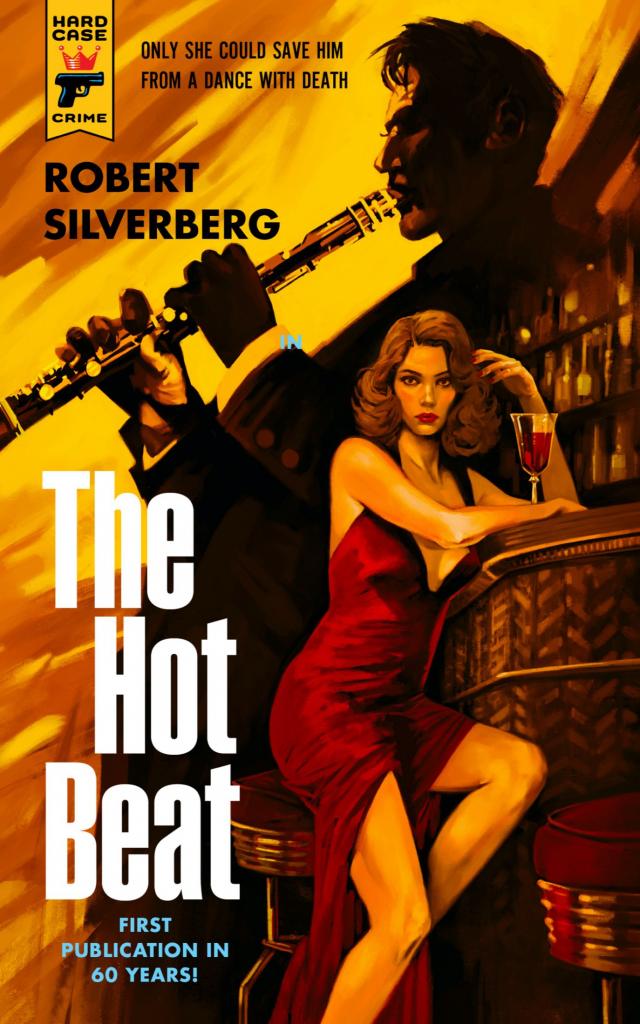
The
HOT BEAT
by Robert Silverberg
Leave Us a Review
We hope you enjoy this book – if you did we would really appreciate it if you can write a short review. Your ratings really make a difference for the authors, helping the books you love reach more people.
You can rate this book, or leave a short review here:
Amazon.com,
Amazon.co.uk,
Goodreads,
Barnes & Noble,
Waterstones,
or your preferred retailer.
A HARD CASE CRIME BOOK
(HCC-155)
First Hard Case Crime edition: September 2022
Published by
Titan Books
A division of Titan Publishing Group Ltd
144 Southwark Street
London SE1 0UP
in collaboration with Winterfall LLC
Introduction copyright © 2021 by Agberg Ltd.;
The Hot Beat copyright © 1960 by Agberg Ltd.;
“Jailbait Girl” copyright © 1959 by Agberg Ltd.;
“Drunken Sailor” and “Naked in the Lake”
copyright © 1958 by Agberg Ltd.
Cover painting copyright © 2022 by Claudia Caranfa
All rights reserved. No part of this book may be reproduced or transmitted in any form or by any electronic or mechanical means, including photocopying, recording or by any information storage and retrieval system, without the written permission of the publisher, except where permitted by law.
This book is a work of fiction. Names, characters, places, and incidents either are the products of the author’s imagination or are used fictitiously, and any resemblance to actual events or persons, living or dead, is entirely coincidental.
Print edition ISBN 978-1-78909-992-8
E-book ISBN 978-1-78909-993-5
Design direction by Max Phillips
www.maxphillips.net
Typeset by Swordsmith Productions
The name “Hard Case Crime” and the Hard Case Crime logo are trademarks of Winterfall LLC. Hard Case Crime books are selected and edited by Charles Ardai.
Visit us on the web at www.HardCaseCrime.com
Introduction
I loved science fiction from the time I discovered Planet Comics, when I was seven years old, in the early months of World War II. I wanted to read all I could find about other worlds, voyages in time, strange alien beings. When I was a little older, and more interested in prose fiction than in comic books, I moved along to Jules Verne and H.G. Wells, and then to such science-fiction magazines as Astounding Science Fiction and Amazing Stories, which had gaudy, even embarrassing names, but provided me with an abundant supply of the fiction I most enjoyed. And, of course, since I had manifested a knack for words ever since I was a small boy, I wanted to write science fiction myself.
I wrote my first s-f story when I was thirteen or so—it was quite terrible—and went on writing them, and started to send them to the magazines I had been reading. I got them all back very swiftly, but once the editors figured out that they were dealing with a fairly talented boy rather than a demented adult, they sent me little notes of encouragement with each rejection, urging me to keep at it, study my craft, persevere in my ambition. Which I did, and when I was seventeen a magazine sent me a check instead of a rejection letter, and I was off and running as a science-fiction writer, just as I had dreamed of being since my earliest teens.
From 1955, when I was still in college, to 1 959, I wrote one story after another, and sold them all, to Astounding and Amazing, to Fantastic Universe, to If, to Infinity, to all the science-fiction magazines of the day. It was a marvelous beginning to my career, and I never even thought of getting a real-world job when I graduated from college: I simply stayed home, wrote stories as fast as I could, filled whole magazines with my output. It was great while it lasted. But it didn’t last.
There was a big upheaval in the business of magazine distribution in 1958, and many of the magazines I had been writing for suddenly went out of business. I hung on as a full-time science-fiction writer as long as I could, but after a time there weren’t enough magazines left to support a prolific writer like me. I hunted around for new markets. One of my best s-f markets had been a magazine called Super Science Fiction, which began publication in 1956 under the editorship of an old-time magazine guy named W.W. Scott who cheerfully admitted that he knew nothing about science fiction, and, after I got to know him, asked me to help him out by doing a lot of stories for him. I was happy to oblige, and he bought every one, and gradually, as the s-f market started to vanish, I began writing for Trapped and Guilty, two magazines of crime fiction that he also edited. I had never been much of a reader of crime stories, unless you count the Sherlock Holmes stories, but I discovered that I had a knack for it and very quickly I was writing two and three stories an issue for Trapped and Guilty.
From there it was an easy jump to think about writing crime novels. During my time as a full-time science-fiction writer I had written half a dozen novels for Ace Books, edited by Donald A. Wollheim, and although Ace’s s-f line was still going strong, I thought of branching out and doing crime novels for Wollheim’s parallel line of mystery books. I proposed one for him, but he had plenty of good crime novelists in his stable and wanted me to stick to my established metier of science fiction.
During that time of professional uncertainty, though, I had begun writing for just about any market I could find, which included the booming men’s-magazine market, publications with names like Rogue and Venus and Mermaid. One of them, Exotic Adventures, I wrote practically single-handed, four or five stories an issue, and when its publisher decided to branch out into paperback books, I was invited to write some for their newly launched Chariot Books and Magnet Books, at a fee of a thousand dollars a book, quite handsome for those days, when a dollar bought as much as ten or fifteen of our modern ones do. And so, in the spring of 1960, I wrote The Hot Beat for Magnet Books, a tale of urban low-life very far from my science-fiction roots but not all that different from the crime stories I had been doing for Trapped and Guilty.
As it happened, my career in noir fiction was a short one—I wrote two or three others, and then started writing non-fiction books on archaeological subjects that met with considerable success, and by 1965, as the science-fiction market returned to life, I wrote a couple of s-f stories at the invitation of a friend who was now editing one of the magazines, and wrote a couple more, and by and by found myself back to my first love, a full-time science-fiction writer again, which I remained until, having reached the age of three score and ten and then some, I chose to rest on my laurels and retire as a writer.
Much to my surprise, the old books, one by one, are finding a new existence in this new century. Nearly everything I wrote sixty-odd years ago has come back into print, even unto the stories for Trapped and Guilty, and even unto my long-forgotten Magnet book of 1960, The Hot Beat, now entering a new incarnation here in a time I once regarded as the far future.
Robert Silverberg
August, 2021
THE HOT BEAT
1
Just before midnight the thin December fog came slithering down from the hills to the city streets and spread a sickly haze over the ugliness of South Main Street. It left a film over the darkened store windows, and brought enough damp cold to make the tinny saloons which dotted the neighborhood look warm and cheerful.
The business curve of the fifteen-cent flophouses took a big upward swing. It figured. The stink and vermin of the cheap beds were lesser evils than the chill rawness of the Plaza benches.
The bums and floaters who had panhandled the price in the course of the day disappeared into the murky halls and up the creaking wooden stairs of a dozen of these rat traps. The others just continued on their way, wandering aimlessly.
Detective Sergeant Brady of the downtown station stopped to light a cigarette before he went into Carrol’s Bar and Grill. With a cigarette dangling between his lips, he might possibly be able to affect a sort of casualness that could help to disguise somehow the cop which otherwise stood out glaringly all over him.
He cupped the cigarette in his hand, shielding the match against the cold wet wind. While he paused there, outside Carrol’s, a middle-aged, stubbly faced tramp in a broad-brimmed Western hat came shambling up, already going into his spiel when he was five feet away.
“It’s a lousy night, mister, and you look like you could spare it. Only a dime. Only a dime for one lousy cuppa coffee.”
“On your way,” Brady muttered. The panhandler seemed to shrink back into the darkness. Brady pushed the blue enameled door open and walked in.
The saloon was crowded.
Small parties of men and women sat in the booths near the wall, talking and laughing noisily. A row of broken-down men sat lined along the bar—drunks in varying stages of cheer and despondency.
Five B-girls in cheap evening gowns sat on the high stools scattered down the length of the bar. The deep necks of their gowns revealed their breasts—some big, others scrawny. The men clustered about the five allowing the bartender to refill their glasses before their drinks were half finished. Down at the end of the bar, one of the drunks was trying to put his hand in one of the girls’ dress-fronts. He got a good squeeze of a breast that had seen better days before, giggling and squealing shrilly, the girl pushed him away.
At the farthest end of the room, Sergeant Brady saw Carrol, the proprietor, leaning against the big, shiny record player. The juke was going full blast. Carrol glanced solemnly at Brady, his face not displaying the faintest show of recognition. He covered his wide mouth with the hand that had been supporting his chin, and watched as Brady squeezed in between two customers at the bar.
The man on Brady’s right had one of the stools. He was fat and sweaty-smelling, and he dawdled half asleep over his drink. The man on Brady’s left waved his hands about in vivid gestures as he spoke. He was talking to the red-haired B-girl next to him. The girl was the youngest of the five, and the open front of her gown revealed firm, creamy young breasts that hadn’t yet acquired the B-girl sag.
He was a young man with good looks—but you had the impression that his looks were fading right before your eyes. A shock of straight blond hair fell across his forehead as he shook his besotted head. The clothes that he was wearing were in the last stages of shabbiness, but they still bore signs that indicated they had been expensive at the outset.
Brady huddled over his drink and listened to the conversation of the young man and the girl, and felt lucky. They were talking about the very thing that had drawn him there that evening. In a way, that was natural enough, not really surprising. The affair was fresh in everyone’s mind, and Brady had counted on Carrol and the girls to steer the talk around it. Brady looked the man over from the corner of his eye.
“I warned Doris,” the drunk was saying, making dreamy circles in the water on the bar. He shrugged sadly, his face taking on a bleary-eyed but philosophical expression. “Not that it makes a damn bit of difference whether you live or die, you know that? Not a single goddam bit of difference in this filthy kind of world we have to live in. They shovel you into the ground and that’s the end of you, and it don’t matter a damn who you were or what you did.” He paused to belch. “No, it don’t matter. But I warned her anyway. I warned her there’d be a rotten finish waiting for her if she didn’t pack up and go home.” He waved his hand again. “What kind of a life was that for a girl with her looks anyway? Selling her rear like a cheap floozie. Hell,” he finished, “you know what? She’s better off dead.”
“What the hell do you know about it?” the girl asked in a surly voice.






