

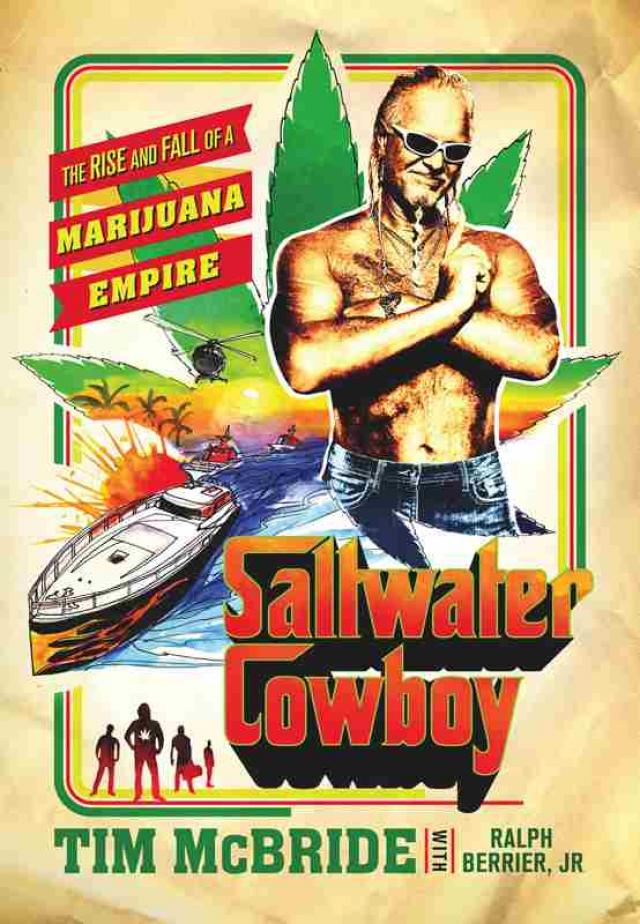
Saltwater cowboy, p.1
Saltwater Cowboy, page 1


Begin Reading
Table of Contents
About the Authors
Photos
Copyright Page
Thank you for buying this
St. Martin’s Press ebook.
To receive special offers, bonus content,
and info on new releases and other great reads,
sign up for our newsletters.
Or visit us online at
us.macmillan.com/newslettersignup
For email updates on the author, click here.
The author and publisher have provided this e-book to you for your personal use only. You may not make this e-book publicly available in any way. Copyright infringement is against the law. If you believe the copy of this e-book you are reading infringes on the author’s copyright, please notify the publisher at: us.macmillanusa.com/piracy.
To my son, Dalton, and my daughter, Kaila, this is who I am, and this is your legacy. You guys are and have been that which drives me every day, and you are the only two loves of my life.
To my father, Jack, who now watches over me from a silvery-lined cloud, I’m sorry I made you cry.
To my brother Pat, who I’m sure is standing next to Dad, telling him a joke, I now whisper into your ear, “I miss you, brother.”
To my brother Mike, though we’ve been separated by vast distances our entire lives and though keeping in touch has never been either of our strong suits, please know that throughout the years I never lost sight of the fact that I have an amazing big brother, and he’s always been just a phone call away.
To my mother, Dee, I’m sorry that if by my life’s experiences I’ve caused your hair to turn prematurely gray. When I hopped into my Mustang and went south, my intentions were no different from those of any other young man. I left home to simply seek out a place in this world where I could stamp my mark. Thanks to you and Dad, I’ve lived my independent life by the seat of my pants and that philosophy of child rearing has set me on this path toward what I now know has been my first, best destiny.
To Tim Healy, for being the first to champion my story and for passing it on to Peter.
To Peter McGuigan and his family at Foundry Literary + Media, thank you for introducing my story to the world.
To my pals Ralph and Casey, thank you for guiding and governing my writing.
PROLOGUE
The Gulf of Mexico smelled like cow shit.
Twice I drew in deep breaths because I didn’t immediately recognize the odor. Cow shit? Out here on the open water?
I could see the cargo ship’s silhouette as the giant orange sun sank toward the horizon. Then I heard them, bellowing, lowing. I couldn’t believe it. The ship’s stern gates were open, and the crew was using cattle prods to stampede an entire herd of cows into the Gulf of Mexico.
As our crab boat drew closer, the putrid smell of manure swamped us. Cows thrashed in the water, snorting, gasping, and groaning in panic as they climbed on top of one another, trying to keep their heads above water, their eyes rolled at the sky. Clark and I were too stunned to process what was happening. A herd of animals was drowning right in front of us. But as shocked as were, we knew we had a job to do. The cows were in the way.
As the ship’s three-man crew looked down on us from the now empty deck, Clark and I tossed our lines at them to tie us off. I singled out the one who appeared to be in charge. He leaned against the rail, peeling an orange, so I hollered up at him, “What the fuck are you doing?”
He yelled back down to me matter-of-factly, with a Cajun accent, “I can’t get the shit out of the hold with all these fucking cows in the way!”
The cows tried to herd together, mooing frantically with nowhere to go. They started sinking under, one after another. I freaked out a little until Captain Red put a calming hand on my shoulder.
“I told you that you wouldn’t believe it,” Red said solemnly as he turned away and walked the deck to the wheelhouse. The hard-bitten captain had known this stampede was coming, but that didn’t mean he was cool with it.
The crew began throwing bales of marijuana down to us, ignoring the hopeless beasts. As the bales rained down, my buddy Clark and I stacked them forward, toward the wheelhouse. They were what we described as pillow bales, big plastic bags stuffed with merchandise inside burlap sacks, the ends stitched closed with twine. They weren’t too heavy, but they were bulky, hard to carry, and took up a lot of space. Plus, some of the bales had already split and were spilling everywhere.
Behind us, another crab boat, our partner in this operation, plowed through a watery field of doomed cows. I watched as the animals banged their heads, horns, and hooves against the hull. As the crew pulled alongside us, no words were spoken. The looks on their faces said everything: What the fuck was that?
I looked at Clark. Loose shake covered his red hair and fair skin, turning his face bronze from resin dust. His cheeks looked like a pair of hamburger buns from all the pot seeds that had stuck to them. I started laughing. He took a look at my pot-covered visage and laughed for the same reason. We needed to laugh. This had been one strange night.
As the deck rapidly filled to capacity, we realized that we would need a different strategy if we were going to fit the ever-growing load onto our two boats and get it to shore. Captain Red maneuvered the boat so we could pile more bales onto the bow—and then on the roof of the wheelhouse around the radar array, and finally on top of the stern canopy that shaded us from the intense Florida sun.
The first stars of the Milky Way smoldered by the time we cast off from the cargo ship. The only parts of our boat that showed from beneath the mounds of bales were our front and side windows and the radar towers spinning overhead. We must have looked like a floating hay wagon.
I could not shake the image of drowning cows as we made the forty-mile run to shore. I looked back and caught a last glimpse of the cargo ship, which I imagined was heading south back to Colombia for another load of bales. And maybe another load of cattle, too.
I learned two things that night:
No. 1: Cows can’t fucking swim.
No. 2: A million-and-a-half-dollar payday for a captain and crew was painfully and obviously worth more than a whole boatload of cattle.
* * *
It was our tradition: on the trip back, we took time to sample the goods. But on this trip none of us had brought a pack of rolling papers or a pipe, and not one of us had a match or a lighter to light the shit, even if we had. You would think a pot hauler would have these things. So we did the next best thing: we improvised by clearing off one of the deck hatches in the stern and placing a couple of handfuls of weed on top. Clearing the spot took a while because the shit was piled everywhere. But we then stripped the wire from one of our fish boxes and touched each end to the positive and negative posts of a twelve-volt battery that the captain kept in the wheelhouse. By doing this we produced a red-hot glow in the wire’s center. Then, you simply touched glowing wire to the weed until it sparked. Clark blew on it like a Boy Scout making a campfire. When smoke began to billow, he held an empty five-gallon bucket upside down over the burning weed and let it fill up with the intoxicating cloud. When the bucket was full, we took turns placing it over one another’s head. Our method was crude but very effective.
Having sampled the merchandise, we told the guys onshore how good it was. They kept a stash for themselves and put one aside for us. It wasn’t a good idea to keep our own stash on board. We had to make sure that the boat was totally clean. When the off-load was complete, we steered a course back offshore to shovel the excess into piles and toss it overboard. Scrubbing the boat down from top to bottom was a meticulous and time-consuming task. Not a trace could be left anywhere on the boat.
After another job well done, the captain set a course for one of our trap lines and dropped anchor next to the end buoy. We really ran a crab boat after all. Part of the time, anyway. It was time to get some sleep. Later that morning, as the sun came up, we pulled that line of crab traps, then came in and unloaded our catch as if we had done two days of fishing.
* * *
I was right in assuming that our South American friends would come back with more. About two weeks later, we were off to haul again, and it turned out to be the same ship and crew. This time we were ready for the messy, loosely packed bales. Captain Red instructed us to line the entire deck with rolls of plastic and duct tape in order to make the cleanup process easier. After all, if we should happen to be boarded and searched later that night, a single seed could mean the difference between serving time and getting away unscathed.
Our two boats approached the ship the same way as before, except this time I noticed something different. This ship wasn’t just carrying a herd of cattle. This time the SS Ol’ McDonald had a variety of animals on board. Goats, pigs, a barking beagle in the wheelhouse window, and a dozen or so small monkeys scrambled over the deck. Later, I learned that monkeys liked getting fucked up on pot seeds and loose buds. They’d taken a nap among the bales when the ship was docked in South America and awakened as stowaways in the Gulf of Mexico.
When the stern gates opened in preparation for the off-load, those goddamn monkeys started freaking out and screaming, like they knew the stampede was coming. They took off climbing to the highest parts of the ship, all in a panic. They were on the bow and on top of the wheelhouse, and some were climbing the ship’s radio antennas. Three of the little shits fought for the last space on the ship’s light mast, alongside six others. I looked over at the wheelhouse just in time to see the be agle as it kept several of those critters at bay near an open window. Just behind that barking dog, the ship’s captain kicked three monkeys out the door, screaming at them as he slammed it shut.
“God damn it … Get outta here you little motherfuckers!”
It was the funniest damn thing I’d seen in a while. Then, I saw the cows, doomed to their fate. Their asses would walk the plank.
After we got the load on board, Captain Red hollered up to the ship’s crew.
“That’s enough of this shit. You need to find a different way to do this or don’t fuckin’ come back!”
He climbed over the mountain of bales and made his way back to the wheelhouse. Inside, he rammed the throttle to full and the giant engine came to life with a muffled roar, belching plumes of black exhaust from the stern. As we pulled away, the thick cloud swept across the ship’s now barren deck and draped all three of its crew in a fitting black shroud. Red was pissed, and we had his back. There was just too much work available and too many other willing captains and crews for us to be screwing around with clowns like those guys. These bastards just weren’t seeing the big picture. Watching those cows drown was bad enough—what if they washed up on shore? I mean, it’s one thing to be walking along the beach on a bright sunny day collecting seashells and you trip and fall over a dead fish. But it’s a totally different thing to trip and fall over a fucking dead cow. It just ain’t natural. Dead cows on the beaches of southwest Florida would be pretty suspicious in the eyes of the law.
When we got back to off-load the pot and I told the guys onshore that another load of cows just went to the Great Roundup at the bottom of the Gulf, they could hardly believe it. They had a good laugh at our expense, but I didn’t care. I got paid $50,000 for each of those hauls.
From that night on, whenever our boat went out to bring back another load of marijuana, the guys had a name for us. We were the Saltwater Cowboys.
CHAPTER ONE
After a three-hour workout, I tossed a towel over my shoulder, picked up my water jug, and went for a walk to cool down.
Finding an empty bench was rare at that time of the evening, so when I saw one, I sat down for a while. I took off my shoes and socks, and I stretched my legs out so I could feel the cool grass under my bare feet. I sat there with each arm over the back of the bench and my head tilted back toward the evening sky.
Hearing the activities of others around me gave me a measure of contentment. There was the ricochet of a racquetball being struck, the ringing bang of a bouncing basketball, squeaking shoes as players ran up and down the court. I closed my eyes. I could hear an occasional jogger go past and birds singing as they prepared to roost for the night in one of the five trees in the yard. I opened my eyes in time to catch a glimpse of a moth drawn to the lights that had come on. It struggled against the same cool breeze that was drying the perspiration from my body.
This might sound like any of a thousand parks and any one of a million park benches in America. But this was the upper compound rec yard of the federal correctional institution in Tallahassee, Florida, and I was sharing it with 1,100 other convicted felons. It was 1991, I was the property of the US federal government, prisoner identification number 09498-018, and I was in hell.
I’d been here three years, and it was still hard for me to get used to the idea that I had seven more to do. It is a dose of harsh reality when you come to the realization that the world as you once knew it doesn’t exist anymore. My whole world now was a little patch of land surrounded by two fences, separated by a twenty-foot stretch of land filled with razor wire, referred to as no-man’s-land.
Every one hundred yards or so, those two fences met up with a concrete and brick structure that stood roughly fifty feet tall. Those were the half dozen or so gun towers. Behind the mirrored glass inside each tower were two armed guards standing vigil, their rifles in hand, just waiting to put a hole in your head should you decide to try your luck and make a break for home. If you were lucky enough to somehow make it past the interior fence, no-man’s-land, and the exterior fence, you would surely be met by one of the two vehicles circling outside. Twenty-four hours a day, seven days a week, and three hundred and sixty-five days a year, those sentinels stood ready with their dogs and their rifles. The guards controlled the convicts’ movements. That’s what they called it—“controlled movement.” They told us when to get up, when to eat, went to move from one area of the prison to another, when to piss, and when to sleep.
You see, there were only two ways for us convicts to get out of there. You either did your time like a good con, or you died. In a sense we were all castaways sharing the same desert island. Eating together, sleeping together, and growing older together.
That said, the most difficult obstacle wasn’t the lack of control. It was the terrible feeling of loneliness and yet never being alone.
The time was nine thirty p.m., and over the intercom came those all-too-familiar words:
“Lockdown … Lockdown … All inmates return to your unit and prepare for ten o’clock count.”
Everything began to wind down. All 1,100 of us would soon be locked into our units. I got out of my sweaty clothes and took a quick shower, then stood around bullshitting with a few guys near my cubicle.
Ten o’clock came and two guards approached. One remained at the door while the other shouted, “Stand next to your bunk, ladies, and shut up … It’s count time!”
So we all stood up straight next to our bunks, and one by one we were counted, like cattle in a pen. The first guard to do the counting must have been a fucking moron or something because when he did his count, he would take a bean from one pocket and put it in the other for every con he counted. After completing his round, the second guard would repeat this process. Only difference was that this guy could remember his count. Afterward we were left standing there while he helped the dumbass figure out how many beans he had in his fucking pocket. When the count was done, the guards would leave and lock us in for the night. We would now have one hour to do whatever we cared to do until lights-out.
Every night at that exact same time, my buddy George and I played as many hands of gin rummy as we could until lights-out. George lived about eight cubicles away from me. I knew that he was locked up because he’d been a bank robber, and he knew that I was in for drug smuggling. But it was the kind of secondhand knowledge that was rarely, if ever, discussed. He was a man of many years—and by “many years,” I don’t mean just that he was in his mid- to late sixties. I mean that he had been there for twenty-eight years before I met him.
George was a kind man and very soft-spoken. When he did speak, it was with a slow Southern drawl. He stood only about five foot six, with a thin face and piercing green eyes. His brown hair was streaked with silver, and he liked to comb it straight back. He was like a father to me. Of course I had a real father, but that was in another life, in an alternate reality.
We could talk about anything, George and I, especially when one of us was having a bad day. Those days didn’t often happen, but when they did, they were very emotional. You constantly trained your mind to leave your old life behind in order to live the new prison life that was ahead of you. But sometimes your mind just couldn’t help but drift beyond those fences. You started thinking about how good it felt to be free. My friendship with George was a special one. We helped each other stay behind the fences. It was the kind of bond that is virtually impossible to achieve in the outside world—and often the only thing that allows you to keep your sanity in a world where insanity reigns. Playing cards was a ritual that helped get us through. We talked about what went on that day. Who got busted, who got his ass kicked. Any other prison bullshit.
But George must have been in a pensive mood that night because he asked me a question we’d avoided over the preceding years. It was the same question I had asked myself dozens of times after lockdown, as I lay on my bunk and stared at the ceiling. A question that, for no matter how long I considered it, I could never answer.
“Timmy, how in hell did you wind up here, anyway?”






