Lure, p.1
Lure, page 1


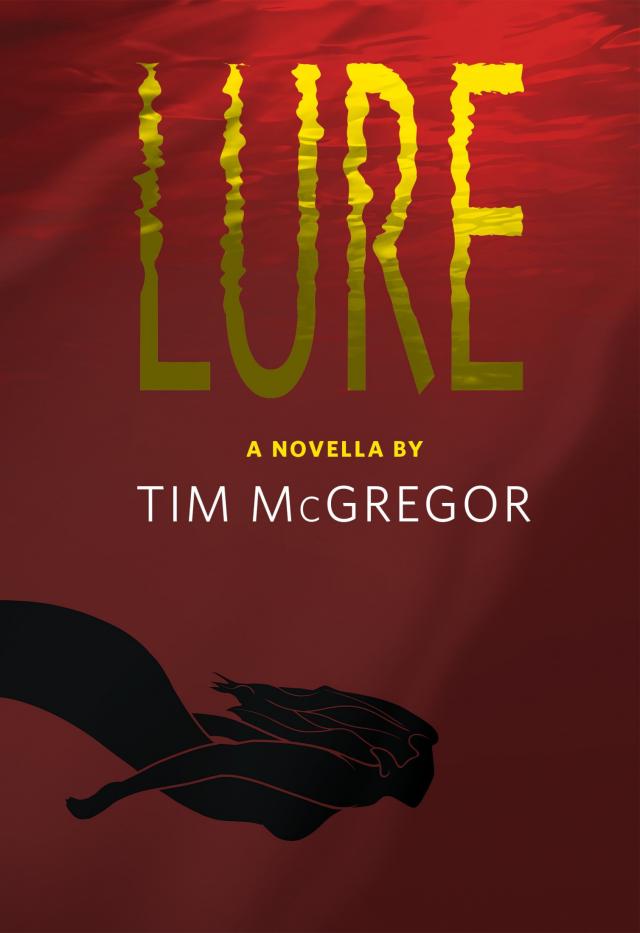
Lure © 2022 by Tim McGregor and Tenebrous Press
All rights reserved. No parts of this publication may be reproduced, distributed or transmitted in any form by any means, except for brief excerpts for the purpose of review, without the prior written consent of the owner. All inquiries should be addressed to tenebrouspress@gmail.com.
Production of this novel was made possible in part by a grant from the Regional Arts & Culture Council.
Visit https://racc.org/ for more information.
Published by Tenebrous Press.
Visit our website at www.tenebrouspress.com.
First Printing, July 2022.
The characters and events portrayed in this work are fictitious. Any similarity to real persons, living or dead, is coincidental and not intended by the author.
ISBN: 978-1-7379823-0-2
eBook ISBN: 978-1-7379823-1-9
Cover illustration by Matt Blairstone.
Interior illustrations by Kelly Williams.
Edited by Alex Woodroe and Matt Blairstone.
Formatting by Lori Michelle.
Printed in the United States of America.
ALSO FROM TENEBROUS PRESS:
Green Inferno: The World Celebrates Your Demise edited by Matt Blairstone
In Somnio: A Collection of Modern Gothic Horror edited by Alex Woodroe
Your Body is Not Your Body edited by Alex Woodroe and Matt Blairstone
One Hand to Hold, One Hand to Carve by M.Shaw
COMING SOON:
Crom Cruach a novella by Valkyrie Loughcrewe
1
THE SEA MONSTER measures forty-six hands across. Its bones hang on the wall in our church, spanning the length of the chancel. According to legend, it is over nine hundred years old. The tail is enormous, like that of some titanic serpent, but the fore end is a hodgepodge of mismatched anatomy. The skull is human, as are the ribs and arms, but there is also the dried baleen of a whale and the bill of a swordfish incorporated into its frame. It is ghastly looking, but impressive.
It’s also very dusty.
“When was the last time this relic was cleaned, do you suppose?” my father says. It is his church now. He is the Reverend Uriah Lensman, pastor here for the last five years.
Father cranes his long neck to look up at the garish relic suspended on the stone wall, a good three fathoms above the floor, blackened with soot from a thousand years of burning candles. It hovers above the icon of our holy creator, the One True God. As far as I know, ours is the only church in the realm to shelter the bones of a monster.
“I don’t think it’s ever been cleaned,” I reply. “The damned thing is so old it might fall apart if I try dusting it.”
“Language, Kaspar, please,” he sighs. “Here of all places.”
An old complaint. My mouth often runs faster than my brains. “Sorry, father.”
My name is Kaspar Lensman. I am fifteen years. My sister, Bryndis, is seventeen. Pip is eleven, and his nose has never stopped running. His full name is Pitr, but no one calls him that. Mother is dead.
Father lays a ribbon to mark his place and closes the parish registry. Yesterday’s birth has been added to the ledger. Another boy. “Fetch the ladder,” he says. “See what you can do about it. Have you been down to the pier yet?”
“No. The fishermen won’t be back yet.”
“Well, don’t wait to long,” he grumbles. “You need to be there when they return, otherwise they’ll cheat us out of our supper.”
The pier is the last place I want to go. It’s not even my duty to perform, but Father insists he is too busy to collect the tithe from the townsfolk. Liar. “Yes, sir.”
Father steps away and crosses to the side door that leads to the rectory, where we live. “Leandra said her husband netted a seal pup yesterday. What I wouldn’t give for a taste of red meat. Or anything besides codfish.”
“I thought it was bad luck to eat seal.”
“Says the man who fails to catch one,” he replies as he goes out the door. The Reverend Uriah thinks of himself as a man of high wit, but I have yet to hear anyone laugh at his quips. He believes this is because of his intellect and education, but in truth, he is simply a humorless, taciturn man. A man of the true faith, not of the people, as he often reminds me.
The ladder is a wobbly thing that looks as old as the church itself. Climbing up, I pray it doesn’t snap under me as I dab the bones with a damp rag. Up close, I can see how the sea monster is constructed; the various bones are lashed together with twine or fastened with penny nails. A patchwork of misaligned bone and tooth, fused together to form this bizarre holy relic.
How in the world did the carcass of a monster come to hang inside the church? The story, as it’s been told to me, hearkens back to the very founding of this village here on the craggy coast. A long, long time ago, this squalid settlement was bedeviled by a monster from the sea depths. It snatched men from their skiffs and slithered ashore to devour women and children in their sod huts. It ravaged the goats and swallowed horses whole. The old wives claimed that the beast, having had a taste of warm blood with that first unlucky fisherman, wanted no more cold fish from the sea. It lusted then for the creatures of dry land, especially those that strode on two legs.
The peasant folk prayed to the old gods of the sea to save them, but they were dead and could not hear their cries. In desperation, some turned their backs on the old ways and lifted their prayers to the heavens and to the sun and to whatever could hear them. Behold, one soul, one righteous heart, heard their lamentations and came riding out of the mountain in the sky on a great steed that blew flames from its nostrils. A hero named Torgrim the Unbending, holding high a sword forged in the furnace of the sun itself. Its steel was lit with holy fire and it thirsted hungrily for the blood of the wicked and the heathen alike. The hero charged his horse through the sea foam and dared the monster to challenge him. The sea churned and chopped, and the great serpent lunged for the man who dared defy it. Torgrim the Unbending smote the beast with his flaming sword, cleaving the monster in two. The beast writhed on the pebbly beach, smoking from the holy flame as the blade drank its blood. The grateful pagans lifted the hero on their shoulders, proclaimed him king, and adopted his faith of the one true God.
Or so the legend tells. I laughed when I first heard the tale, which did not endear me to the locals. A gaffe, which only caused the villagers to dislike us even more when my father became pastor to this far-flung parish. Half the people in the village claim to be direct descendants of this noble hero, which explains the number of men named Torgu or the daughters named Torga.
I am the only Kaspar in town. Most snicker at my name behind my back. A few do it to my face. Fitting in has not been easy. We will always be outsiders, my family and I.
2
BEFORE HEADING TO the pier to collect the tithe, I decide to check my own traps. With any luck there will be a crab or maybe a few cod, which will allow me to skip the tithing altogether. I hate having to beg the fishermen. And they hate me for it in return.
A set of worn stone steps lead down to the church crypt, where the former reverends and the prominent men of the village are interred. The stone walls here are cold and always damp with saltwater. The church was built on the cliffside over the sea, with the crypt chiseled out of the rock. Another passageway leads from the tombs down to a wooden hut on the sea. My traps are tethered here, strung down into the dark water, and baited with a few dinner scraps.
Hauling both traps out of the water proves disappointing. The bait is gone, but no crabs or fish have been captured. These creatures are wily, having figured out how to nip the bait without being snared. I throw the traps back into the water and climb the stairs to the church. I have no choice but to go begging for the tithe now.
The church sits high on the escarpment, overlooking the village. From here, all one sees are the battered roofs of the cottages clustered before the enclosed bay. Beyond that, open sea. The mountain range that rings our little village is treacherous to pass, closing us off from the rest of the world. The only way in or out of Torgrimsvær is by sea.
Life here on the razor’s edge of the known world is difficult. Here the stars twinkle green at night and the sun turns a rich blood red at midday. It is not a place for the weak, and the people of this northern coast are a proud lot. Hardy and resilient, they proclaim themselves God’s chosen people, and thus, superior to those in other realms. The kingdoms of the east they consider to be degenerate, and the empires in the south are flabby and weak. Westerners are devils incarnate. The Almighty favors those whose flesh is hardened by salty winds and hard toil.
The village square is small, but it contains a stone fountain built over the very spot where it is said Torgrim the Unbending slew the great sea monster. I’m told villagers used to toss pennies into it as a wishing well, back when the fishing was plentiful. People hold onto their pennies now. The coins are long gone, taken by the village boys who dove in to fetch them from the bottom of the fountain. All those wishes, stolen by naked, shivering boys. The fountain has since evaporated to a few feet of brackish water that smells badly. No one makes wishes anymore.
My father was assigned to this remote coastal parish when I was ten years old. We packed our paltry belongings and made the long sail to this desolate fishing village hidden away from the rest of the world. Mother did not want to go. She was a country girl with soil under her fingernails and hay in her hair. She had no wish to trade our small farm for a hut on the bitter coast. My father assured her that being granted his own parish was a great advanc
Three years after settling in Torgrimsvær, Mother vanished. No one really knows what happened to her, but local tongues like to wag. They claim that, unable to bear her unhappiness, Mother filled her pockets with stones and stepped off the pier.
One benefit of becoming the new reverend, my father was assured, was that the fishermen were duty bound to provide for their spiritual leader. Father had envisioned the men happily bringing us the catch of the day, the women offering bread from their own kilns, but this was not the case. Father had to go down to the pier and ask the fishermen for whatever they could spare, which the men would comply with the smallest or sickliest of the day’s catch. The tithe, they sneered. It was humiliating, my father would complain to mother at the dinner table. In time, he refused to do it, sending me in his stead.
It is the worst part of my day, going round hat in hand like a beggar. Agrippa, sitting in his little skiff, offers up a minnow no larger than a finger. Otho’s tithe is a single clam. Wall-eyed Wilfrid has nothing at all, holding up his empty net to show me.
“I’m sorry, Kaspar,” he says, his left eye rolling east. “Luck was not with me today.”
“Not a single fish, Wilfrid? How will your family eat?” Wilfrid and his goodwife have seven children. All are thinner than spiders, but they have the appetites of lions.
His smile is contrite. “The missus is a sorceress at the stove. She can always conjure something for us to sup on.”
I watch the poor man sway in his little boat and feel pity for him. I reach into my basket for a fish. “Today’s tithing is slim, but I could spare this minnow. Take it.”
His coarse-calloused hand waves the notion away. “No, no. I’ll not have our reverend go hungry. Tomorrow, God willing, will be a better day.”
“I pray it is. Good day, Wilf.”
The offerings from the other men are equally stingy. The catch in my basket is barely enough to feed a cat. Another night when the family shall go to bed hungry.
The last boat is docked at the far end of the quay, away from the others. A trim sloop with a single mast and a maiden carved into the prow. The skipper of this vessel is Gunther Torgmundsin, a scarred giant of a man. Gunther the Brave, as he is called. Like most villagers, Gunther claims to be a descendant of the fabled hero that slew the sea monster. In Gunther’s case, it is probably true. His arms are thicker than tree trunks and laced with white scars from his years of hunting fish. He used to be a harpooner on whaling ships, spearing the leviathans with his weapon, and riding the beasts down. His tales are legendary.
When Gunther the Brave sees me coming, his face breaks into a grin. “Well, well. If it isn’t the little beggar boy.”
“How was the fishing today, Gunther? Was the sea good to you?”
“The sea was a proper bitch this day.” Reaching into his nets, he holds up two creatures that barely resemble fish at all. “Or she was having a joke on me. I can’t decide.”
One creature is armored, like a lobster. It looks more like an insect than a fish. The other is a ball with spikes.
“What are they?”
“God only knows,” he says. “But boiled and salted, I’m sure they’ll taste fine.”
I nod at the spiked thing. “Isn’t that one poisonous?”
“Only to the weak,” he laughs and tosses the damned thing into my basket. There is a scar on Gunther’s face, livid and white, that runs from his brow to his jawline. A swordfish off the Borsican coast had tried to pluck out his eye. Its sailfin now decorates the hearth in his cottage.
“Mind the pointy bits when you fillet that,” he adds. “But be sure to get the heart. It’s the tastiest morsel on the whole thing.”
“Thank you, Gunther.”
“How is the Reverend? The family?”
“Fine.” I look at the meager bounty in the basket. “Grateful, as always.”
The scar on Gunther’s face crinkles when he speaks. “Be content with what you have, son. God may choose to wash us into the sea tomorrow.”
This is a common saying in our village. It baffled me when we settled here. It’s meant to remind everyone to be humble in their position and to never tempt fate by puffing oneself up like the morning rooster. When asked how one is faring, the answer is always ‘fine’ or ‘well enough’. To say one is happy is considered boastful, which risks having it all swept away. Few people smile in our village.
“Tell your father to fasten the shutters tonight,” the giant fisherman says. He wags his chin north, where the sky is darkening. “There’s a squall coming in.”
Thanking him again, I leave Gunther to his nets and head home with the dismal catch for our dinner. Halfway down the stone pier, I see Agnet coming the other way. I could no more stop the smile on my face than I could stop the sun from going down. I don’t see much of Agnet Guiscard these days. Not since last summer, anyway.
“Hello Kaspar,” she says, risking a smile. “Has the sea been good to you?”
Agnet is sixteen. A year older than I am. Not everyone would agree that Agnet is the prettiest girl in our village, but those people are fools. Or blind. Or possibly insane. Her eyes are brown and as big as pennies, but there is a light to them that I have seen in no other. She has freckles everywhere.
“Well enough,” I reply, letting her peek into the frayed basket.
“The fish are being coy with everyone these days,” she says. Her nose wrinkles. “What is that spiky thing? Is it even a fish?”
“I’ll find out when I scale it.” I feel my face grinning like the village idiot’s. “You look well. How is your mother? Doing better, I hope.”
The light in her eyes dims a little. “She’s still abed. I pray she’ll recover, but I don’t think my prayers are worth much.”
“I’m sorry. That must be very hard, looking after her as well as keeping your other, uh, duties.”
“I am content with it. God may wash us all out to sea tomorrow.”
That damn admonition again. It floats everywhere here, dripping from the slate roofs and rolling along the cobblestones. There’s no escaping it.
“If there’s anything I can do to help, Agnet. Sit with your mother or fetch peat for the fire. Anything.”
“That’s kind of you,” she says. The breeze ripples up from the sea and blows her hair over her eyes. When Agnet smiles, she reveals a wide gap between her front teeth. She’s overly mindful of it, but it is her best feature. She’s about to say something when a voice bellows along the quay for her to quit dawdling.
“Goodbye, Kaspar.”
Gathering her skirts, she hurries along the pier to the vessel at the far end, where Gunther is hollering for her. Her husband these last twelve months. They married a fortnight before Midsummer when the fishing was plentiful.
3
“IS THIS A JOKE?” asks my sister. “What am I to do with this?”
She grimaces at the paltry contents of the basket. I shrug. “This is what they had.”
“Father won’t be happy with this.”
“Is there anything he’s happy with?” I take the sharpest knife in the kitchen to clean the fish. “Where is Father?”
“In the church,” Bryndis says. “Sligo came to see him. He said it was urgent.”
“What was so urgent?”
I square my sister with a look. This could be bad news, but she dismisses my alarm. “He didn’t say,” she says.
Bryndis dabs a wrist against her brow. It is washing day, and she’s been toiling over a hot cauldron all afternoon, scrubbing and wringing our garments. Bryndis is seventeen, the oldest sibling. She has our mother’s dark hair and impudent nose. Mother claimed that her family was descended from eastern royalty, exiled here to the north because of some palace intrigue. I do not know if this is true, but she fervently believed it. Bryndis, I think, wants to believe this claim, also. She certainly acts regal in the way that she orders my brother and I about. Since Mother’s disappearance, Bryndis has taken on more of a parental role in our home. Or that role was yoked around her neck by default.