The spice islands voyage, p.1
The Spice Islands Voyage, page 1
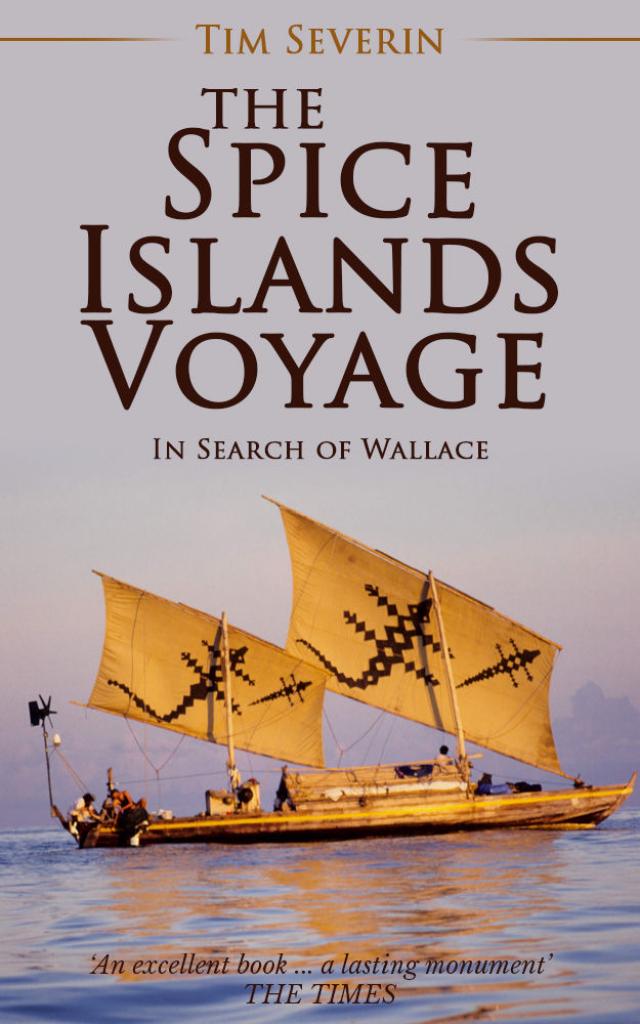


The Spice Islands Voyage
Tim Severin
© Tim Severin 1997
Tim Severin has asserted his rights under the Copyright, Design and Patents Act, 1988, to be identified as the author of this work.
First published in 1997 by Little, Brown
This edition published in 2018 by Lume Books.
Table of Contents
THE FEVER VICTIM
KEI ISLAND PRAHU
BIG KEI
ARU
TURTLE BEACH
JEWELS OF THE MOLUCCAS
THE SAGO ZONE
RED BIRDS OF PARADISE
BACAN
TERNATE
WALLACE’S STANDARD WING
MALEOS AND BATS
EPILOGUE
THE FEVER VICTIM
In a palm-thatched house a gaunt and impoverished white man lay on a cot, stoically sweating and shivering through an attack of fever. It was late February or early March 1858, the precise date lost because the invalid had made so many field trips that his diary had become vague, and he may have been confused by the fever. For three and a half years he had been exploring some of the remotest islands on earth. Besides contracting malaria, he had endured bouts of semi-starvation and occasionally been so badly crippled by tropical ulcers on his legs and feet that he could move only by crawling on all-fours. The results of his wanderings lay scattered about him: waterproof storage boxes, locally made of woven and lacquered palm leaves, contained thousands of dead insects. They were mostly beetles, but there were also samples of the region’s vivid and spectacular butterflies. The majority of the specimens were already pinned, with detailed notes written rather untidily beside them. There were also the dried skins and skeletons of exotic birds, and a few bones of small mammals. Fresh specimens — which the sick man had not yet had time to scrape and dry — hung dangling by strings from the rafters or were carefully marooned on saucers of water to save them from the columns of ants which regularly pillaged his makeshift work table and carried off bits of flesh and feathers. These unskinned specimens gave the invalid’s room a distinct smell of tropical decay, but he was so accustomed to the odour that he scarcely noticed it any longer.
An Englishman in his mid-thirties, the malaria victim was in the Spice Islands or Moluccas, in what is today the Republic of Indonesia, and he was a naturalist of a new kind. He financed his work by sending rare zoological specimens to an agent in London, who sold them to museums and wealthy collectors and remitted the funds to the Moluccas. The wanderer kept a notebook, with lists of just how many beetles and other insects he had shipped, sometimes using discarded gin cases, along with the pressed corpses of unknown bats and even a desiccated tree kangaroo. Occasionally he made a note, calculating how much the shipment might earn him if it sold well. On the inside front cover he wrote himself a reminder, estimating the money he would need to save to provide a worthwhile annuity. The skins of the more beautiful and rare birds earned him most, though few could bring in the money he had made two years earlier when he packed up and shipped back five orang-utan hides (pickled in arrack) and 16 of their skulls from the Sumatran rainforest. He insured the orang skins for £50 and expected to get five times that price if his agent managed to find the right clients. Paying his field expenses in this way, so that he could continue with his scientific research, placed him among the world’s first professional naturalists.
The invalid knew he should stay on his cot until the alternating hot and cold fits were over. As he lay there, he kept his mind busy by turning over a puzzle which had intrigued him for more than ten years: how had the world come to be populated by such an extraordinary variety of animals and plants? Was there any way to explain the striking differences between the species, or a universal rule to help understand their individual characteristics? It should be a theory which could be applied equally from the smallest to the largest creature. It should be just as valid for, say, the lumbering Javan rhinoceros or the tiny, round-eyed furry tarsier, the smallest of primates, both of which lived in the rainforests of Indonesia.
The best solution to the puzzle so far had been put forward early in the century by a French naturalist, Jean-Baptiste Lamarck, who had proposed that natural conditions had moulded the development of animals into their present forms. The most conspicuous example Lamarck cited was the giraffe; he claimed that it had grown its long neck over the course of many centuries because the animal had been constantly stretching upward to browse on tall trees. The idea was attractive, but inadequate. It did not properly explain, for instance, why Nature could produce such elaborate creatures as the gorgeous Birds of Paradise which the sick man had seen for himself in those tropical islands the previous year. Nor did Lamarcks theory explain why the Bird of Paradise grew plumage which was often more like twisted wire than feathers, or why the creature danced high in the trees in the morning or evening in a blaze of colour.
As the sick man mulled over the problem of the immense diversity of Nature, he remembered the gloomy theory devised by his countryman, the economist Thomas Malthus, who believed that less-advanced human populations would always be kept under control by ‘positive checks’. Disease, accident, war and famine would repeatedly cut back numbers to a sustainable level. The naturalist tried to imagine how this same bleak picture might also apply to the animal world in general, and what would result from such regular, massive threats to the members of any species. ‘Why do some live and some die?’ he asked himself. ‘And the answer was clearly that on the whole the best fitted live. From the effects of disease the most healthy escaped; from enemies, the strongest, the swiftest, or the most cunning; from famine, the best hunters or those with the best digestion; and so on. Then it suddenly flashed upon me that this self-acting process would necessarily improve the race, because in every generation the inferior would inevitably be killed off and the superior would remain — that is, the fittest would survive.’
As soon as he felt well enough, the naturalist went to his makeshift desk, put on the spectacles he wore for his weak eyes and wrote down his revolutionary theory before the next bout of delirium swept it away. The following evening, and the evening after that, he reworked his phrases until he had the idea lucidly explained. For one of the most profound concepts of the modern scientific age, his essay was surprisingly brief; its exposition ran to a little more than 4,000 words, including examples and explanations. It started by describing what he called ‘the struggle for existence’ among animals, and then showed mathematically that their rates of reproduction far exceeded the growth in food supply, and therefore the vast majority would die. Of the remainder, the essay concluded, ‘those that prolong their existence can only be the most perfect in health and vigour;…the weakest and least perfectly organised must always succumb.’
‘The more I thought over it,’ the lone naturalist recalled, ‘the more I became convinced that I had at length found the long-sought-for law of nature that solved the problem of the origin of species.’
Satisfied with his synopsis, he wrote a covering letter asking whether the idea was worth publishing in a learned journal, and signed his name — Alfred Russel Wallace.
Then he sent the package by mail steamer to England, where it was delivered to a country house in Kent whose solid prosperity was a complete contrast to the humble palm-thatch house where Alfred Wallace had worked out his theory. Here, with 15 household servants, a wife who was the daughter of the wealthy pottery manufacturer Josiah Wedgwood, and a private income which would make him the equivalent of a modern millionaire, lived Charles Darwin…and at that point the story of the genesis of the ‘Darwinian’ theory of natural selection becomes murky and contentious.
For most of the previous 20 years, Darwin had been working diligently on the question of how the animal species came to be different. He had not made any public pronouncement of his ideas, though he had put a smattering of his thoughts into letters which he sent to his eminent scientific friends for their comment. This was enough for them to expect that if anyone would crack the ‘Species Question’, Darwin was the person to do it. From talent and heredity, much was expected of him. His grandfather, the poet and scientist Erasmus Darwin, had already written on the topic of evolution, and the grandson had added to the family’s reputation as natural scientists with his superb description of his voyage aboard the exploring ship Beagle. During that voyage the sailors had nicknamed him ‘FlyCatcher’ from his habit of littering the decks with insect specimens. Now the leading savants in England were waiting impatiently for Darwin, who was approaching his fiftieth birthday, to publish his magnum opus.
No one knew quite how far Darwin had progressed, for he had become a semi-recluse. He was reading everything that had been written on the subject, building up an extensive private library of books which might throw light on the matter, making margin notes in volume after volume. He had painstakingly written several volumes of his own, collections of learned monographs on fossils and barnacles which he considered held a clue to the way all animals had developed. He was also conducting experiments with the crossbreeding of pigeons, pigs and horses. He spent hour after hour walking in his garden, thinking. His head gardener observed that Darwin would sometimes stand stock still for ten minutes at a time, in a reverie gazing at a single flower. Above all, he was keeping up a voracious correspondence with his fellow savants, seeking their ideas and opinions and asking them for data. But very rarely did he mention how his own work was coming along, though everyone presumed it to be close to pu blication.
Now arrived Wallace’s essay from the Spice Islands: it had taken three months to get to England, and was a bombshell. The effect on Darwin was ‘almost paralysing’, Wallace later found out. Darwin read the new essay, and was dumbfounded. In a few pages Wallace set out the key elements of the theory of evolution over which Darwin had been labouring for so long. His language was lucid and clear. ‘I never saw a more striking coincidence,’ Darwin wrote in amazement, ‘if Wallace had my ms. sketch written out in 1842, he could not have made a better short abstract. Even his terms now stand as heads of my chapters.’
Darwin knew enough about this lone wanderer at the far side of the world to realise that he was a man to be taken seriously. Zoological journals had been publishing a number of contributions about beetles and tropical birds sent in from south-east Asia, and the author’s opinions were invariably perceptive and sound. Indeed Darwin himself had already sent two letters to Wallace asking him to submit interesting specimens, particularly of any unusual native poultry, and encouraging Wallace to pursue ideas on evolution. In his letters, though, Darwin had been deliberately vague about his own work and more interested in learning from Wallace’s field observations. Yet in the elite circle of Darwin’s scientific confidants, the distant insect hunter was a nobody, a complete outsider. Wallace had never been to a university, and rarely attended the scientific gatherings of which the Victorian savants were so fond, for the very good reason that he was a field naturalist and above all because he was extremely shy.
Darwin was racked by conflicting emotions. On the one hand he had to applaud the brilliant thinking of this impecunious collector, a man 14 years his junior, who had been tackling the ‘Species Question’ alone in the equatorial jungle. On the other hand, Darwin was alarmed that his life’s major work would be overtaken at a stroke. Uncertain what to do, he forwarded Wallace’s brilliant essay to his friend Sir Charles Lyell, a renowned geologist and leading light of the scientific establishment, and asked for his advice. In turn, Lyell consulted with Dr Joseph Hooker, the eminent botanist and later the Director of Kew Gardens. Lyell and Hooker were among the two most powerful and respected men in British science at the time, and both knew Darwin had long been working on the problem of evolution. But, despite their pleading, he had never published anything.
Later Wallace obliged by sending him a Javanese chicken.
So they hatched what seemed at first glance to be a fair solution. They came up with the notion that the best way of protecting Darwin’s years of meticulous work was for his ideas and Wallace’s essay to be placed before the scientific community simultaneously. Luckily Darwin had written down some of his ideas on evolution in 1842, and again in 1844 in letters to his friends. Lyell and Hooker arranged for these extracts to be read out on 1 July to a meeting of the Fellows and Guests of the Linnean Society, the premier learned society for those interested in natural history. Brief sections from Darwin’s early letters were read out first, then Wallace’s essay which said much the same thing, only more elegantly and much more fully, was ‘communicated to the Society’. Neither Darwin nor Wallace was actually present, Darwin because one of his children had died of scarlet fever a few days earlier, and Wallace because he was then in New Guinea, one of the first Europeans to spend any length of time in that huge distant island, collecting more birds and beetles and totally unaware of the stir he had caused.
On the face of it, Lyell and Hooker had come up with a judgement of Solomon. It appeared that they had given an even-handed chance for both men to be recognised as co-authors of the new idea. But the truth of the matter was that the joint announcement gave Darwin his chance to seize the initiative, just as long as Wallace stayed safely out of the way in the tropical rainforest. Darwin’s advantage was further improved by the fact that the content of the two papers made very little impact at the Linnean meeting itself. Hardly anyone seems to have realised that Darwin and Wallace had altered the science of evolutionary biology forever.
Darwin now acted swiftly. He took great care to distance himself from the Lyell-Hooker stratagem, since he realised that Wallace had never been consulted about the announcement, and in a sense he had betrayed his colleague’s trust. Badly jolted by Wallace’s letter, Darwin rushed into print. Working flat out on his long-delayed manuscript, Darwin completed it in only 17 months by producing a much shorter version of his original planned volume. He gave it the title On the Origin of Species by Means of Natural Selection or the Preservation of Favoured Races in the Struggle for Life, and it was published in the year after he received the shattering letter from the Spice Islands.
Darwin’s book was a huge success, running through six editions in the next 13 years, and it earned for him the lion’s share of the credit. In his book he acknowledged Wallace’s pioneer work, but as the years went by he was to make fewer and fewer references to his co-discoverer, instead referring to ‘my doctrines’. Soon, only Darwin’s name was immediately linked with the theory of the evolution by natural selection, or ‘survival of the fittest’ as it was paraphrased by the philosopher Herbert Spencer six years later. The impact of this theory was to be one of the most profound scientific developments of the modern age. Darwin’s Origins would be referred to as ‘the book that shook the world’, and the main thrust of its argument that all living creatures have developed slowly over time and that all related organisms have a common ancestor would ultimately find general acceptance, though for decades it was contested, criticised and sometimes reviled. Supported by the research of geneticists and molecular biologists, the idea of slow, inexorable evolution now dominates the way we look at the world around us. Yet scarcely anyone recalls that it was originally introduced to a small scientific gathering in Victorian London who would have thought of it as the Darwin-Wallace theory.
Typically, Wallace saw no injustice in the circumstances. His generosity was astounding, even naive. ‘I shall always maintain (the idea) was yours and yours only,’ he wrote to Darwin, who naturally worried how Wallace would react when he eventually discovered what had been done in his name and without his permission. He need not have been concerned, for Wallace was even to argue that the theory had required someone of Darwin’s eminence to publish it. No one, he said, would have paid any attention if it had come from an insignificant scientist like himself. In fact when Wallace eventually did bring out his own book on evolutionary theory, he went so far as to call it Darwinism. When Wallace finally came home nearly three years later, all he wanted to do was to get on with cataloguing and describing his beloved insects and bird skins. Only after that was well advanced did he turn to writing the story of his adventures as a naturalist in south-east Asia, and make public his ideas about animal distribution and diversity which he drew from his experiences. To ensure that no one mistook even that remarkable and fascinating book as a bid for rivalry with Darwin, he dedicated the volume to Darwin with the words ‘Not Only as a Token of Personal Esteem and Friendship, but also to express my deep appreciation for His Genius and His Works’.
In short, Wallace came back from south-east Asia and stepped into Darwin’s shadow, deliberately and courteously. His book, The Malay Archipelago, was the monument he preferred, and it reveals a truly extraordinary man.
Wallace confounds the usual image of the Victorian explorer which is based largely on the African model. He did not go forward, rifle in one hand, bible in the other, on the lookout for big game or souls to save. Nor did he seek to map the source of great rivers or to climb the peaks of the highest mountains. Africa, of course, was a very different proposition from south-east Asia: the former a huge continental land mass with a little-known interior, while Indonesia is a vast array of islands, more than 13,000 of them spread along the Equator, in seas that had been criss-crossed for centuries by ships from China, South Asia and, more recent to Wallace’s arrival, from Europe and North America. Some Indonesian islands like Borneo and New Guinea were of immense size. Their hinterlands presented such barriers that they would not be properly explored until the modern era. Other islands were scarcely larger than a single English county, yet supported rich cities and brilliant civilisations and had been well known to foreign traders and settlers since the time of Christ. Perhaps the most striking characteristic of this huge and sprawling archipelago of archipelagos was its cultural variety. Some island populations were very highly evolved, while others remained in the Stone Age. And though most of Indonesia was already under Dutch colonial rule by the time Wallace arrived there, this control was only nominal in many regions. Wallace visited places where he was the first European ever to spend any length of time, and he lived for months among the local peoples who had never had a white man stay with them before.