Tracking marco polo sear.., p.1
Tracking Marco Polo (Search Book 4), page 1
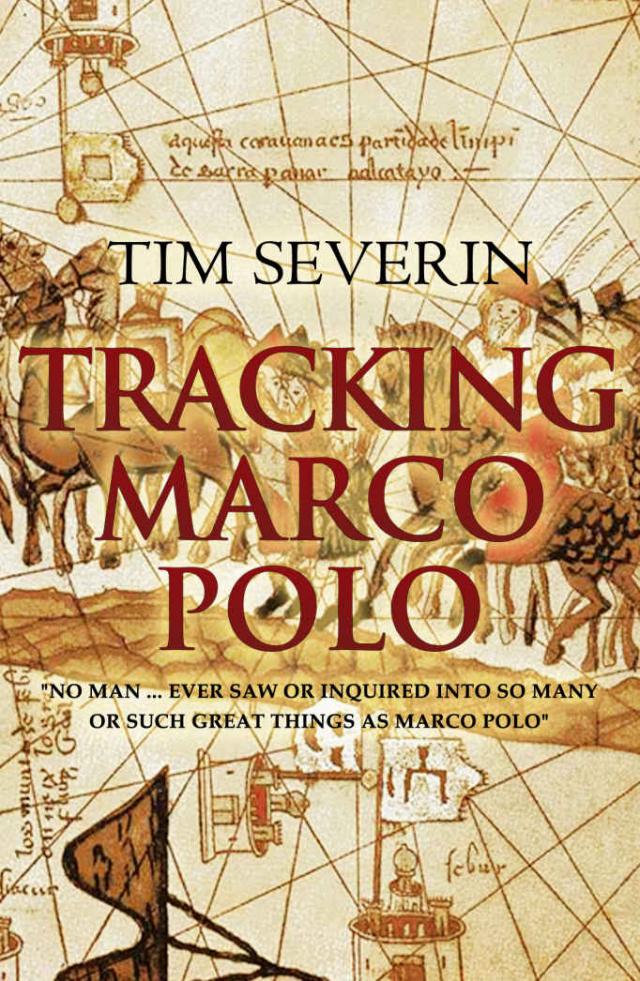


Tracking Marco Polo
Tim Severin
Copyright © Tim Severin 1964
The right of Tim Severin to be identified as the author of this work has been asserted by him in accordance with the Copyright, Designs and Patents Act, 1988.
First published in the United Kingdom in 1964 by Routledge & Kegan Paul.
This edition published in 2018 by Lume Books.
Table of Contents
Preface
Foreword
Chapter One – Preparations
Chapter Two – To Venice
Chapter Three – The Balkans and Istanbul
Chapter Four – Marco Polo’s Lesser Armenia
Chapter Five – Marco Polo’s Greater Armenia
Chapter Six – Valley of the Assassins
Chapter Seven – The Village of the Magi
Chapter Eight – Apples of Paradise
Chapter Nine – Hormuz to Herat
Chapter Ten – Afghanistan
Chapter Eleven – Reflections
Preface
This is the story of the Marco Polo Route Project, an attempt to re-trace Marco Polo’s overland journey across the length of Asia. Half of Polo’s long road now lies within the Chinese People’s Republic whose borders were closed to the Route Project team, so that the theme of the Project is not yet entirely fulfilled. One day I hope it will be possible to travel the Chinese section of the old caravan road, but for the present this account concerns Polo’s travels from Venice to the Hindu Kush. Across Turkey, Persia and Afghanistan, the three members of the Project team endeavoured to follow the exact path of the Polo caravan; to compare Marco’s descriptions with our own; to unravel some of the mysteries which surround his narrative, and to enjoy ourselves in the process. Because of these aims, it may seem that wherever we travelled nothing had changed since the Middle Ages. This is not so. Great development has taken place nearly everywhere. But we were much more interested in uncovering the few unchanged facets of Asian life, and in concentrating on these scattered medieval relics it is easy to create a false picture of the countries concerned. At the same time I cannot claim that we tackled the problems of Marco Polo’s Asia with any academic skill. Our approach was amateur. We possessed only the most elementary scholarship, gleaned from the mass of material written on the subject of Marco Polo. Our sole advantage was derived from personal experience of the same countryside which Polo had described nearly 700 years earlier. But this, after all, was the spirit of the Marco Polo Route Project.
From start to finish of our trip the idea of following Marco Polo would never have been put into action had it not been for the assistance of many people. Elsewhere there is a list of those organizations who helped us with essential supplies of all kinds, and I should like to state that their liberality was very deeply appreciated. Here I want to take the opportunity of expressing our gratitude to that formidable body of sponsors who were kind enough to devote valuable time to our cause, helping us with advice, finance and recommendations. This group numbers General Sir Alexander Galloway; Warden A. Farrer; Professor C. Hinshelwood; Professor J. Needham; Col. SirTufton Beamish M.P.; Peter Roy Esq.; Cdr. A. Courtney M.P.; F. E. Harmer Esq. C.M.G.; Sir William Hayter; Professor E. W. Gilbert; C. G. Smith Esq; R. Saggars and the late Mr. Temple.
These names by no means complete the list, for in addition there were many people, in England and en route, who came most generously to our aid. To these therefore I say — thank you.
T.S.,
Oxford,
February, 1964.
Foreword
The letter came from the man who was to be the editor of this book. Would I like to call at his office in London? He had read a magazine article I had written about my experiences in southern Persia looking for the trail of Marco Polo, and he would like to discuss the possibility of my writing a book about my travels. The publisher’s office turned out to be a ramshackle warren of narrow twisting stairways, uneven floors where walls had been knocked through to make extra space, dingy cream and brown paint, and distracted inhabitants who vaguely directed me through the labyrinth, and then disappeared like absent-minded mice into cluttered holes.
The appointment was for 11 a.m., and I knocked at several wrong doors before finding the right office. “Come in!” I pushed open the door, and stood there. “Can I help you?” asked the scholarly looking man behind the desk.
I hesitated. Another wrong door, I thought. “I’m looking for Colin Franklin’s office.”
“I’m Colin Franklin,” the man replied politely. “What do you want to see me about?” He seemed to have no idea why I was there.
“You asked me to come and see you at eleven,” I explained, “It’s about my magazine article.”
He looked very taken aback. “But when I read the article and wrote to an address in Oxford, I was expecting a retired Indian Army colonel. Who had perhaps visited Persia on his way back home.” I was twenty-one, and still a student of geography at Oxford.
So, from the outset, Tracking Marco Polo was both an old-fashioned, and an undergraduate, book. When the typescript was accepted six months later, it encouraged me to continue with post-graduate studies in the history of exploration and discovery, and to try to make my living as a writer on the subject. In that way I hoped to be able to continue to make the sort of journey which formed the purpose of the Marco Polo Route Project and which I had enjoyed so much.
Now, twenty-two years later, a great deal has altered in the places which Stanley, Mike and I visited light-heartedly on our battered motorcycles, and yet I’m sure I would make the same decision again. Paradoxically those countries which we found easy to visit — Persia and Afghanistan — are now out of bounds to the casual traveller. But the country which we longed to visit but could not — China — has increasingly opened up to visitors. Turkey, meanwhile, has developed and industrialized dramatically. Excellent roads now run where once our motorcycles skidded and bucked on gravel and pothole tracks; and it seems that each provincial town now boasts its factory chimney where formerly we were greeted as such outlandish creatures that the Turkish shepherds set their dogs on us and, once, a particularly aggressive individual whipped off his heavy, greasy flat cap and skimmed it like a discus at Mike’s eyes as he drove past and nearly brought him crashing off his machine.
Six years after my first visit to Istanbul with the Marco Polo Route Project I went back there. I managed to track down Irgun, the chirpy young Turkish entrepreneur who had befriended us and introduced us to his splendid Turkish family living in the poorest quarter of Istanbul. As I expected, Irgun had done well in the interval. He had gone off to Germany, worked in a factory there, and saved enough money to return home and open a souvenir shop just near the Istanbul Hilton. “The shop is very good business,” he told me cheerfully, “We sell everything the tourists want.” I pointed out a cabinet in one corner displaying an impressive selection of antique-looking coins from classical Greek and Roman times. “That belongs to a friend of mine,” said Irgun. “He rents the space from me. If you want to buy any coins, ask me first.”
“Why’s that?” I asked.
“I can get you a better price,” promised Irgun, “and many of the coins are fakes. My friend has them made specially. Last week there was a conference of some professors in Istanbul, and one of them came into the shop. He had a big reference book of coins with him, and he came back three times and looked through all the coins before he bought five of them to take back to a museum in his own country.”
“And were the coins genuine?”
“Two were,” replied Irgun with a grin. “But three were fakes. My friend made them only a month ago. You see, he uses the same reference book.”
Of my two travelling companions, Stanley went on from Oxford to become in turn a poet, a trainee with the World Bank, an international civil servant and a Euro MP. Mike, meanwhile, was obviously sufficiently impressed by the easy-going lifestyle of his two undergraduate friends to decide that university life was worth sampling. He gave up being an assistant film cameraman, obtained a place at Trinity College Dublin, transferred to Oxford, and is now a successful novelist. As Stanley has also written ten books, it means that the former members of the Marco Polo Route Project have produced a total of more than twenty-five books between them. Clearly, besides their love of travel, they also shared an irresistible urge to set pen to paper.
For me, the events of the expedition foreshadowed many future experiences. Re-reading this account of the adventures, mishaps, and shear fun of the motorcycle journey along Marco Polo’s path, I can recognize many features that were to recur. My later travels would also involve the same last-minute scramble to get everything ready for departure, and introduce the same bizarrely naive errors in the rush: how on earth could I have attached the two sidecars on the left, English, side of the motorbikes when setting out on several thousand miles of road where everyone drives on the right (or middle)? And I always seem to have had the same good fortune in the nature of my travelling companions and the people we met along the way.
But perhaps the most remarkable foreshadowing in Tracking Marco Polo is my interest even then in the sea road to the Indies. Specifically in this book I referred to the Arab navigators and their ships, and how Marco Polo was so wary of their vessels, because they were sewn together with coconut cord instead of fastened with nails, that he refused to sail in them. I had no way of knowing in 1961 as I hopped along the beach of Bandar A bbas in south Persia with a broken foot, and looked at the local traditional ships with their turbanned crews while the sweat poured down the wooden shafts of my crutches, that twenty years later I would organize the building of a medieval sewn ship and make the Sindbad Voyage, seven and a half months under sail from Muscat to China. For even then I was only following once again the genius who had first sparked my interest in re-tracing the journeys of exploration, because Marco Polo had made that same voyage, in the reverse direction, as he came home to Venice to tell the world about the wonders of Cathay.
Tim Severin
Co. Cork
September 1983
Chapter One – Preparations
Ye Emperors, Kings, Dukes, Marquises, Earls and Knights, and all the people desirous of knowing the diversities of the races of mankind, as well as the diversities of kingdoms, provinces and regions of all parts of the East, read through this book, and ye will find in it the greatest and most marvellous characteristics of the peoples, especially of Armenia, Persia, India and Tartary, as they are severally related in the present work by Marco Polo, a wise and learned citizen of Venice, who states distinctly what things he saw and what things he heard from others. For this book will be a truthful one. It must be known, then, that from the creation of Adam to the present day, no man, whether Pagan, or Saracen, or Christian, or other, of whatsoever progeny or generation he may have been, ever saw or inquired into so many and such great things as Marco Polo above mentioned.
So begins one of the world’s most famous and fascinating books, originally published in the thirteenth century under the title of A Description of the World and now best known as The Travels of Marco Polo. The appeal of Marco Polo’s tale seems to hold everlasting popularity, and for hundreds of years translations have been appearing in scores of languages ranging from Japanese to Irish.
In the fifteenth century the book’s tales of Golden Cipango were read by Christopher Colombus, and the pages of one copy in the Biblioteca Colombia at Seville is marked with seventy notes, supposedly in the hand of the Great Admiral himself. In England, an Elizabethan edition by one John Frampton must have come into the hands of Frobisher, Drake and Raleigh. In the nineteenth century, a passage from Marco Polo’s description of the summer palace of the Great Khan of the Mongols, inspired Coleridge to write his immortal line on the ‘stately pleasure domes’ of Xanadu, and even in the Jet Age one of the world’s major airlines advertises that its planes fly a service along the Route of Marco Polo.
But more than anything else, the fascination of Marco Polo’s book with its fabulous stories about the Great Roc and the gems of Golconda finds a special place in the imagination of young readers. The original book was written for the almost child-like imagination of the people of the Middle Ages, and today it still appeals most of all to a youthful public. For my own part I first read the story of Marco Polo’s journey to mystic Cathay when I was at prep school, and can still remember the eagerness with which I followed his great journey and pictured myself travelling by caravan along the Old Silk Road eastward across all Asia to the canals and pagodas of China.
Ten years later while reading Geography at Oxford, it seemed slightly incongruous that Polo’s name should come up in that section of the Honours School syllabus which is vaguely called the History of Geography. This time Polo’s book was to be regarded as a reference for European knowledge of Asian geography in the thirteenth century. But academic interest in Marco Polo was only slight, for we were told that his book was too widely disbelieved in his own day to have much influence on his contemporaries and our attention was drawn rather to the works of the great Arab travellers, the Greek and Roman ideas on geography, and the arid histories of the development of obscure navigating instruments. But for me, that brief mention of Marco Polo had re-awakened my early fascination with his journey, and the rest of the course faded into the background. Luckily, the University Libraries provided me with all the material necessary for a quick survey of what was known about the great traveller.
In spite of Marco’s world-wide fame, very few definite facts seemed to be known about Polo apart from a great deal of scholarly conjecture, mainly in the nineteenth century, on the contents of the book itself. Most amazing of all, I could not find that anyone had seriously tried to follow his route, and to compare the existing conditions with the country he described nearly seven hundred years before. It was true that several parts of the route had been covered at various times by different people, but no single person with a geographer’s training, however slight, had attempted to follow the complete trail that wound across Turkey, Persia, Afghanistan, over the Roof of the World and across China. I decided that if it was possible, my boyhood dream of following in the steps of Marco Polo would become reality.
At that time I had just started the second year of my three year course at Oxford, and the obvious opportunity for the trip was in the four months of the coming summer vacation in 1961. Between June and September the deserts of Persia and Afghanistan would be at their hottest, and I had to find someone foolhardy enough to plan on crossing them with me. Surprisingly, I found my companion within a week. Word got around my college that I was planning a trip to China. Then someone mentioned that he knew of another undergraduate, called Stanley Johnson, who was toying with the same idea. On this vague piece of intelligence I dropped into Exeter College one October afternoon and was directed to Johnson’s room. At my knock, a voice bellowed at me to enter and I pushed in to find a burly young man with an unruly shock of blond hair, sitting on the floor beside the wreckage of his tea.
‘Are you Johnson?’ I asked.
‘Yes,’ the bear-like figure replied. So coming quickly to the point I went on.
‘My name’s Tim Severin. I hear that you are thinking of going to China next summer vac. Well, so am I, perhaps we could join forces.’
‘Splendid idea! Have some tea,’ was the answer, and the Marco Polo trip was under way.
Over that tea, we exchanged ideas. We found that we both held Trevelyan Scholarships, and that both of us had at one time been cowboys, Stan in Brazil and myself in Montana. Stan was determined to use his long summer holiday to continue his travels, and was especially interested in seeing Asia. As an excuse to do this, he was hoping to get permission to visit the Great Wall of China. I explained my Marco Polo idea to him, and immediately his imagination grasped the attraction of the scheme and he was enthusiastic. By the time I returned to my own College for dinner, we had planned our opening moves. The two main essentials were money with which to finance ourselves, and permission to travel through the countries along Polo’s route. But before we could get either, we had to formulate a more precise plan for our journey, so that we had a positive scheme to present to the various embassies and possible sponsors. Without this detailed plan we could not hope to obtain either visas or cash.
Since Stan was already deep in his preparations for University examinations at Easter, I disappeared back into the libraries for weeks of investigation into what field research we could usefully carry out on our trip, and also how we might best tackle the problems of travelling over the vast distances and difficult terrain. In the course of my studies, it became increasingly clear that by far the most genuine way of following Polo would be to take his book as our route guide and follow it, just like a guide book, from place to place. By doing this, we would be able to bridge the gap in time between the medieval traveller and ourselves, and as far as possible see the countryside as it now is, through his eyes. But to do this properly, it was vital that we should know as much as possible about the man we were following, so that we could understand his viewpoint and try to appreciate those things which had changed since his time or had remained unaltered for more than six centuries. One thing was certain, that despite the ages that separated us from Polo, the timelessness of the East and the factors that govern much of life there, terrain and climate, would be on our side, preserving living fragments of history.