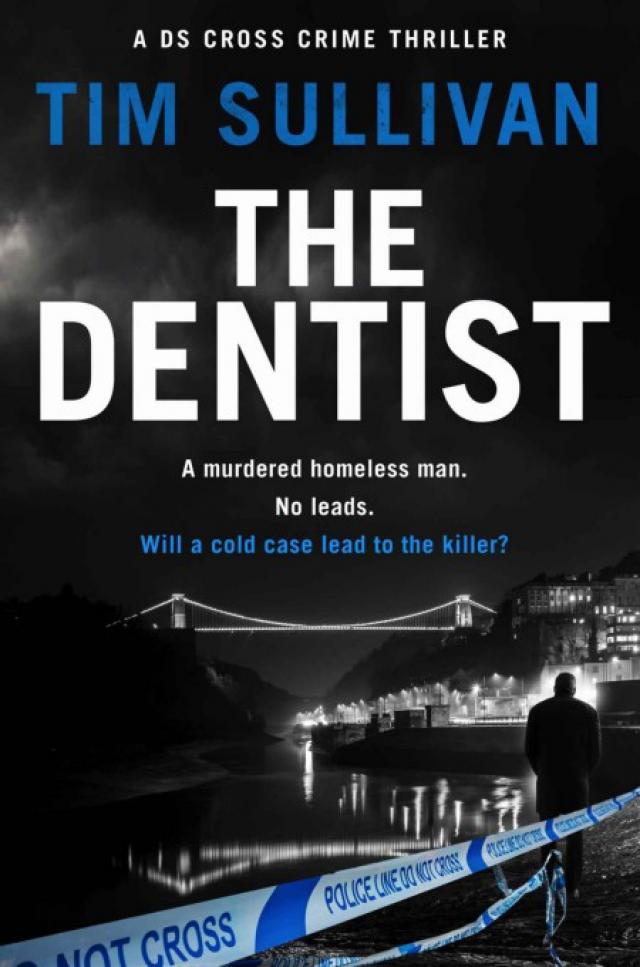
The dentist, p.1
The Dentist, page 1


Copyright © 2020 by Tim Sullivan
All rights reserved.
No part of this book may be reproduced in any form or by any electronic or mechanical means, including information storage and retrieval systems, without written permission from the author, except for the use of brief quotations in a book review.
First published 15th June 2020 by Pacific Press.
THE DENTIST
Tim Sullivan
For Rachel
Contents
Chapter 1
Chapter 2
Chapter 3
Chapter 4
Chapter 5
Chapter 6
Chapter 7
Chapter 8
Chapter 9
Chapter 10
Chapter 11
Chapter 12
Chapter 13
Chapter 14
Chapter 15
Chapter 16
Chapter 17
Chapter 18
Chapter 19
Chapter 20
Chapter 21
Chapter 22
Chapter 23
Chapter 24
Chapter 25
Chapter 26
Chapter 27
Chapter 28
Chapter 29
Chapter 30
Chapter 31
Chapter 32
Chapter 33
Chapter 34
Chapter 35
Chapter 36
Chapter 37
Chapter 38
Chapter 39
Chapter 40
Chapter 41
Chapter 42
Chapter 43
Chapter 44
Chapter 45
Chapter 46
Chapter 47
Chapter 48
Chapter 49
Also by Tim Sullivan
About the Author
Acknowledgments
Bibliography
Chapter 1
The young woman standing in front of him was smiling. Cross was sure of this as her mouth was turned up at both corners, which was a definite sign. He wasn’t sure what it meant though, because he didn’t know her. With people he knew he would note the upturned mouth, together with what had been said, combine it with the tone in which it had been said and make his inference. Context was everything for Cross. His interpreter. Only then would he be able to come to his conclusion: – happy, ironic maybe, sometimes exasperated. With some work colleagues, he had a mental library of their smiles, frowns, enquiring expressions, catalogued in his head for reference. Frame grabs from previous conversations which he could then recognise and decide on his reaction. This was a necessary process for Cross as smiles meant nothing to him per se. They didn’t trigger any innate emotional response in him. They didn’t make him feel anything. He didn’t empathise.
Smiles were therefore just another thing in life that needed interpretation. He’d heard it said that some people actually smile with their eyes. As if this gave their smile more meaning. As if it were some profound inroad to their inner soul. For Cross this was absolute nonsense, it was just a physiognomical accident.
All this girl had said was ‘Hi,’ and she was now waiting in the ensuing, awkward, silence for the customary return greeting. But it wasn’t forthcoming. What she didn’t know was that Cross didn’t work like that. His brain wasn’t wired that way. Most people would fill the vacuum with an “Hello.” Then not knowing what the young woman wanted would follow with the inquiry “What can I do for you?” But Cross was different. Her smile, he concluded, was nervous. She was waiting for something but he wasn’t sure what it was. Why didn’t she just tell him? That was, after all, presumably why she came up to him in the first place. People seemed to do this all the time. It was so puzzling.
‘I’m Mackenzie,’ she said.
Well that was a start. An introduction.
‘You’re DS Cross.’
Why did people persist in telling him who he was?
‘Well, nice to meet you.’ She paused another moment just to make sure Cross wasn’t going to respond. He wasn’t. So she left. He watched her go then turned his attention back to the corpse lying at his feet.
It was the corpse of an elderly man, at first glance maybe late seventies, eighties. His weathered face told the story of a life led lately on the streets. With the homeless, though, age was such an amorphous concept. Cross had come across several he would’ve sworn were of retirement age only to discover they were in their early thirties. He examined the man. Filthy, his overcoat matted with dirt and tied at the waist with a piece of string. He was unshaven, with long fingernails under which were semi-circles of black dirt. A cloud of stale alcohol wafted up from the body obliterating the cold early morning smell of rot and autumnal decay in the air. A smell Cross had always appreciated when examining a dead body. It centred him. It was his olfactory equivalent of keeping your eye on the horizon when in a moving boat to prevent seasickness.
To Cross’ annoyance, Uniform had already dismissed this as a ‘homeless on homeless’ crime and, having reached that conclusion, had lost interest. Cross was already pretty sure they were wrong. This was because of the carrier bag the old man was still hanging onto. In it, some scraps of food and six cans of strong cider. Cider was life’s blood on the streets and if alcohol happened not to be your thing, then it was currency with a street value higher than gold.
Cross studied the corpse’s face. Who was this man? How did he end up here? Like this. What events in his life led him to this moment? What was his story?
He was always drawn to cases like this. Cases of the dispossessed. The outsider. He related to them because in many ways he was one himself. An outcast, a social misfit, a curiosity - someone it was easier not to engage with, to walk past, avoid. This was what interested him in murder in the first place. The ability to give a victim a voice when they no longer had one of their own. All the more compelling if the victim had had no voice when they were alive. Loners who had no-one to speak for them when they’ve gone. No friends or family asking questions of the police, demanding to know what had happened.
Cross had received the call that morning when he was having breakfast at Tony’s. He ate in this particular café in Redland every morning and every morning he ate exactly the same thing. Every weekday morning that was, unless he was away, which was rare. It was handy for Cross as he lived directly above it, in a small flat. He had walked in and sat at his usual table which had a rather incongruous, chipped plastic ‘reserved’ sign at its middle. The café was populated by a group of regulars eating their full Englishes. Builders, taxi drivers, with their money bags in the middle of the table, pensioners up early out of habit, hoping someone said hello making them feel like they’re part of the human race again. Men buried in their tabloids. All the customers were men. Cross didn’t come at weekends, despite the convenience of his small flat being directly above Tony’s. This was because on Saturdays and Sundays Tony lets a young couple come in and make brunch. All poached eggs, avocados, huevos rancheros, lattes, sweetcorn fritters, smoked salmon and crème fraiche. It had become quite the hot spot with the young and it gave him two days off but it wasn’t for Cross. It wasn’t that he felt out of place in the young, bearded, hipster crowd - that was, after all, something he dealt with on a daily basis. It was the length of the, seemingly permanent, queue that he didn’t have the patience for. Dogger and Whiff – for that was the young couple’s names – had offered for him to jump the queue. A horrifying suggestion. He couldn’t possibly accept preferential treatment, he was a policeman after all. Before that a Thai couple had done a weekly three- night residency cooking Thai food. It was so successful that they had been able, with Tony’s blessing and a not inconsiderable financial investment, to open their own restaurant in St Paul’s nearby.
‘Morning George.’
‘Morning Anthony.’
Cross was the only customer to call him this. The first time he walked in he saw the alcohol license above the door in the name of ‘Anthony Korsan’ and had used that ever since. No-one corrected him so there was no reason for him to think otherwise. Tony walked over with tea in a cup and saucer. Everyone else was drinking from mugs. He placed it in front of Cross and removed the ‘reserved’ sign. Cross then produced a knife and fork from his pocket, and put the paper napkin in his lap.
He had no need to order. Tony knew what he wanted. He and the waiter came over to Cross’ table a little later with his breakfast. Nothing odd in that except that all the components were on separate plates.
A fried egg.
Bacon.
Mushrooms.
Toast.
Baked beans.
‘Bon appétit,’ said Tony, putting another, empty, plate in front of Cross.
‘Merci,’ Cross replied.
Cross placed the fried egg on his plate and carefully cut the white away from the yolk and ate it. He then placed each of the three rashers of bacon equidistantly from the edge of the plate, the middle rasher underneath the yolk. (Tony had ensured in the kitchen that each rasher was identical in length.) Cross’s phone rang. He checked who it was before he answered.
‘Cross… I’ll be straight over.’
But he went back to his breakfast, breaking the yolk with the left-hand rasher of bacon. He ate as he looked through the condensation on the window, observing life on the street outside. The area had changed in the twenty-five years he’d lived there. It had become quite gentrified over the years and this was reflected in the changing nature of the shops around him. They’d become m ore bespoke and upmarket, more artisan. A bakery, a Michelin-starred restaurant, Wilks. It was as if the more affluent area of Clifton had run out of room and spread inexorably west over Whiteladies Road into Redland. He now recognised some local people as they went about their everyday routine at this time in the morning. He amused himself by building an imaginary picture of their lives, their jobs, their marital status, their sexuality. In his head he had created an alternative Redland with its social infrastructure and personalities all cast by him.
When he arrived at the crime scene, which was on the edge of the Downs, close to the gorge, Cross was stopped by a uniformed policeman. This wasn’t unusual for Cross and in many ways it was quite understandable. He had arrived on a bicycle fully kitted out in a dayglo green helmet with a flashing light and digital camera attached to the top, dayglo cycling windbreaker, dayglo bicycle clips round his ankles and a small backpack over his shoulder. He looked more like an eccentric, absent minded, fifty-year-old geography teacher who had lost his way en route to an orienteering field trip, than a serving Detective Sergeant in the major crime unit of the Avon and Somerset police.
‘I’m sorry but you’ll have to stay behind the tape,’ said the policeman.
‘Of course, I have… somewhere I have…,’ said Cross rummaging through his pockets. He was in no way annoyed, quite the opposite in fact – he was pleased this young man was doing his job. If the policeman didn’t know who Cross was he should, of course, ask for identification. In fact Cross would go as far as to say that even if the police constable did know him he should still, strictly speaking, ask for identification. Cross believed in order, in proper procedures being followed. Life would be so much easier if everyone did likewise. He finally took off his backpack as DS Ottey approached, a black single mother of two in her late thirties. She was Cross’ current partner.
‘It’s okay, he’s with us,’ she said.
Cross finally produced his id.
‘DS Cross,’ he informed the policeman who then lifted the tape for him to go under.
‘I’m sorry sir.’
‘No need to apologise, just doing your job,’ Cross replied.
But with that he remained rooted to the spot looking at the policeman expectantly who then asked ‘Was there anything else sir?’
‘DS Cross 2117 and the time is…’ He looked at his watch. ‘9.04’
The policeman was confused.
‘For the log,’ Cross explained.
‘He’s right,’ said Ottey, ‘You should be taking a log of everyone in and out of the crime scene.’
‘Oh, of course. Sure,’ said the PC. He got out his notebook and entered Cross’ details as he looked on.
‘2117… that’s correct,’ Cross turned and was a little surprised to see that Ottey had started walking away.
‘Josie?’ She stopped in her tracks and turned back.
‘DS Ottey 3472. I arrived about fifteen minutes ago,’ she said as Cross watched the constable writing it down. Satisfied, he then wheeled his bike after her. She knew what was coming next, the inevitable lecture. Cross simply couldn’t let this stuff go. In fact it was more than that. It actually really upset him. He couldn’t cope if procedure was not followed correctly.
‘It’s really important,’ he informed her, gravely.
‘I know but I’m the only one who’s here,’ she replied.
He gave her that look she knew so well. The look that said he was waiting for her to tell him what he already knew. That she wasn’t not telling the entire truth. What his father would call a white lie, another expression he had never understood. Why should a lie have a colour that made it different? Why were there no other coloured lies, like red or yellow? But he had learnt that, logic aside, this meant it wasn’t a grave, terrible consequential lie.
‘Apart from local CID. No harm done,’ she went on.
He stopped walking and looked at her.
‘Okay, okay, I’ll get them all to sign in,’ she conceded.
Cross’s obsession with order and procedure was what made him one of the most successful detectives in the Major Crime Unit of Somerset and Avon police, in terms of his conviction rate. 97% of his cases resulted in successful convictions. He not only had a great set of deductive skills, and was something of a legend in the interview room, but it was his detailed presentation of cases to the CPS, his ordered collation of evidence, which was genuinely astonishing. His dogged, slavish adherence to procedures was extraordinary, if at times frustrating for those working with him. Prosecutors beamed when they saw his name attached to a case because they knew that everything would have been meticulously pored over and set out in a fully comprehensive order. Cautions, chains of evidence and, warrants would have all been executed properly. None of the ‘shortcuts’ some policemen employed which often led to an arrest, but invariably to a collapse of the case in court. But it wasn’t just this efficacy which they held in such esteem, it was the case he had built up in the interview room which was so compellingly incriminating. No-one in the police force utilised the ‘no comment’ response with such lethal, pinpoint, accuracy. Suspects answered a series of carefully constructed questions with ‘no comment’ as instructed by their lawyer. Cross was more than happy for them to do this as he built a picture of what he thought, or in some cases knew, had happened at the same time as withholding nuggets of evidence from them. When he judged the timing was right and they’d dug themselves into a hole of adequate depth, they were confronted with this evidence. They then had to change ‘‘no comment” to some sort of response, which basically built a picture of their guilt. It was a chess game and Cross was the grand master.
They just didn’t know it.
Chapter 2
‘You’re sure it’s murder?’
Cross and Ottey were standing in front of DI Carson’s desk. At thirty-five Carson had the air of someone who would go far in the force. Not because he was a great detective or a particularly astute policeman, but because he had that unmistakable air of someone who was political. Not overtly political in a Machiavellian kind of way, but simply in knowing which battles to fight and which to walk away from. Who to support and, conversely, who not to, and when to offer that support. He had an exquisite instinct for worthwhile allegiances. He’d go on to work his way rapidly up the career ladder in a seemingly effortless manner. Not for nothing was his nickname ‘FCC’ – future Chief Constable - the ‘bigger picture’ was an expression he would come to use with increasing frequency, the higher the office he attained. Even then he had this ability not just to look at what is in front of him but at context in a wider sense. An ability, it had to be said, that Cross found irritating and at times obstructive to the immediate matter in hand.
‘Would you be asking that question if it wasn’t a homeless person?’
‘That’s not fair DS Ottey and you know it,’ said Carson.
‘It’s murder,’ interjected Cross aware that the conversation was already in danger of becoming unnecessarily confrontational and that time would be wasted.
‘Well if it’s homeless on homeless it’s going to be a lot more difficult,’ Carson replied.
‘It isn’t,’ said Cross.
Carson looked at him unsure as to what he was saying.
‘Homeless on homeless,’ Cross elaborated.
‘The cans of cider,’ explained Ottey.
‘What if the perpetrator panicked and that’s why he left them?’ asked Carson.