

How i became a ghost, p.1
How I Became A Ghost, page 1


Published by The RoadRunner Press
Oklahoma City
www.TheRoadRunnerPress.com
© 2013 by Tim Tingle. All rights reserved.
First edition hardcover, The RoadRunner Press, July 2013
United States of America
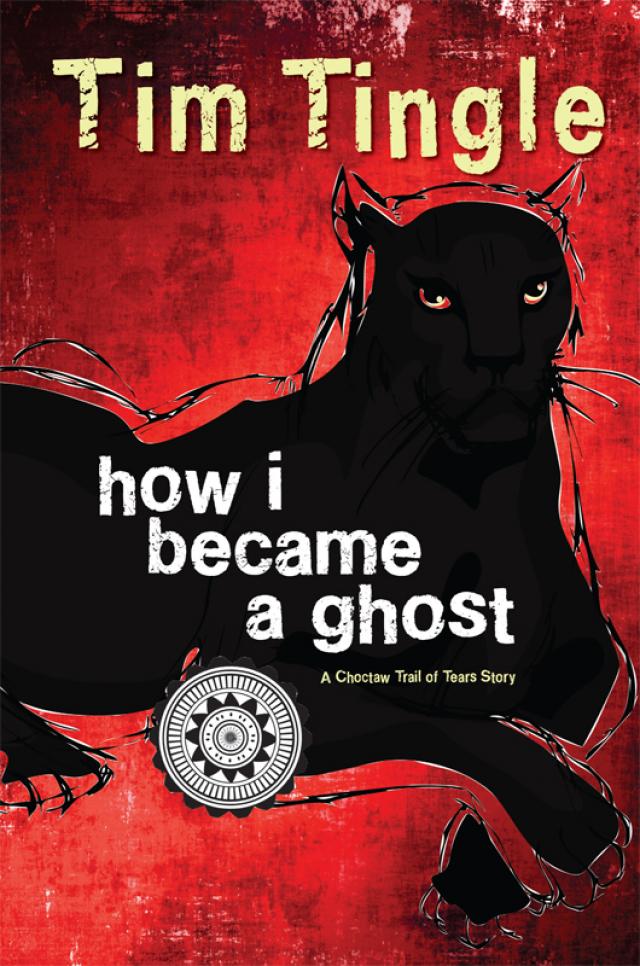
Cover illustration: Uliana Gureeva
Map by Steven Walker / Cover design by Jeanne Devlin
This is a work of fiction. While the literary perceptions and insights are based on experience, all names, characters, places, and incidents are either products of the author’s imagination or are used fictitiously. No reference to any real person is intended or should be inferred.
First published June 18, 2013
http://www.theroadrunnerpress.com/
Tingle, Tim.
How I became a ghost : a Choctaw Trail of Tears story / Tim Tingle. — 1st ed.
p. : ill., map ; cm. — (The how I became a ghost series ; bk. 1)
Summary: A Choctaw boy tells the story of his tribe’s removal from the only land its people had ever known, and how their journey to Oklahoma led him to become a ghost—one with the ability to help those he left behind.
Interest age level: 009-012.
Issued also as an ebook and an audiobook.
ISBN: 978-1-937054-53-3 (hardcover)
ISBN: 978-1-937054-55-7 (trade paper)
ISBN: 978-1-937054-54-0 (e-book)
ISBN: 978-1-937054-56-4 (audiobook)
1. Choctaw Indians—Relocation—Juvenile fiction. 2. Indian Removal, 1813-1903—Juvenile fiction. 3. Ghosts—Juvenile fiction. 4. Choctaw Nation of Oklahoma—Juvenile fiction. 5. Choctaw Indians—Fiction. 6. Ghosts—Fiction. 7. Historical fiction. I. Title.
PZ7.T489 Ho 2013
[Fic] 2013935579
To my mentor Charley Jones,
who taught me the power of humor
in the Choctaw story
Contents
Chapter 1 Talking Ghost
Chapter 2 Treaty Talk
Chapter 3 Dancing on the Stones
Chapter 4 Fire in the Hair
Chapter 5 Swamp Choctaws
Chapter 6 Men with Blankets
Chapter 7 Snow Monsters
Chapter 8 Walking People
Chapter 9 Nita and the Ghost Walkers
Chapter 10 Bloody Footprints
Chapter 11 Nita’s Walk
Chapter 12 Disappearing Daughter
Chapter 13 The Coming of My Final Day
Chapter 14 Joseph’s Story
Chapter 15 The Bending Branch of Treaty Talk
Chapter 16 Seeking Naomi
Chapter 17 Good-bye to My Family
Chapter 18 Trail of Tears
Chapter 19 Naomi Meets the Ghost
Chapter 20 Naomi the Strong
Chapter 21 The Panther and the Fire
Chapter 22 Buried with the Bones
Chapter 23 Naomi and the Bonepickers
Chapter 24 A Soldier’s Vow
Chapter 25 A Day of Death
Chapter 26 Choctaw Rattlesnake
Chapter 27 Wagon of the Bonepickers
Chapter 28 Panther and the Wolf
Chapter 29 Pushmataha and the Choctaw Four
Acknowledgments
About the Author
Discussion Questions
Chapter 1
Talking Ghost
Choctaw Nation, Mississippi, 1830
MAYBE YOU HAVE never read a book written by a ghost before. I am a ghost. I am not a ghost when this book begins, so you have to pay very close attention. I should tell you something else. I see things before they happen. You are probably thinking, “I wish I could see things before they happen.”
Be careful what you wish for.
I’m ten years old and I’m not a ghost yet. My name is Isaac and I have a mother and a father and a big brother, Luke. I have a dog, too. His name is Jumper and he is my best friend. We go everywhere together. We swim in the river together; we chase chickens together.
“Make sure Jumper does not catch any chickens!” My mother always yelled this from the back porch.
“Why can’t Jumper catch chickens?” I asked my father one evening, as we sat on the porch watching the stars.
“That’s your mother’s rule,” he said.
“But why?”
“Because Jumper won’t wait for the chickens to be cooked,” he said. “He’ll chew the chickens and choke on the bones and bloody feathers. Would you want to eat bloody feathers?”
“No,” I said. “Good rule.”
“Then make sure Jumper follows it.”
“Hoke,” I said, which means “okay” in Choctaw.
Jumper and I, we take long walks in the woods together, we tug weeds from the corn stalks together, and we spend the day and night together.
“No dogs in your bed!” This was another rule of my mother’s, but Jumper was smart. He waited until my mother fell asleep, then he climbed under the covers with me. In the morning, when he heard my mother making noise in the kitchen, he jumped out of bed.
Maybe she knew Jumper broke the rule. Maybe she smiled and let him get away with it. She was a good mother and we had a happy life, mostly. I had too many chores and too little free time, but I knew if I could just wait till I grew up, I’d have all the free time I wanted.
Then came the day that changed everything. Without any warning, I saw the ghosts. I also saw things before they happened.
My father rose early that morning, long before sunrise. He left the house while it was still dark. He carried his shotgun and his bag of shotgun shells, so I knew he was going hunting.
I finished my chores and started tossing mudballs against the barn wall. Jumper barked and chased the mudballs, but only for a little while.
“I’m bored,” Jumper said. “Let’s chase chickens!”
We were on our way to the chicken pen when I saw my father coming home from the woods. He was carrying only his shell bag and his shotgun, so I knew something was wrong.
Usually he returned with a wild turkey or sometimes a deer. He never returned from a hunting trip with nothing. He walked through the back door and I followed him. He didn’t say a word to me, just held up his hand to let me know I should stay outside.
I listened through the door.
“We must move,” my father told my mother. “What do you mean ‘we must move’?” my mother asked. “You better move! Go back to the woods and catch us something to eat!” She was laughing.
“No,” said my father, and he was not laughing. “There is Treaty Talk in town. We must move.”
I was only ten, but I knew what Treaty Talk meant. It meant the Nahullos wanted something. Nahullos were people that lived a few miles away. They were not Choctaws, like us. We were nice to them and they were nice to us. But Treaty Talk always meant something else, and that something else was never nice.
My father took my mother by the hand and she gave him a strange look. He led her to their room, closing the door behind them. I was afraid of Treaty Talk and I didn’t want to listen, not anymore.
Maybe it will all go away, I thought. You never know when your life is about to change. Treaty Talk is why I became a ghost.
Chapter 2
Treaty Talk
THE SUN ROSE HIGH in the sky, and I knew mother would have lunch ready soon. I was wrong. Everything about this day was wrong.
My father and mother kept talking, and I even thought I heard my mother crying. I waited on the front porch till Luke came home for lunch. He was twelve years old and never helped around the house. I had to do everything.
Hoke , sometimes he helped, but never enough.
“What’s going on?” Luke asked.
“Mom and Dad are talking. Dad said there is Treaty Talk.”
“Oh no,” said Luke. “That means lunch will be late today. I’m not waiting around.” He left to play stickball with his friends. See what I mean?
I circled the house and sat beneath the window of my parents’ room, so I could hear what they were saying. My mother was crying, and she never cried.
“We have to be ready to go,” my father said.
“Where will we go?” my mother asked.
“A long way from here. The Treaty has already been signed. We have till spring. But we should get ready to move.”
We had no lunch that day. I fell asleep on the porch and Jumper rolled into a ball against my belly. When my mother finally stepped outside, the sun was peeking over the pine trees, ready for the moon to take over.
“Come with me,” she said, taking my hand. Jumper trotted beside us.
“Where are we going?” I asked.
My mother said nothing. We walked through our garden of tomatoes and winding bean vines. We crossed the cornfield, where all the stalks were brown and dying. The evening air was already crispy cold and winter was coming. As we entered the woods, we met Luke walking from the river. He seemed upset.
“Luke, take Jumper home,” my mother said. “Tell your father we will be home soon.”
Luke nodded without saying a word.
He already knows what this is about, I thought.
We stepped from the woods and came upon a gathering of twenty old Choctaw men, scattered up and down the riverbank. I knew these men. They were the oldest men in town and they were our friends. We had supper at their homes and we knew their families.
One of the old men was Mister Jonah. He lived with his wife not far from us. As we watched, Mister Jonah took off his shirt and rubbed his back against a tree trunk. The tree was old, older than he was, and the bark was sharp and cracked.
Mister Jonah moved up and down, rubbing his back against the tree bark. His skin was dry and wrinkled. The bark cut into his skin and he started bleeding. Blood dripped from his back and covered the ground at his feet. His face was still as a stone, as if he didn’t feel the pain, but I knew it had to hurt!
“Mother,” I asked, “what is he doing?”
“Shhh,” my mother whispered. “Don’t talk. Just watch.”
Soon all of the old men started rubbing their backs against the trees. When their backs were ripped open and bleeding, they sat in a puddle of their own blood. One man patted dirt on a friend’s back to stop the bleeding. But the bleeding never stopped.
Hoke. I should tell you this. Do not be afraid. This is how things are. When you will soon be a ghost, sometimes you see people before they are ghosts. You see how they will die. I didn’t know it yet, but whenever I felt a warm shiver, I was about to see something no one else could see.
I felt the warm shiver. I closed my eyes. When I opened them, Mister Jonah was sitting by the tree.
Suddenly, his hair burst into flames! He screamed and waved his arms. He fell rolling to the ground. His arms were skinny logs and flames shot from his fingers.
No one moved to put the fire out.
I tried to run to him, but my mother held me tight. I jerked my arm free, took two steps, and stopped.
Mister Jonah sat with his back against the tree. His back was bleeding, like before, but his white hair fell over his shoulders. No burns on his arms. No burns anywhere.
The flames were gone. I looked at my mother. I was the only one to see the flames. They were flames for another day, a day that soon would come. If I was already a ghost, I might expect to see something like this. But I was not a ghost. Not yet.
“Mother, please tell me what is happening,” I said.
“These men are saying good-bye to their home.”
“They live in town. Their homes are in town.”
My mother gripped my hand tight. “Come on,” she said. “There is more to see.”
Chapter 3
Dancing on the Stones
MY MOTHER LED ME to another spot on the river, where old Choctaw women were sitting on a pier. Some were the wives of the old men and some were widows.
I knew this pier. It was a long wooden pier with shallow water all around it. I fished from this pier, but very carefully, for the bottom of the river was covered with sharp stones. When I was only six, I went fishing by myself with my new cane fishing pole. I walked to the end of the pier and flung my line into the river. My cane pole slipped from my hand and I jumped in after it.
When I hit the river bottom I exploded in pain. The stones cut deep into the soles of my feet. I started jumping up and down, a stupid move, as every step I took meant more cuts.
I swam to the shore, leaving a bloody trail in the water behind me. I lost my first fishing pole that day and limped home in pain.
Yes, I knew this pier. While my mother and I watched, the old women sat on the edge of the pier, with their feet hanging over the water. Ten women sat on one side of the pier and ten sat on the other side. Four of the oldest women sat on the very end of the pier.
“They better be careful,” I said.
“They know what they are doing,” said my mother.
The sun peeked over the hills for one last look. Night was near. I leaned against my mother. The women started singing an old Choctaw song, rocking back and forth to the rhythm of the song. My mother joined them, singing in a whispery voice.
When the song was over, one woman shouted, “To the water!”
All at the same time, the old women jumped from the pier to the water. The stones must have cut their feet, but the women didn’t seem to notice. They lifted their feet up and down and turned in circles in the water.
I could not believe what I was seeing. I gripped my mother’s hand and looked up at her. Blood rose from the bottom of the river, and still the women danced. Their faces were the strangest thing of all.
The water was blood red, but the women showed no pain. They didn’t squeeze their faces tight, like people do when they step on a sharp stone or stub their toe against a rock. The old women stared ahead like they were blind, like they saw nothing and felt nothing.
Missus Jonah was there. Her hair didn’t turn to fire, like her husband’s, not at first. I watched her dance with the others, till I felt the warm shiver again and closed my eyes.
“No,” I whispered to myself. I shook my head. I didn’t want to open my eyes, but I did.
Missus Jonah stopped dancing. The flames started at her feet, under the water. She screamed and tried to stomp out the flames. The fire climbed above the water and soon she was covered in flames.
The other women kept dancing on the stones. No one moved to help her.
Suddenly, just like before, the flames were gone. A few women limped to the shore. I looked to my mother. I knew she didn’t see the flames.
As we left the pier, I looked over my shoulder at these tired old Choctaw women. Some were still dancing in the water.
“Mother, please tell me what is happening,” I said.
“These old women are saying good-bye to their home,” she said. “There is one more thing I want you to see. Then we can go. I will cook a good supper for you tonight.”
We followed the river around a curve. The hills were lower here and the sun snuck through the trees. We came to my favorite swimming spot, where the river bottom was soft sand. A weeping willow tree hung over the water. My father once told me this tree was more than a hundred years old.
“It is the oldest willow in Choctaw country,” he said.
The branches of the tree were long and thin and the leaves were light green. They hung over the river, like lime green walls of a small room.
In the center of this river room sat a Choctaw woman and her husband. They were the two oldest people in our town. Old Man and Old Woman, that is what we called them. They were both almost a hundred years old, and people spoke to them with respect.
My mother and I stood in the shadows and watched.
They sat in the shallow water, facing each other. Old Man dipped his hands in the river and lifted a double handful of wet, dripping sand. He smiled at his wife. She laughed and shook her head.
“No,” she said, but she was smiling, too. He nodded his head up and down, then clapped his sandy hands to her face!
“Oh!” she squealed. She laughed and wiped the sand from her face. Then she scooped up two handfuls of sand and smacked him. These two old people acted like children. They laughed and played. They sat in the river and splashed and threw sand all over each other.
I knew what would happen next. The warm shiver came and I closed my eyes. After what I had already seen, I was afraid to look. I didn’t want to see Old Man and Old Woman covered in flames.
What I saw was even worse.
When I opened my eyes, Old Man was covered in sores. His face was swollen and his eyes were closed. He shook as if he were freezing to death.
He turned to me, begging me to help him.
Old Woman had ugly yellow sores on her neck and face. She fell into the river and bubbles floated from her nose. She kicked and trembled, rolling her head from side to side.
Old Woman looked at me and tried to speak. A stream of bubbles rose from her lips. Then she stopped moving.
I closed my eyes again. When I looked up, everything was like before. Old Man and Old Woman were laughing and playing, like children in the river.
I did not have to look at my mother. I knew she hadn’t seen the sores on Old Man and Old Woman. On our way home, I asked her again, “Mother, what were the old people doing?”
“They are saying good-bye to their home,” she said.
“Their homes are in town.”
“No,” said my mother. “Their houses are in town. This river, this dirt, this is their home. This is our home. Your father was right. There is Treaty Talk and we must move. It is time to say good-bye to our home.”
Chapter 4
Fire in the Hair
WE RETURNED FROM the river. While Luke and Jumper and I played in the backyard, Mother cooked supper. Everybody was quiet while we ate. No one said anything about the old men and women at the river. No one said anything about Treaty Talk, but the silence spoke louder than words. Soon after supper we went to bed.






