

Ex wife, p.1
Ex-Wife, page 1


To H.
FOREWORD
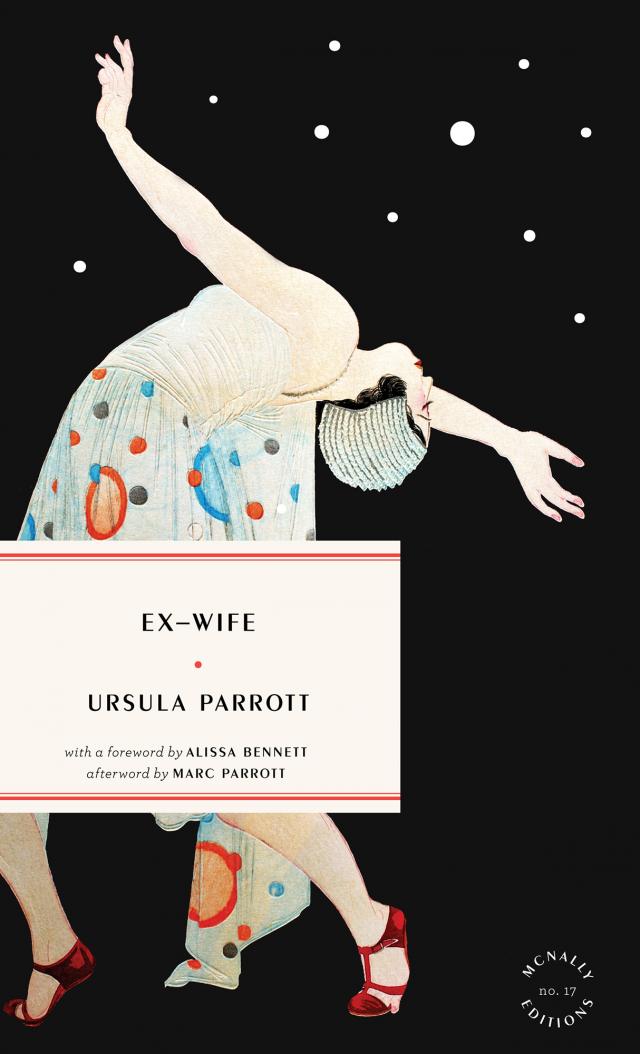
I’d never heard of Ursula Parrott when McNally Editions introduced me to Ex-Wife, the author’s 1929 novel about a young woman who suddenly finds herself suspended in the caliginous space between matrimony and divorce. The first thing I wondered was where it had been all my life. Ex-Wife rattles with ghosts and loss and lonely New York apartments, with men who change their minds and then change them again, with people and places that assert their permanence by the very fact that they’re gone and they’re never coming back. Originally published anonymously, Ex-Wife stirred immediate controversy for Parrott’s frank depiction of her heroine, Patricia, a woman whose allure does not spare her from desertion after an open marriage proves to be an asymmetrical failure. Embarking on a marathon of alcoholic oblivion and a series of mostly joyless dips into the waters of sexual liberation, Patricia spends the book ricocheting between her fear of an abstract future and her fixation on a past that has been polished, gleaming from memory’s sleight-of-hand.
It’s been nearly a century since Ex-Wife had its flash of fame (the book sold more than one hundred thousand copies in its first year), and as progress has stripped divorce of its moral opprobrium, it has also swelled the ranks of us ex-wives. Folded in with Patricia’s descriptions of one-night stands and prohibition-busting binges are the kind of hollow distractions relatable to any of us who have ever wanted to forget: she buys clothes she can’t afford; she gets facials and has her hair done; she listens to songs on repeat while wearily wondering why heartache always seems to bookend love. My copy is riddled with exclamation marks and anecdotes that chart my own parallel romantic catastrophes, its paragraphs vandalized with highlighted passages and bracketed phrases. There is a sentence on the book’s first page that I outlined in black ink: “He grew tired of me;” it reads, “hunted about for reasons to justify his weariness; and found them.” The box that I have drawn around these words is a frame, I suppose; the kind that you find around a mirror.
For all its painful familiarity, it’s easy to get caught in the trap of Ex-Wife’s nostalgic charm; there are phonographs and jazz clubs and dresses from Vionnet; there are verboten cocktails and towering new buildings that reach toward a New York skyline so young that it still reveals its stars. If critics once took issue with the book’s treatment of abortion, adultery, and casual sex, contemporary analyses have too often remarked that Patricia’s world cannot help but show us its age. “Scandalous or sensational?” wrote one critic when the book was last reprinted, in 1989. “Times have changed.” Yes and no; released in the decade between two World Wars, and just months before Black Tuesday turned boom to bust, Ex-Wife probes the violent uncertainty of a world locked in a perpetual state of becoming.
Lurching toward sexual revolution but still psychologically tethered to Victorian morality, women of Parrott’s generation found themselves caught in the freefall of collapsing convention. The seedy emotional texture of Ex-Wife’s Jazz Age debauchery reflected the panic felt by women across the country who had glimpsed freedom but remained ill-equipped to navigate its consequences. Almost immediately following the book’s publication, the press began a guessing game that sought to identify who was being shielded under its mantle of anonymity; was Ex-Wife a confession, a fantasy, or the indictment of a culture shifting too rapidly to acknowledge the inevitable casualties we leave in the wake of change? By August of 1929, conjecture had correctly zeroed in on Katherine Ursula Parrott (neé Towle), a journalist and fashion writer who seemed to bear an uncanny resemblance to her bobbed and brushed heroine.
Considering the book in the context of what we now know about her life, one cannot put much stock in Parrott’s suggestion that Patricia was a composite figure. Instead, Ex-Wife seems to have been a place to record injuries too personal for her to claim as her own. Born in Boston to a physician father and a housewife mother, Parrott decamped to New York’s Greenwich Village shortly following her graduation from Radcliffe College in the early 1920s. Her first marriage to journalist Lindesay Parrott Sr. ended in divorce in 1926, the year he discovered that the childless marriage he had insisted upon was not so childless after all. In 1924, Ursula had learned that she was pregnant and left the couple’s London home for Boston, where she gave birth to her only son before depositing him in the custody of her father and older sister. It was a secret that she managed to keep from Lindesay and their glamorous circle of friends for an astonishing two years. Marc Parrott, whose afterword concludes this book, would never have a relationship with his father. He was nearly seven years old when his mother finally acknowledged her maternity and assumed responsibility for his care. It was 1931 by then, and Ursula had become one of a handful of women who would find her fortune writing escapist romance tales under the pall of the Great Depression.
Marc Parrott’s recollections of his mother paint a vivid portrait of a spendthrift who often worked for seventy-two-hour stretches in order to meet the deadlines that would keep her (and her lovers) in furs. Parrott swanned through the 1930s publishing short stories and serialized novels in women’s magazines, her name often mentioned alongside the Hollywood stars who were attached to her screenplays and cinematic adaptations. Although I never once found her son mentioned in the many news items devoted to her work and her persona, Parrott was occasionally found in the company of a pet poodle improbably named “Ex-Wife”; in more ways than one, it would seem, her greatest scandal was also her most stalwart companion.
Though Ex-Wife was initially framed as the writer’s endorsement of a dangerous new cultural model, Parrott herself was painfully aware of the double standard that continued to condemn “girls who do.” Divorced for a second time in 1932 and a third five years later, the writer openly mused about her vulnerability in a world where marriage no longer insulated aging women from “man’s urge for variety.” Parrott called divorced women like her “Leftover Ladies,” a term that implies both surplus and rejection. Her abandoned woman is doomed to a battle that offers neither victory nor surrender. I think of Patricia examining the phantom lines that have begun to etch themselves across her face. I think of her cold creams and her lipsticks, of her awareness of a clock that never stops ticking. “The Leftover Lady is not free to get old,” Parrott wrote the winter after Ex-Wife came out, “for she has entered the competition, in her work and in her social life, with younger women. And that competition is merciless.”
By the early 1940s, as a serial divorcée who wrote stories with titles like “Love Comes but Once” and “Say Goodbye Again,” Parrott found herself a target of increasing mockery in the press. No longer young or glamorous enough to rate in the world she knew, her name would soon be attached to a series of scandals that could not be dismissed as the product of invention. In December of 1942, she was arrested and charged with helping an imprisoned soldier to escape from the military stockade in Miami Beach where he was being held on suspicion of trafficking narcotics. Michael Neely Bryan was a twenty-six-year-old jazz guitarist who had found some notoriety playing in Benny Goodman’s band before enlisting in the Army; the heady mixture of drugs and sex led to a high-profile 1944 trial and brought a swift conclusion to Parrott’s fourth and final marriage. Under headlines that read “Novelist Seen Making Love in Army Stockade,” the writer was described as a matronly woman who, following a lurid encounter, drove through a checkpoint with her lover hidden in the back seat of her car. The two enjoyed one night of freedom at a hotel, where they registered under the name Artie Baker, then turned themselves in to the police, each making a tearful confession. “I looked at him and knew how badly he wanted to go to dinner,” Parrott said, “So I decided to take a chance for him.”
Though Parrott was ultimately acquitted, the trial marked her. No longer welcome in the pages of magazines that catered to “respectable” middle-class women, Parrott published her last story, “Let’s Just Marry,” in 1947, by which time she had completed twenty-two novels, fifty short stories, and four original film scripts, in addition to the eight novels that were adapted for the screen. She would surface in a fresh scandal in 1950, when she was arrested in Delaware after skipping out on a $255.20 bill following a six-month hotel stay. Friends said that she’d gone to Delaware to gather material for a new book, but would note that she’d spent much of her time walking her dog and very little of it in front of her typewriter. Newspapers suggested that she’d been undone by too much success, as though the tale she’d told two decades prior had finally proven to be a cautionary one. Parrott endured one final humiliation that definitively ended her career and any illusion she had of a return. In 1952, she was accused of stealing $1,000 worth of silverware from a friend who had allowed her to stay in his house under the premise that she needed a place to work on a new book. A warrant was issued for her arrest, and she spent the remaining five years of her life in hiding. She died, at the age of fifty-seven, in a charity ward.
It seems easy from here to understand that Parrott’s career as a writer was usurped by the drama of her scandals. Like many women whose early lives and work are defined by rebellion, Parrott’s indiscretions ceased to appeal once they were no longer deemed youthful ones. Her legacy endured one last condemnation when her work was framed by history as “women’s literature,” a term that was a tombstone in the days before it was understood as an industry. It became a ghost, like its author, neither married nor divorced, resigned to a perpetual now. Drifting around without a future, she drinks and shops, she goes on dates, and she wonders what else can possibly change in a world that no longer seems to have any rules. “Men
Maybe I feel protective of Patricia because she feels so familiar to me, proof that time doesn’t always change us in the ways that we would like to believe. If the book was once too far ahead of its day and later too far behind, it seems now somehow just right, as though we have rounded the circle again and finally found synchronicity. Wedged between Edith Wharton’s constrained society girls and the squandered glamour of Jean Rhys’s doomed wanderers, Ex-Wife was received by an interstitial America still negotiating who and what women were allowed to be. Once caught in a cultural riptide, the book now reads as a shockingly anticipatory account of what it means to want and what it means to be left; we live in a world now where most of us know the feeling of both. I think of the letter Patricia sent to a lover who could not love her back in the way that she needed him to, of the loneliness she felt when day turned to night and back again. “I shall be long dead,” it reads, “of waiting for a telegram saying you are coming home.”
Alissa Bennett
New York City, 2022
I
My husband left me four years ago. Why—I don’t precisely understand, and never did. Nor, I suspect, does he. Nowadays, when the catastrophe that it seemed to be and its causes are matters equally inconsequential, I am increasingly disposed to the belief that he brought himself to the point of deserting me because I made such outrageous scenes at first mention of the possibility.
Of course, during the frantic six months that preceded his actual departure, he presented reasons for it, by dozens. I remember some of them. At times he said I had lost my looks. At other times he said I had nothing but looks to recommend me. He said I took no interest in his interests. He said also that I insisted on thrusting myself into all of them. He said I was spiritless, or temperamental; had no moral sense, or was a prude. He said he wanted to marry the woman he really loved; and, that once rid of me, he would not marry anyone else on a bet.
In the four years since, I have listened to the causes given for the dismal ends of many marriages, and have come to believe my husband’s list as sensible as most.
He grew tired of me; hunted about for reasons to justify his weariness; and found them. They seemed valid to him. I suppose if I had tired of him, I should have done the same thing.
But I was not tired of him; so I fought his going ruthlessly and very stupidly. I was sure that if I fought I would win. I have never been as sure of myself since, as I was then, when I was twenty-four. No stirring of any ethical scruples about possessiveness, or idea of the futility of coercing emotion, complicated my efforts to keep what I wanted.
At first, I think, I pretended to high motives—“stay for the sake of our families,” and so on. Later, as I grew panicky, I experimented with argument, rage, anguish, hysteria and threats of suicide; and refused to admit to myself, until five minutes before he left, that he really might go, in spite of everything.…
While he finished packing, I sat, beginning to believe it. I tried to think of some last-minute miracle to manage: considered slashing my wrists so that he would have to go get a doctor, and then to stay until I recovered. But I recognized, in a world that had suddenly become an altogether incredible place, that he might just walk out and leave me to die of the slashes.
I hoped I looked devastated; I hoped I looked lovely. Then I remembered that the armchair in which I sat was a wedding present from his Aunt Janet, and wondered what one did with a husband’s relatives’ wedding presents when a husband left. (In New York, one sells them to impecunious young-married friends, ultimately.) The lamp beside me was among the first of the modernistic ones. I remembered that Wanamaker’s had not been paid for it.
The sound of trunk lids closing, stopped. He came in.
He stood there, looking handsome and stubborn and unhappy. I was assailed by recollections of how good-looking I had thought him—first time we met, a house party at New Haven, four, no five Springtimes.…
“I’m going to get a cab for my things,” he said.
“Peter, don’t go,” I said.
“What’s the use of that?” he said.
We regarded each other. And suddenly, after six months in which I had always managed to find one more protest, relevant or otherwise, there were no more.
I ached. We had loved each other for three years, and hated each other half the fourth. It seemed such a long way to have journeyed from a gay and confident beginning.
Apparently, he had a few last words to offer, if I could manage none. He suppressed two or three beginnings.
“When will you divorce me, Patricia?”
I said, “On the far side of hell.”
He shrugged. He was not even angry. He just looked tired.
“Have it your own way, Patty.” (He had not called me “Patty” for months. “Pat,” casually; “Patricia,” furiously.)
Then he said, “Well, don’t mourn me long, old de-ah.” He came and patted my hair, and went out.
My last and silliest inspiration arrived. I thought, “If he doesn’t get his trunks, he can’t go,” and I bolted the apartment door. He came back with the cab driver, and knocked. I sat very still. He shouted, “If you don’t open that door, I’ll break it in.” He would have done it. So I opened the door. He threw his keys on a table. “I shan’t ever need these,” he said.
I went back to sitting in the armchair. Trunks and bags and taxi man and husband departed, noisily. I thought, “This is the end. Why don’t I cry or something?”
II
In that lazy space on Sunday, between late breakfast and time to dress for a cocktail party, Lucia, with whom I was sharing an apartment, tried to define “ex-wife.”
“Not every woman who used to be married is one. There are women about whom it is more significant to know that they work at this or that, or like to travel, or go to symphony concerts, than to know that they were once married to someone or other.”
She looked at me, reflectively. “You’re an ex-wife, Pat, because it is the most important thing to know about you… explains everything else, that you once were married to a man who left you.”
“You’re one, too, by that definition. That you once were married to Arch explains most things about you,” I said.
“Yes, but I convalesce somewhat. One isn’t an ex-wife if one’s in love again, or even if one never thinks about one’s husband anymore.”
“How many years does it take to get to that stage?” I asked. I had been to dinner with Pete the evening before, and knew that I would be miserable for a week.
“There, there, child,” she said, “you’ll feel better tomorrow.” She began again. “An ex-wife is a woman with a crick in the neck from looking back over her shoulder at her matrimony.”
I contributed. “An ex-wife’s a woman who’s always prattling at parties about the joys of being independent, while she’s sober… and beginning on either the virtues or the villainies of her departed husband on one drink too many.”
“An ex-wife,” Lucia said, “is just a surplus woman, like those the sociologists used to worry about, during the war.”
“Nobody worries about an ex-wife though, except her family—or her husband if she is one of those who took alimony,” I said.
“We don’t need to be worried about that, yet, darling. We’re too much in demand. Wait ’til we’re forty… if we’re not dead of insufficient sleep, before then.”
“I’ll be dead of drinking bad absinthe,” I announced, resignedly.
Lucia protested. “I really wish you would stop drinking that stuff. It will hurt your looks.”
But her voice was languid. We were just talking. Pretty soon it would be time to make up one’s face, and put on a velvet frock, and things would start happening fast again. It was not a bad life, while things happened fast. And they usually did.
I tried one more definition. “Ex-wives… young and handsome ex-wives like us, illustrate how this freedom for women turned out to be God’s greatest gift to men.”
We laughed. The winter sun came warmly in over our shoulders. It was pleasant, sitting there. Peter and I had fought like hell the night before.






