Deception, p.1
Deception, page 1


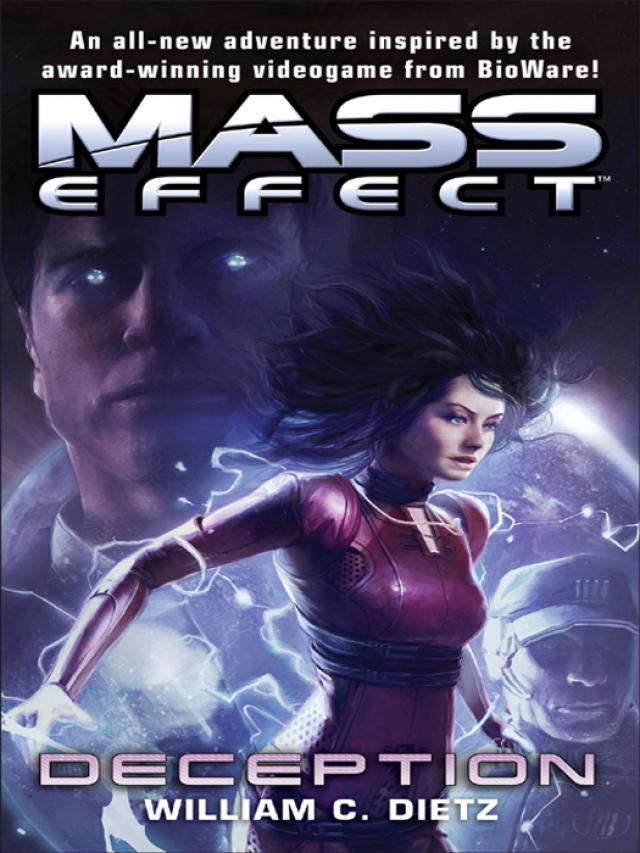
Mass Effect: Deception is a work of fiction. Names, characters, places, and incidents are the prodcts of the author’s imagination or are used fictitiously. Any resemblance to actual events, locales, or persons, living or dead, is entirely coincidental.
A Del Rey eBook Edition
Copyright © 2012 EA International (Studio & Publishing) Ltd. Mass Effect, Mass Effect logo, BioWare and BioWare logo are trademarks of EA International (Studio & Publishing) Ltd. All Rights Reserved.
Published in the United States by Del Rey, an imprint of the Random House Publishing Group, a division of Random House, Inc., New York.
DEL REY is a registered trademark and the Del Rey colophon is a trademark of Random House, Inc.
eISBN: 978-0-345-52645-8
www.delreybooks.com
www.bioware.com
v3.1_r1
Contents
Cover
Title Page
Copyright
Prologue
Chapter One
Chapter Two
Chapter Three
Chapter Four
Chapter Five
Chapter Six
Chapter Seven
Chapter Eight
Chapter Nine
Chapter Ten
Chapter Eleven
Chapter Twelve
Chapter Thirteen
Chapter Fourteen
Chapter Fifteen
Chapter Sixteen
Dedication
Acknowledgments
PROLOGUE
ON THE PLANET KHAR’SHAN
Many weeks of effort had been required to track the object from the point where it had been stolen to the batarian homeworld and the ancient city of Thondu. There were lots of things Kai Leng didn’t like about the place, including the crowded streets, the asymmetrical architecture, and the food. But most of all he didn’t like the batarians themselves. Not because so many of them were pirates, slavers, but because they were aliens and therefore a threat to the human race. That made him an extremist, not to mention a racist, and that was fine with Leng.
The auction house was located off one of Thondu’s serpentine streets. A flight of stairs led up to the front door. Because of an injury sustained during a recent and especially difficult mission, Leng was using a cane as he mounted the steps one at a time. Having passed through a pair of open doors he entered a generously proportioned lobby where he was confronted by a security checkpoint and two batarians. Each alien had four eyes, all eight of which stared at the human with open suspicion.
Leng offered the invitation to the guard on the right who passed it in front of a scanner. The electronic document was real, having been purchased from a local businessman at considerable expense, and the batarian nodded respectfully. “You can enter, but the handgun stays here. And leave the cane too.”
“No problem,” Leng replied, as he gave both items to the second guard. “Take good care of them.”
“You can pick ’em up on your way out,” the other guard growled, as he placed both the pistol and the cane on a table loaded with weapons collected from other guests.
At that point Leng was ordered to empty his pockets onto a tray. The effort produced three coins, a pill box, and a stylus. The first guard eyed the collection, uttered a grunt, and motioned toward a metal frame. “Please step through the metal detector.”
Not having set off any flashing lights or buzzers, Leng was allowed to recover his belongings and proceed to the room beyond. It wasn’t that large, and didn’t need to be, since only a limited number of people were wealthy enough to buy the type of merchandise the auction house specialized in. With nothing else to look at all eyes were on Leng as he made his way to the front of the room and took a seat next to an elderly turian.
It would have been nice if he’d been able to intercept the object before it was offered for sale, but having failed to do so, Leng was prepared to do it the hard way.
Time seemed to drag as two additional guests arrived, took their seats, and waited for the auction to begin. Finally a well-dressed volus appeared and took his place behind the podium. “Good afternoon gentle beings. My name is Dos Tasser and I will serve as your auctioneer today.
“All of you have had access to the catalog and are therefore familiar with the items that will be offered today. Bids will be submitted in increments of a thousand or a million credits and all sales are final. Are there any questions? No? Then the auction will begin.
“The first item in the catalog is a Prothean Egg, which, when activated, opens to reveal a holographic star map. And because the map is not consistent with any part of known space, experts assume that the system depicted lies somewhere beyond our galaxy, and must have been important to the protheans.
“If so, and if the purchaser is able to figure out where these planets are, they might be able to claim a technological treasure trove so valuable that the cost of the egg will be negligible by comparison. Bidding will start at ten million credits. Do I hear eleven?”
There was a bid at eleven, followed by many more, and a final offer of fifty-two million, which was sufficient to secure the elaborately decorated egg for a beautifully dressed asari whose face was hidden by a carefully draped veil. Did she intend to find the star system projected by the egg? Or to place it on a shelf where it would serve as a conversation piece? Leng didn’t know and didn’t care.
The next object was a vial of tears that had been shed by a turian saint. Or that’s what Tasser claimed, even though there was no proof of such a thing, and the liquid in the container could have been tap water. However, that didn’t stop the turian seated next to Leng from paying five thousand for the relic. And, judging from his demeanor, he was happy to do so.
With that out of the way it was time for Tasser to take bids on the object that Leng was after. “And here it is,” the volus said, as he raised what looked like a crystal gemstone for the audience to inspect. Light reflected off the device and made a pattern on the walls.
“Here, sealed inside a protective matrix, is the design for a DNA-specific bioweapon. The seller, who prefers to remain anonymous, claims that if released among the human population this disease would target a person known as the Illusive Man. An individual said to be the founder of Cerberus.
“We, of course, cannot attest to the truth of that—nor be held responsible for the results should such a disease be released. So, ladies and gentlemen … bidding will open at five million. Do I hear six?”
Leng not only knew about Cerberus, he worked for the organization, and had for more than ten years. And because of that he understood the threat. Not just to the Illusive Man, but to tens of thousands of people who were distantly related to him, all of whom would be equally vulnerable.
And that was why Leng threw the coins. They struck the floor all around Tasser, producing a series of loud bangs and a cloud of dense smoke. Leng was already on his feet by then. A few swift steps carried him to the front of the room where the volus was just starting to turn away. Leng grabbed a wrist, took the matrix, and let go. A well-aimed kick put the auctioneer down.
But Leng wasn’t the only person in the room who wanted the object, or was willing to commit violence in order to obtain it. Like Leng, the man who attacked him was unarmed, but he was strong, as became evident when he wrapped an arm around Leng’s throat.
Leng grabbed on to the attacker’s arm with both hands and pulled down while simultaneously pressing his chin against his chest. That allowed him to take a precious breath while he bent both knees and lowered his center of gravity. Then he pulled, straightened, and felt the man flip up and over. He continued to hold on to the man’s arm, which caused the assailant to land on his back. Leng stomped his face, felt something give, and knew that part of the fight was over.
Then, having turned toward the back of the room, Leng pressed the button on his stylus. His pistol, or what looked like a pistol, produced a loud BOOM as it exploded, hurling shrapnel in every direction. When he entered the lobby both of the batarian guards were down and one was clearly dead. “Don’t bother to get up,” Leng said, as he bent over to pick up his cane. “I’ll find the door on my own.” Then, having completed his mission, Leng limped away. His right leg was on fire. But the matrix was safe, the Illusive Man would be pleased, and he could leave Khar’shan. Life was good.
ONE
THE CITADEL
“I don’t want to go,” Nick said stubbornly. “Why can’t I stay here?”
David Anderson didn’t have any children of his own, and had the matter been left to him, the ex-navy officer would have ordered the teenager out of the apartment with possibly unpleasant results. Fortunately, the woman he loved knew how to deal with such situations. Kahlee was in good shape for a woman in her forties, or thirties for that matter. As she smiled tiny creases appeared around her eyes. “You can’t stay here because David and I may want you to tell the Council what happened on the day Grayson invaded the Grissom Academy. It’s important to make sure that nothing like that ever happens again.”
Nick had been shot in the stomach during the attack and sent to the Citadel for advanced medical treatment. So he knew about Grayson firsthand. Nick, with shoulder-length black hair and a relatively small frame for a boy his age, looked hopeful. “Can I go to The Cube on the way back?”
“Sure,” Kahlee replied. “But only for an hour. Come on—let’s go.”
A crisis had been averted, and Anderson was grateful. As they left the apartment the door locked behind them. An elevator took them down to the first floor and out in to the hectic crush of the lower wards. A monorail loomed overhead, the pedways were crowded with individuals of every species, and the streets were jammed with ground vehicles. All of which was normal for the huge star-shaped space station that served as the cultural, financial, and political hub of the galaxy.
Anderson had been an admiral, and the Alliance’s representative to the Citadel Council, so he had spent a lot of time aboard the habitat. Everything was organized around a central ring. It was ten kilometers across, and the Citadel’s forty-kilometer-long “fingers” pointed from it to the stars beyond. The total population of the station was said to be in excess of thirteen million sentients, none of whom had played a role in creating the complex structure.
The asari had discovered the station 2,700 years earlier while exploring the vast network of mass relays put in place by a space-faring species known as the protheans. Having established a base on the Citadel, the asari learned how to create mass effect fields, and made use of them to explore the galaxy.
When the salarians found the space station a few decades later the two races agreed to form the Citadel Council for the purpose of settling disputes. And as more species began to travel the stars, they had little choice but to follow the dictates of the technologically advanced Council races. Humans were relative newcomers and had only recently been granted a seat on the Citadel Council.
For many years it had been assumed that the protheans were responsible for creating the Citadel. But more recently it had been learned that the real architects were a mysterious race of sentient starships called the Reapers who conceived of the space station as a trap, and were responsible for annihilating all organic sentients every fifty thousand years or so. And, even though Reapers were trapped in dark space, there was evidence that they could reach out and control their servants from light-years away. And that, Anderson believed, was a continuing threat. One the Council should deal with immediately.
The problem being that day-to-day interspecies rivalries often got in the way of the big picture. That was just one of the reasons why it had been so difficult for Anderson and Kahlee to get the Council to look beyond historical grievances to the greater threat represented by the Reapers. Anderson and Kahlee were certain that the Reapers had been in at least partial control of Grayson when he invaded the Grissom Academy, but they were still struggling to convince certain members of the Council. And that had everything to do with the presentation they planned to give. Hopefully, if they were successful, the Council would agree to unify behind an effort to counter the danger that threatened them all. Otherwise the Reapers would do what they had done before—wipe the galaxy clean of sentient life.
As Anderson led the others aboard a public shuttle he was reminded of the fact that the Reapers had created the Citadel as bait for a high-tech trap. One that had been sprung so successfully that now, two years later, some of the damage the sentient machines had caused was still being repaired.
The vehicle came to life as Anderson settled himself behind the controls. The contragravity speeder was powered by a mass effect field and would carry them from the lower wards to the vicinity of the Presidium where the Council’s offices were located. Kahlee was sitting next to him and Nick was in the back, fiddling with his omni-tool. The device consisted of an orange hologram that was superimposed over the teenager’s right arm. It could be used for hacking computers, repairing electronic devices, and playing games. And that’s what Nick was doing as Anderson guided the shuttle through a maze of streets, under graceful pedways, and into the flow of traffic that ran like a river between a pair of high-rise cliffs.
Ten minutes later the shuttle pulled into a rapidtransit platform where they disembarked. A short, tubby volus pushed his way forward to claim the speedster for himself. He was dressed in an environment suit and most of his face was hidden by a breathing mask. “Make way Earth people—I don’t have all day.”
They were accustomed to the often rude manner in which the Citadel’s citizens interacted with each other and weren’t surprised by the stranger’s contentious tone. The volus were closely allied with the raptorlike turians—many of whom still felt a degree of animosity toward humans resulting from the First Contact War. And that was just one of the problems which prevented the races from trusting each other.
As Anderson, Kahlee, and Nick walked toward a bank of elevators they passed a pair of beautiful asari. The species were asexual, but to Anderson’s eye they looked like human females, even if their skin had a bluish tint. Rather than hair, waves of sculpted skin could be seen on the backs of their heads and they were very shapely. “You can put your eyeballs back in your head now,” Kahlee commented as they entered the elevator. “No wonder the asari get along without men. Maybe I could too.”
Anderson grinned. “Just looking, that’s all. I’m partial to blondes.”
Kahlee made a face as the elevator started upward and the salarian standing in front of them lost his briefcase. It had been tucked under his arm but suddenly slipped out and landed on the floor. Like all of his kind the salarian’s head was narrow and crowned with two hornlike appendages. As he bent to retrieve the object it scooted away from him.
“Nick!” Kahlee said crossly. “Stop that … Give him the case and apologize.”
The teen looked as if he might object, saw the expression on Kahlee’s face, and apparently thought better of it. Having removed the folder from the floor, he gave it back to its owner and mumbled, “Sorry.”
The salarian had seen biotic pranks before and wasn’t amused. “You have a talent,” he snapped. “Use it wisely.”
Nick was one of the rare individuals who could manipulate the gravity-like force found in all of the otherwise empty spaces in the universe. The boy had been working to refine his biotic skills of late and the subtle combination of energies required to dislodge the briefcase and then move it around was quite impressive. It was also annoying and made Anderson frown. Fortunately for Nick, Kahlee was more patient. Maybe too patient.
The elevator doors opened smoothly and the passengers spilled out into a lobby that opened onto the Presidium. In marked contrast to the densely packed wards it was almost entirely open. There were artificial clouds in the blue sky, sunlight streamed down from above, and, as Anderson accompanied the others out onto a curving walkway, he could feel a light breeze touch his neck. The parklike area was home to a lake, clusters of trees, and a large expanse of well-manicured grass. People representing various races were constantly coming and going. Some appeared to be in a hurry while others strolled along or sat on benches.
Anderson’s pace was more purposeful as he led the others toward the Citadel Tower, located at the very center of the massive space station. It was difficult to appreciate the structure by looking straight up at it, but Anderson knew it could be seen from many kilometers away, and was the most important landmark on the Citadel.
The Council Chambers were positioned toward the top of the spire and it wouldn’t pay to be late, so Anderson set a brisk pace. The Council’s agenda typically remained in flux right up until the beginning of each meeting. So Anderson had no way to know if their presentation would be first, last, or somewhere in between.
But before the threesome could enter the tower it was necessary to check in with the Citadel Security Services (C-Sec) kiosk located outside the main entrance. The person in charge was turian. Bright eyes stared at Anderson from bony sockets that were surrounded by a tracery of scarlet tattoos. A flat, thinslitted nose was flanked by hard facial plates. The officer’s mouth formed an inverted V and wasn’t designed to smile. “Yes, sir … What can I do for you?”
“My names is Anderson. Admiral David Anderson. This is Kahlee Sanders and Nick Donahue. We were invited to appear before the Council today.”
The turian said, “One moment please,” as he scrolled the list of names on the monitor in front of him. “Yes, here you are. Now, if you would be so kind as to look at the scanner we’ll confirm your identity.”
The device was built into the kiosk. And as Anderson looked into it he knew that it was scanning his retinas. From there the data would be sent to the Citadel’s central computer where it could be checked and confirmed. All in a couple of seconds. The turian nodded. “You can proceed to the elevator, Admiral … Welcome to the Citadel Tower. Miss Sanders? Please look into the scanner.”